

How the OM System PEN turns its smaller sensor into a selling point
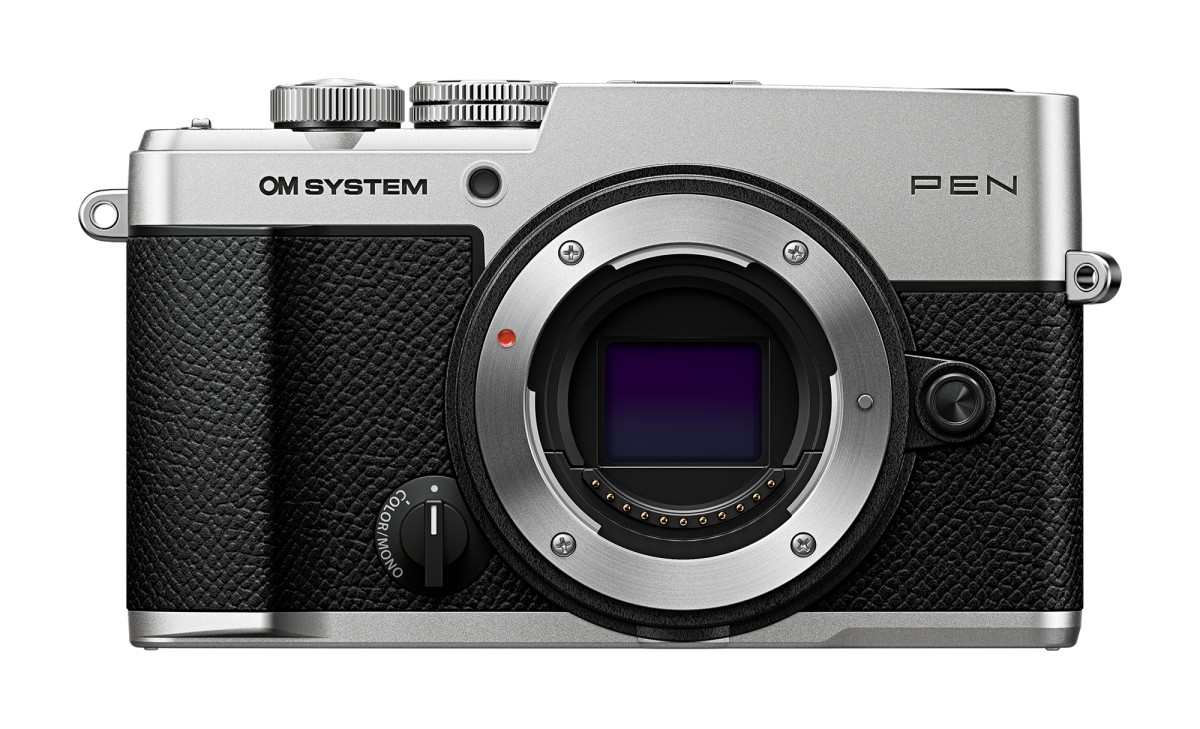
Yes, there are similarly-priced APS-C cameras. But what do you sacrifice for the extra IQ?
 OM System
Earlier this week, OM System announced the PEN, a small, interchangeable lens camera with a Four Thirds sensor. Our initial review mainly focuses on it versus the higher-end range-finder style cameras that it descends from and competes against, but it’s worth also looking at how it compares to the other cameras at the $1000 price point. Because while it’s true that you can get a larger sensor for the same money, it’s also worth considering what you give up for that additional light-gathering capability.
Meet the contenders
The PEN joins the now-rarified halls of cameras that retail for under $1000 (body only, you’ll still need to add a lens), while still offering a good level of manual control. Nowadays, that list includes some very capable APS-C cameras, such as the Canon EOS R10, Nikon Z50II and Fujifilm X-T30 III. They all boast similar spec sheets, with sensors that range from 20-26MP, relatively fast burst rates and strong video features.
But given that they use larger and therefore presumably slightly more expensive sensors, surely there’s a catch somewhere…
IBIS
 IBIS can help make it easier to get sharp shots, even when shooting with relatively slow shutter speeds.
OM System PEN | OM System 14-42mm F3.5-5.6 III | 21mm | 1/60 sec | F5.6 | ISO 2500
OM System’s forebear, Olympus, was a pioneer when it came to including in-body image stabilization in its cameras, and the PEN continues in that tradition. And it’s an undoubtedly useful feature to have, letting you use slower shutter speeds while still shooting handheld, provided you’re shooting a stationary subject.
While Nikon, Canon and Fujifilm offer kit lenses that have optical image stabilization, giving you a similar benefit (at least in stills, not so much in video), the PEN’s stabilized sensor works with any lens, including the primes many photographers will want to pick up. However, it’s worth keeping in mind that primes are typically faster, giving you the option to raise your shutter speed by opening up the aperture, and are often in easier-to-hand-hold focal lengths. Plus, the PEN’s IBIS system is less powerful than what we’re used to, providing only 5.5EV of correction in the center, compared to the up to 7.5 that’s typical in other models (including the OM-5 II, which can achieve it by synchronizing with a lens’s optical stabilization, something the PEN can’t do).
The PEN’s IBIS system is less powerful than what we’re used to
To get an APS-C camera with IBIS, you’re looking at spending several hundred dollars more – the price of one of those fun prime lenses – likely thanks in part to the fact that the system has to be more robust to move around a larger sensor. So while it’s not the end-all be-all, it is a clear point in the PEN’s favor.
Weather sealing
OM System has leaned into its reputation for making rugged, weather-sealed cameras, and the PEN is no exception. It comes with an IPX1 rating, and while the “X” indicates that it hasn’t been tested for dust resistance, OM says it has that, too. That’s a relatively light rating – it means the camera can survive dripping water for 10 minutes, when fitted with a similarly sealed lens (don’t worry, OM System has plenty) – but it’s more than you’ll get with any of the other $1000 cameras we’re looking at today.
Whether that’s because OM System is able to include it (or pay the licensing fees for an IP rating) because of the lower component costs on its sensors, or that it’s just something the company prioritizes more than the others is hard to say, but it’s peace of mind that’s unusual at this price point.
Computation
 OM System takes computational photography so seriously, it puts a button on the back of the camera that allows you to quickly access those modes.Richard Butler
Micro Four Thirds cameras were some of the first attainable ILCs to make use of computational photography, taking multiple shots and stitching them together to produce a higher resolution version, simulate an ND filter and more. Some of these features are enabled in part by IBIS, but it’s also possible thanks to clever algorithms and relatively fast sensor readout speeds, something you won’t get with all of the APS-C options.
Even if the hardware were capable of it, the fact is that Nikon, Canon and Fujifilm haven’t put in the work to replicate these features, so their respective cameras don’t offer anything of the sort. You have to step all the way up to a Panasonic full-frame camera to get anything similar with a larger sensor (even then it’s mainly just the ability to shoot handheld high-resolution multishot), which is a very different size, weight and price point indeed.
Size
A Four Thirds sensor is physically smaller than an APS-C one, which means you can theoretically build a smaller, lighter body around it. However, while the OM System PEN is small, it’s not unbelievably so; there have been other Micro Four Thirds cameras that are appreciably more compact, including other models in the PEN line and the venerable GM1 and GM5 from Panasonic. And, indeed, the APS-C Fujifilm X-M5 is roughly the same size, though it doesn’t have an EVF of sensor stabilization. There are even some full-frame cameras that aren’t too much bigger, such as the Panasonic S9 and Sony a7C II.
 Fujifilm’s X-E5, which has an EVF and IBIS, is roughly the same size as the OM PEN, too, proving it’s possible to put an APS-C sensor into this size of body.Richard Butler
However, the PEN is a fair bit smaller than the cameras we’re comparing today, largely thanks to the prominent grips and SLR-style humps on the EOS R10, X-T30 III and Z50II (though the X-T30 III actually manages to be a touch lighter).
The real size benefit comes from the lenses, though. While there are some size-comparable APS-C lenses on the market, it’ll be easier to gather a collection of Micro Four Thirds lenses that are smaller and lighter than their APS-C counterparts without having to pick and choose focal lengths too carefully to optimize for size. That’s even more true for full-frame options.
Size isn’t the biggest win for the PEN, but it’s definitely still worth considering.
Trade-offs go both ways
Of course, none of this is to say that the OM System is better in every way than its price-comparable competitors with larger sensors. Besides the image quality benefits, Nikon, Canon and, to a lesser extent, Fujifilm, have more modern autofocus systems, and all of them are substantially better options if you wish to shoot video relatively seriously. The APS-C cameras also all have built-in flashes, which some people will appreciate, and most of them manage to match the PEN when it comes to burst rates and pre-capture (not that OM System is pitching this as anything like an action camera).
There are absolutely reasons why some people would go with one of $1000 APS-C camera over the $1000 PEN. Perhaps they’re looking for a camera that’s a bit more capable for sports and wildlife, or are more serious about video. But it’s worth acknowledging that you will be giving up some nice-to-haves in the process, or having to pay way more to get them.
Want to stay up to date on the latest product news and releases? Add DPReview as a preferred source to ensure our independent journalism makes it to the top of your Google search results.
What's Your Reaction?
 Like
0
Like
0
 Dislike
0
Dislike
0
 Love
0
Love
0
 Funny
0
Funny
0
 Wow
0
Wow
0
 Sad
0
Sad
0
 Angry
0
Angry
0










Comments (0)