

I Couldn’t Imagine Working With a Photo Editor on a Different Continent
Long before I worked on the PetaPixel news desk, I was an agency photographer covering breaking news, features, and sports.
I was young and in need of guidance. I found that in the form of my photo editor, whom I’m going to call Gary.
I would speak to Gary every morning when he assigned me jobs for the day, talking me through what was expected and the specific set of photos I needed to produce.
After I wired him the photos, he would let me know whether I had done a good job or a terrible one.
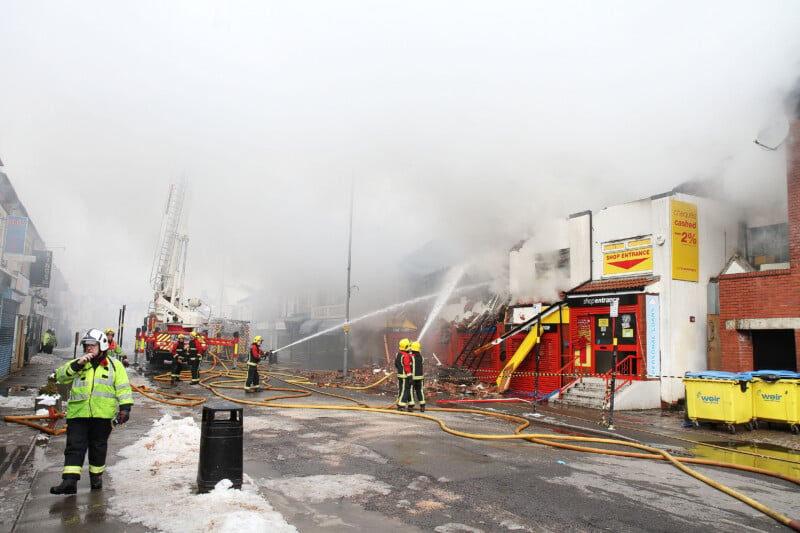 I used to cover hard news like this fire in 2013.
He would often edit my photos, reframe them slightly, change the crop, cull some of them, or call me up and ask if I had a different angle.
But Gary did far more than that. He was a leader in the newsroom, worked closely with the news editor to shape stories and come up with ideas, and was an excellent salesman.
His vivacious personality helped. He invented nicknames for me and the other photographers, made silly jokes, and was just generally good for staff morale. Not everyone liked the owners, but everyone liked Gary.
After I had worked there for a few years, the agency was bought out, and Gary moved to a new hub hundreds of miles away. Our relationship was never the same. The new regime was different, and I left soon after.
Photo Editors and AP
I thought of Gary this week when the Associated Press officially cut all eight of the remaining photo editor positions in the U.S.
AP has moved the positions to its hub in Noida, India. The agency says it has plans to grow the Indian operation to 100 staff members, including video producers.
AP photo editors are legendary: Consider the famous Napalm Girl photograph, for example, when Horst Faas and Hal Buell overruled Carl Robinson’s decision not to wire Nick Ut’s photograph.
Photo editors have played a crucial role in the fortunes of photographers for a very long time, advocating for us while seeing the bigger picture.
It’s not a question of whether talented photo editors exist in India. Of course, they do. But there’s something valuable about having an editor who understands the local news environment, knows the photographers personally, and can build relationships over years of working together.
And look, I get it: the press industry is tough. Agency bosses were once raking in vast sums of money — these days they face lousy picture rates from a fractured industry.
Photo editors do not attend a news story in person the way photographers do; therefore, they could theoretically be anywhere. This is a globalized, technologized world: workers in developing countries are technically in competition with workers from the U.S.
But while these big decisions make sense from a financial point of view, what are the long-term consequences?
Photographers, like my younger self, have fewer opportunities to benefit from a leading light like Gary.
Nowadays, photographers are increasingly expected to be fully formed; the bosses need someone they can rely on to do a good job no matter what. And while there are plenty of great photographers out there who can do that, they all had to cut their teeth somewhere.
As with many other things in life, it feels like the ladder for the younger generation is being removed.
Image creditsHeader photo licensed via Depositphotos.com.
Affiliate Disclosure PetaPixel articles may include affiliate links; we may earn a commission if you buy through one.
What's Your Reaction?
 Like
0
 Dislike
0
 Love
0
 Funny
0
 Wow
0
 Sad
0
 Angry
0









Comments (0)