

‘Jinsei’ Review: The Century-Spanning Lives of a J-Pop Star Fill a Masterfully Bizarre Anime Epic
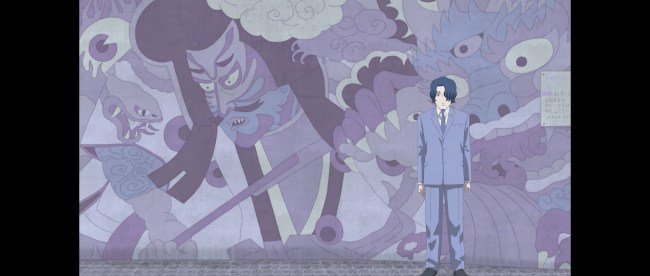

For a film about a man whose sense of self is so poorly defined that he’s referred to by a different name in every chapter of his life, “Jinsei” makes a point to select a visual language and stick to it. Ryuya Suzuki’s masterful anime, which spans the century-long life of a J-Pop star, makes it impossible to ignore how little it shows you. The postage stamp aspect ratio blacks out all four sides of the frame, forcing your eyes to focus on images that take up less than half the screen. The hauntingly simple animation clicks by at a frame rate that seems a few standard deviations slower than real life, creating the intentional sensation that we’re missing out on important nonverbal context. And everything largely unfolds in shades of grey — even as colors are gradually introduced in the film’s later acts, the palette is so bleakly monotone that they just suggest synthetic attempts at recreating the kind of joy that hasn’t been present in this world for ages.


It all provides the perfect backdrop for an otherwise unclassifiable story. “Jinsei” is everything from a commentary on the artificiality of the Asian music industry to a study of how the tragedies from early in our lives never stop following us. And while it begins as a fairly restrained father-son story, it eventually fills up with robots, sci-fi-tinged wars, and transhumanist cults. That’s what happens when you have an entire century to cram into a movie that runs less than 90 minutes.
Unfolding over the course of ten chapters, “Jinsei” is best enjoyed with minimal plot spoilers, but you could adequately summarize it as the story of a boy becoming an idol. We meet our protagonist (voiced by Japanese rapper Ace Cool), who goes by so many names to so many people that he might as well be anonymous, as a school-aged child dealing with the death of his mother and a father who is ill-prepared to pick up the pieces. It isn’t long before he starts pursuing a career in the music industry, finding membership in a boy band called Zinroku while callous record executives will stop at nothing to mold his image into something inoffensively charismatic enough to shoehorn into other mediums of mindless entertainment. Things only get stranger from there, but suffice it to say that the term “idol” takes on multiple meanings as our hyper-capitalist society crumbles and the world faces bigger problems.
The repeated use of the term “idol” is no mistake. He’s never referred to as a “singer” or a “pop star,” with the clear implication being that music is only a small part of the equation. He’s expected to be a God-like figure that a nation can worship. The film elegantly juxtaposes the heights of glamor with his passive nature, portraying him as a man who keeps ascending to the next tier of fame simply because people around him tell him it’s the thing to do. He becomes so used to following orders that he eventually appears on talk shows as a nationally beloved figure, but is incapable of saying a word without a script in front of him. “Jinsei” is hardly the first film to portray the inner workings of the music industry as hollow and artificial, but it does a remarkable job of using those existing stereotypes to deepen our understanding of a character who never quite figured out who he is.
The most impressive element of “Jinsei” is Suzuki’s singular authorship of the film. The first-time feature filmmaker serves as its writer, director, editor, and composer, hand-drawing the movie himself over the course of two years. The film makes no attempt to hide the fact that its resources are sparse, and finds a muted narrative that pairs perfectly with the bare bones production value. Anyone lamenting that it’s getting harder to make truly personal films should jump at the chance to watch something that so clearly emerged from the mind of one passionate artist.
For all of its scale, “Jinsei” is ultimately rooted in some universal, if contradictory, truths about human existence. We don’t all get to live 100 years and preside over massive breakthroughs in human-robot relations. But we each contain an entire universe, playing a multitude of unique roles that look wildly different to outside observers. But at the end they just hide the fact that we’re still carrying the same formative experiences wherever we go. The metaphysical task of our lifetime is to align all of those selves into something we can make sense of before it’s time to die. It’s easier said than done, but Suzuki gracefully lands the plane of his protagonist’s spiritual journey. For that reason alone, “Jinsei” is worth seeing.
Grade: B+
A Greenwich Entertainment release, “Jinsei” is now playing in New York City, with expansion to follow.
Want to stay up to date on IndieWire’s film reviews and critical thoughts? Subscribe here to our newsletter In Review by David Ehrlich, in which our Chief Film Critic and Head Reviews Editor rounds up the best new reviews and streaming picks along with some exclusive musings — all only available to subscribers.
What's Your Reaction?
 Like
0
Like
0
 Dislike
0
Dislike
0
 Love
0
Love
0
 Funny
0
Funny
0
 Wow
0
Wow
0
 Sad
0
Sad
0
 Angry
0
Angry
0










Comments (0)