Ladybird browser's first downloadable alpha is surprisingly capable
Note: At the time of writing, I was unaware of criticism directed at Ladybird creator Andreas Kling’s public statements. Readers interested in this background can find further context in accounts by Kelson Vibber and Drew DeVault.
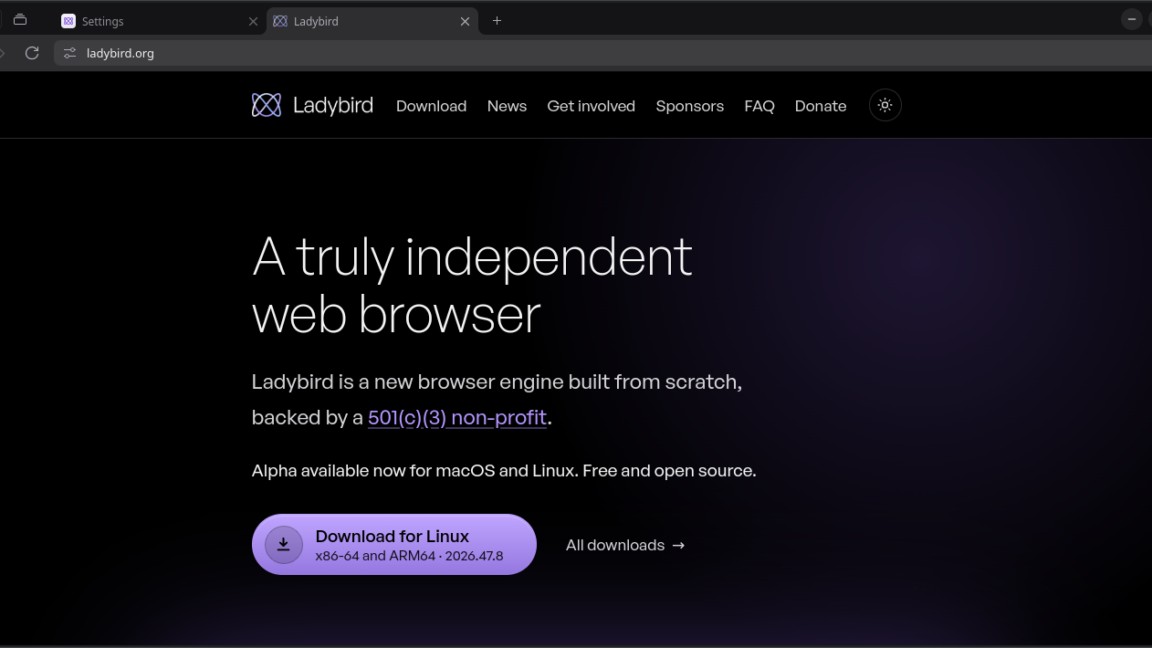
After four years of work to build a browser engine from scratch, the Ladybird project released its first downloadable alpha on November 23, offering prebuilt versions for macOS and Linux. Previously, curious users had to compile the browser themselves from its source. Now it’s an installable package with automatic updating.
Ladybird is most notable for what it isn’t: another browser fork. Where Chrome, Edge, Brave, and Opera all run on Google’s Blink engine, and Firefox depends on Gecko, Ladybird’s rendering engine and its LibJS JavaScript engine were written from scratch. “The engine is our own, built from the ground up, and not a fork,” project lead Andreas Kling wrote in Monday’s announcement. “The browser around it is modest, but functional.”
A fourth engine
Nearly the entire modern web currently runs on three browser engines. There’s WebKit (Safari), Gecko (Firefox), and the biggest of them all, Blink (Chromium). Those limited options mean that web developers often end up optimizing sites for Chromium specifically, since that’s where the majority of traffic is, and as a result, the whole web platform tends to follow suit toward whatever the dominant engine supports.
An independent implementation of web standards has value not just by providing additional competition in the market, but because it can’t help but reveal places where sites depend on Chromium behaviors rather than published specifications. The fact that Ladybird exists isn’t likely to shift the market tides any time soon, but every new browser engine increases the number of implementations that standards can be tested against, which can surface Chromium-specific assumptions and push the ecosystem toward the spec.
Some background
The Ladybird project was borne out of Kling’s SerenityOS project, an attempt to develop a new independent OS from scratch, before splitting off as a separate project. Kling formed the Ladybird Browser Initiative, a 501(c)(3) nonprofit funded by sponsorships and donations. The project’s site highlights that there are no sponsored search engine deals supporting the project like many other popular browsers, and sponsoring entities have no say in the project roadmap.
What's Your Reaction?
 Like
0
 Dislike
0
 Love
0
 Funny
0
 Wow
0
 Sad
0
 Angry
0










Comments (0)