

Lomography's $479 Petzval Lens Turns a Bus Ride Into a Dreamscape
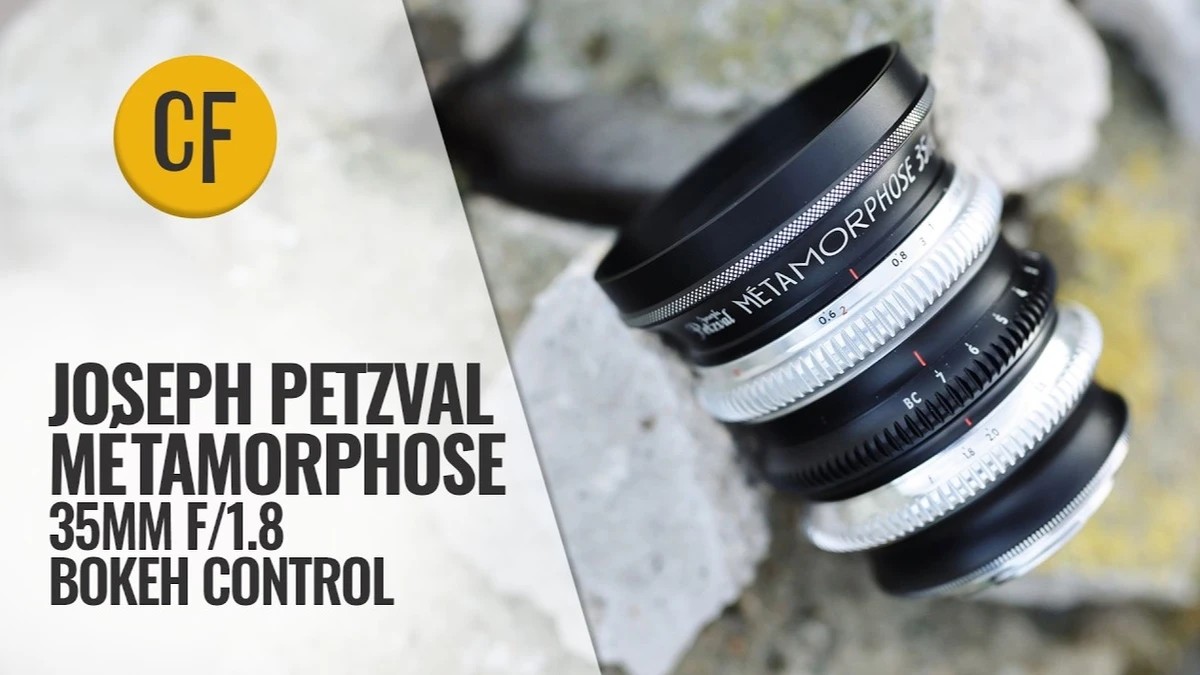
At $479, Lomography's newest Petzval lens asks you to spend real money on a lens that deliberately gives up sharp corners, even contrast, and a flat plane of focus. If you shoot video, music, or anything where mood outranks detail, a lens like this does things in camera that are hard to fake convincingly in post.
Christopher Frost spent a couple of weeks with the Lomography Joseph Petzval Métamorphose 35mm f/1.8, on loan from Lomography with no input into his review, and calls it the most extreme lens of its type he's handled. It's a manual-focus full frame lens in Sony E, Nikon Z, and Canon RF mounts, and he recommends pairing it with a full frame body to get the whole effect. The bokeh control ring is where things get strange. At setting one, you get hard-edged, soap-bubble bokeh in the background and a strongly curved plane of focus that shows up clearly in the corners. Crank it to seven and the frame turns into a massive swirl and warp around nearly the entire periphery, leaving only a pinpoint of sharpness at the center. That range gives you two distinct looks in one lens, and stopping down calms both of them, so the aperture ring doubles as an intensity dial.
Frost's sample footage makes the case better than any spec sheet could. A plain bus ride becomes a woozy dreamscape at setting seven and f/1.8, and he points to dream sequences and nights out clubbing as natural fits. The wide aperture helps there, letting in plenty of light for dark venues. Point the lens at bright lights and it throws off flare and internal reflections, which he acknowledges is technically a flaw while noting it makes footage look even wilder. Setting one tames the flare, though only a little. At setting seven, there's also heavy vignetting, which pushes the eye even harder toward that small sharp center.
Because the optical design bends everything on purpose, Frost skipped most of his usual tests and shot a large flat surface instead to show what the glass is doing. At setting one and f/1.8, the center has some sharpness but dreamy contrast. Stop down to f/2.8 and that center looks crisp with excellent contrast, though the sharp area stays small. The corners stay soft at f/5.6, and they remain soft even at f/11 and f/22. At setting seven and f/1.8, the difference is wild. Heavy vignetting darkens the corners, and the sharp point in the middle is tiny, with low contrast. It sharpens at f/2.8 and looks pretty good by f/4, but the sharp area stays deliberately small, and the corners are still very soft at f/8 and f/16, though the warping is greatly reduced. The lens even turned the head of his wife, a graphic designer who is used to seeing lenses all over the house. The build is all metal, tough and heavy, with three control rings for aperture, bokeh control, and focus. All three turn smoothly but take real effort to move. The filter thread is 67 mm, and it ships with a slip-on cap that stays put just securely enough. There's one more extra: aperture plates that screw into the rear of the lens to shape out-of-focus highlights. They work far better at setting one than at the wilder setting seven, and only a few plates come with the lens, so he'd like Lomography to release more, or even a kit for making your own.
Frost considers $479 a lot to spend on the lens, but he can imagine plenty of serious video makers happily paying it to have something this unusual ready in their bag. His one complaint is the sharp spot, which is really tiny at f/1.8. Otherwise, he calls it a bit of a blast, and a niche product that's definitely not for everyone.
His bus-ride footage at setting seven shows the swirl better than any still, and it's in the video.
What's Your Reaction?
 Like
0
 Dislike
0
 Love
0
 Funny
0
 Wow
0
 Sad
0
 Angry
0







Comments (0)