

'Lunch Atop a Skyscraper': Unraveling Photography's Most Famous Mystery
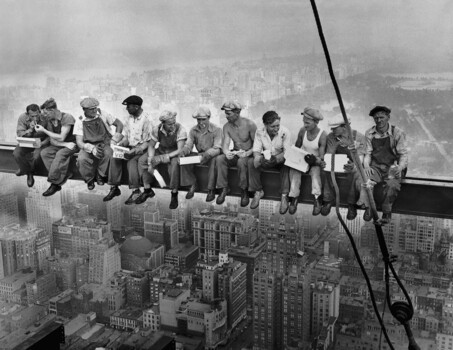
Eleven men sit shoulder to shoulder on a steel beam, more than 800 feet above Manhattan, eating sandwiches and lighting cigarettes as if the drop beneath their boots were nothing more than a curb. There is no safety line, no net, no visible fear. It is one of the most reproduced images of the twentieth century, and almost everything the average person assumes about it is wrong.
The men were not caught mid-shift by a passing photographer who happened to look up. The date is known. The building is known. The reason the picture exists at all is known, and it has nothing to do with luck. What nobody can say for certain, even now, is who pressed the shutter.
That single missing fact has turned an ordinary lunch break into a decades-long detective story, one that runs from a Depression-era publicity office through a small Irish pub and into a corporate archive that still could not close the case. The photograph is famous. The truth behind it is far stranger than the myth.
The Picture Everyone Thinks They Know
The image was made on September 20, 1932, during the final months of construction on the RCA Building, the 70-story centerpiece of Rockefeller Center now known as 30 Rockefeller Plaza. The workers are perched near the top of the rising tower, seated on a steel beam more than 800 feet (over 240 meters) above the streets of midtown. Behind them, Central Park and the rooftops of the city fall away into haze.
For decades the photograph circulated with almost no reliable information attached to it. It was routinely credited to Lewis Hine, the great social documentarian who spent years photographing laborers and the building of the Empire State Building. Hine did not take it. The negative sat in the Bettmann Archive, a vast commercial collection of historical images, and the caption that traveled with it was thin to the point of uselessness. One of the most widely reproduced photographs of the twentieth century came with a blank where the author's name should be.
Part of the reason the image endures is what it captures about the moment it was made. In 1932 the country was three years into the Great Depression. Rockefeller Center was one of the largest private construction projects in the world, a symbol of confidence built in the middle of economic collapse. The men on the beam were the ones doing the actual work, many of them immigrants, and the photograph made them look invincible. That reading is genuine. The staging around it is where the story turns.
A Staged Shot, Not a Stolen Moment
The men on the beam were real ironworkers, and the height was real. The lunch was not. The photograph was arranged as a publicity stunt, one frame in a marketing campaign designed to sell space in the new Rockefeller Center and to keep the project in the newspapers during a period when almost nothing else was going up.
Ken Johnston, who managed the historical photo collections at Corbis, which owned the archive for years, described it plainly. The event was organized, with several photographers on hand and a clear promotional purpose, even though the workers themselves were genuine tradesmen and the danger was not faked. Calling it staged does not mean the men were actors. It means the moment was set up to be photographed, posed and composed for the camera as part of a deliberate publicity campaign. The men and the height were real, although the photograph does not reveal how far the nearest completed floor or other structure lay beneath them.
The publicity operation produced more than one memorable frame that day. A companion image from the same shoot shows several of the same men stretched out and apparently napping on the identical beam, boots dangling over the void. That picture is far less famous, but it comes from the same session and underlines the point. This was a shoot, planned and executed, not a lucky glance across a construction site.
Knowing it was staged takes nothing away from the image. If anything it makes the achievement clearer. Someone had to conceive it, position real men at a genuinely lethal height, and expose the frame with the heavy, deliberate equipment of the era. The question is who.
Who Pressed the Shutter?
The name attached to the picture most often is Charles C. Ebbets, an American photographer who lived from 1905 to 1978 and who worked as a photographer on the Rockefeller Center publicity operation in 1932. In 2003 the case for Ebbets went public, largely through the research of his daughter, Tami Ebbets Hahn. Her family produced material that pointed hard in his direction: receipts on professional letterhead, images of Ebbets working at heights on the site, and original 1932 clippings kept in his personal scrapbook.
Corbis, which controlled the image at the time, hired a research firm to settle the attribution. It did not settle it. The investigation surfaced complications rather than a clean answer. Credit had once been assigned to Hamilton Wright, whose syndicate Ebbets had worked for, and in that era the head of a features syndicate was often credited for pictures actually taken by staff working under him. More importantly, the inquiry established that Ebbets was not the only photographer on the beam that day. Two others, Thomas Kelley and William "Lefty" Leftwich, were also documented as present during the shoot.
That uncertainty sits at the center of the whole story. Multiple cameras were working the same setup at the same height on the same afternoon, and the surviving records cannot prove whose exposure became the famous one. Later research by the longtime Rockefeller Center archivist Christine Roussel has narrowed the field to two principal possibilities, Ebbets and Leftwich, with Kelley present that day but apparently never claiming the picture. Roussel leans toward Ebbets, and the circumstantial evidence in his favor is substantial, but no surviving record conclusively connects his camera to the famous negative. Corbis, too, eventually leaned toward Ebbets and displayed his work under his name, without the attribution ever hardening into certainty. Because the photographer cannot be confirmed, the image is frequently published, to this day, with no photographer credit at all. A picture this recognizable, and the one thing a photographer cares about most, its authorship, remains open.
It is a strange fate for an image so precise in every other respect. You can name the building, the date, and the height. You can explain why it was made and who paid for it. You cannot reliably sign it.
Chasing the Men on the Beam
If the photographer is a mystery, the workers were, for a long time, a bigger one. Eleven men, no names, no records tying faces to identities. That blank is what drove the 2012 documentary Men at Lunch, directed by the Irish filmmaker Seán Ó Cualáin, produced by his brother Éamonn Ó Cualáin, and narrated by the actress Fionnula Flanagan.
The project began by accident. In 2010 the Ó Cualáin brothers came across a copy of the photograph hanging on the wall of a pub in Shanaglish, a small village in County Galway. Beside it was a note from a local man, Pat Glynn, claiming that his father and a relative were two of the figures on the beam. That scrap of family lore sent the filmmakers from the west of Ireland to New York to see whether the anonymous men could be named.
The film makes a strong case for an Irish presence on the beam, consistent with the wave of immigrant labor that built much of modern Manhattan. It investigated family claims that the two men at the extreme ends were Matty O'Shaughnessy and Sonny Glynn, both associated with Shanaglish, but those identifications remain unconfirmed, since the absence of employment records prevents any of it from being pinned down. The two names most firmly connected to the photograph through archival comparisons are Joseph Eckner, third from the left, and Joe Curtis, third from the right, and even those are now being reassessed by newer research. The man on the far right, tipping a bottle, has also been claimed as the Slovak worker Gustáv Popovič, based partly on an inscribed copy of the photograph found among his possessions, though that identification is disputed and conflicts with the Glynn family's claim to the same figure. The documentary is candid that certainty is hard to come by nearly a century later. Family memory, physical resemblance, and a handful of documents can point toward a name without nailing it shut.
What the search really recovered was the human layer the publicity campaign had flattened. These were working immigrants during the Depression, risking their lives on steel for wages, and the campaign that used them left most of them nameless for eighty years. Putting even a few names back on the beam is the part of the story that matters most.
Why the Image Still Works
The photograph has never really left circulation. Time magazine included it in its 2016 selection of the 100 most influential images ever made. It hangs, in poster form, in dorm rooms and diners and pubs on more than one continent. Rockefeller Center has leaned into it directly, building a tourist experience at the Top of the Rock observation deck that hoists visitors onto a replica beam so they can pose for their own version, safely anchored, several hundred feet up.
The staging is a large part of why it endures. A truly candid frame of tired men eating lunch would probably have been forgettable. What the 1932 shoot produced instead is a composition: eleven figures balanced along a strong horizontal line, the city stacked in soft focus behind them, the whole thing organized so the eye reads danger and ease at the same time. It is a designed picture that happens to be true. The men were really up there. The risk was real. The frame was still built.
That combination, genuine subject and deliberate construction, is the thing modern photographers chase constantly and rarely name. A great deal of "authentic" imagery is arranged. The 1932 beam shot is an early, extreme, and openly commercial example, and it still outperforms most of what has been made since. If you want to build cityscapes with that kind of scale and control, Elia Locardi walks through the planning and post-processing of urban work in Photographing the World 2, which is a useful counterweight to the myth that the best city images are simply found.
The original was made with the slow, deliberate large format gear of the 1930s. The surviving negative is a glass plate, and the photographers on the project are associated with bulky Graflex cameras that could take glass plates or sheet film, though no record ties a specific camera and holder to this exact exposure. Either way, it demanded a level of care per frame that has almost no modern equivalent. There was no chimping and no burst mode, and each exposure required deliberate preparation. But this was a sustained session with several photographers and numerous frames, not a single unrepeatable shot. Every exposure still cost real time and money, which is part of why the day was planned so tightly.
Yet, the lesson buried in the picture is not about equipment at all. It is that the most enduring images are often the most engineered, and that engineering is not a dirty secret. Someone decided those men should sit on that beam, framed exactly that way, and made the exposure. Ninety years later we still cannot agree on that person's name, and we are still looking at their work.
Lead image: "Lunch atop a Skyscraper," September 20, 1932, eleven ironworkers eating on a beam more than 800 feet above midtown during the construction of Rockefeller Center. Attributed to Charles C. Ebbets, though the authorship is disputed. Public domain (published in the New York Herald-Tribune, October 2, 1932; U.S. copyright never renewed). Source.
What's Your Reaction?
 Like
0
Like
0
 Dislike
0
Dislike
0
 Love
0
Love
0
 Funny
0
Funny
0
 Wow
0
Wow
0
 Sad
0
Sad
0
 Angry
0
Angry
0











.jpg)


Comments (0)