

‘Making Marie Antoinette’ Review: Eleanor Coppola’s Tender Documentary About Her Daughter’s Masterpiece Doubles as a Wistful Self-Portrait

The term “nepo baby” had yet to be coined by the time that Sofia Coppola — prematurely defined by her punchline of a performance in daddy Francis’ “The Godfather Part III” — re-emerged in her late 20s as one of the most gifted filmmakers of her generation, but few celebrities in her position, before or since, have ever been so acutely responsive to how they’re seen in the public eye. Drawing from lived experience in a way that allowed her to interpolate the biases she’d faced as both a Hollywood scion and a young woman in the arts, Coppola’s first two features directly confronted the sort of privilege and presumption that had shadowed her since childhood. Each in their own ways, “The Virgin Suicides” and “Lost in Translation” vividly traced the interior lives of girls who weren’t permitted to have them, and they did so with a hyper-real sensitivity that allowed the movies to resonate with anyone who’s ever felt observed but unseen, as if just out of frame in every picture that had ever been taken of them.


Of course, success can — and often should — breed a special kind of resentment for nepo babies who dare to make a name for themselves, and so it was no surprise that people only sharpened their knives from “dinner” to “butcher” after Coppola won the Oscar for Best Original Screenplay in 2004. By the same token, it was, perhaps, even less of a surprise that Coppola’s response to such bitterness was to make a movie humanizing Marie Antoinette, the one-time Queen of France and eternal figurehead of unearned entitlement (“I know I will be able to express how a girl experiences the grandeur of a palace,” Coppola wrote to Antoinette biographer Antonia Fraser, whose book she hoped to use as source material).
Least surprising of all? That a sizable percentage of critics and audiences were rather ungenerous towards the finished product, a $40 million costume drama more interested in the rhythms, customs, and furnishings of Antoinette’s gilded cage than it is in the anger her reign helped to foment beyond the palace walls.
Never mind that Antoinette was a brilliantly natural subject for a filmmaker so compelled by the negative space between women and the worlds they inhabit, or that the movie’s panopticon-like vision of Versailles allowed Coppola to explore the relationship between power and personhood with peerless clarity, or that her gauzy direction invited the movie to love Marie Antoinette without ever letting her off the hook — or out of the guillotine, as it were (talk about having your cake and eating it too). Never mind that Coppola shrewdly offset her production’s unprecedented access to the actual palace grounds with a variety of inspired anachronisms (chief among them the single greatest soundtrack of the 21st century), and as a result created a sharply modern look at the unbearable lightness of being famous. Never mind!!
Not that I was mad about that. Please don’t put in the newspaper that I got mad. Time has been kind to people who share my view that “Marie Antoinette” is a semi-understood masterpiece, and not only because critics like me have been increasingly emboldened to argue that case. (In 2022, I included it on my Sight & Sound ballot of the 10 greatest films ever made). Following years of murmured reconsideration, the film will be formally canonized into The Criterion Collection this November. And before that, MUBI will release — first in theaters, and then on its streaming platform — a feature-length documentary about the making of “Marie Antoinette” that is called, if you can imagine, “Making Marie Antoinette.”
 ‘Making Marie Antoinette’
Despite what the 600-word preamble you just read might have led you to believe, that documentary is the true subject of this article. Sorry. But we all went on that long walk together for two reasons: 1.) I am physically and spiritually incapable of passing up any chance to get on my soapbox about the films of Sofia Coppola, whose formative impact on me would be impossible to overstate, and 2.) Because anyone reading this review of “Making Marie Antoinette” should know that I sat down for the movie like I was opening the fucking Ark of the Covenant. Footage of Rip Torn loosening up before a banquet scene, or of Jason Schwartzman trying to make Kirsten Dunst laugh before they get in the royal bed together… To some people, this might be the routine stuff of a vintage EPK, but to me it’s like watching DV video of Michelangelo painting the Sistine Chapel.
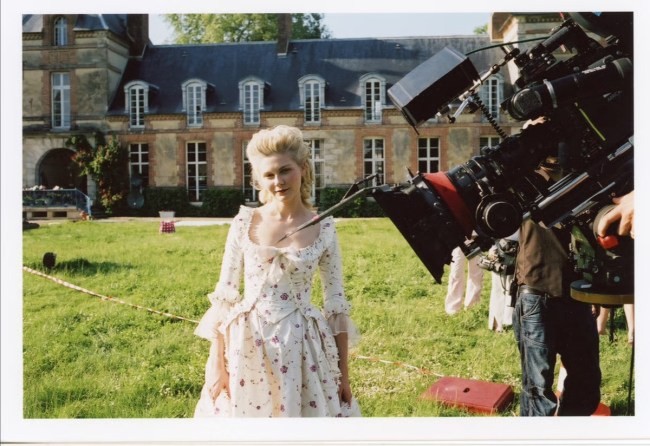
And yet, even for those of you who haven’t spent the last 20 years wishing you could have a fuller context for this iconic set photo, I contend that “Making Marie Antoinette” is considerably more than meets the eye. Hardly some mere collection of random snippets that were shot by the world’s luckiest Columbia Pictures intern, this was directed by — and with the intimate access of — Sofia’s late mother Eleanor Coppola, whose film about the production of her husband’s “Apocalypse Now” remains the quintessential documentary about a movie in crisis, which helps to explain why the cast and crew of “Marie Antoinette” were so accommodating of her camera, or at least so determined to downplay the rare moments when it annoyed them. (Dunst is an inveterately gracious professional, but more than once do we see her flinch — and then smile — right into the lens.)
The Eleanor Coppola of it all also helps to explain why Sofia was so eager to revisit that footage during the COVID lockdowns, when she and Eleanor were gifted the time to comb through all 80 hours of the raw video they had from set. When Eleanor died in 2024, Sofia — as she explains in a series of title cards at the start of this doc — determined to complete “Making Marie Antoinette” as a tribute to her mother.
 ‘Making Marie Antoinette’
And there’s no mistaking the sincere intentionality behind that choice: Despite her position behind the camera, Eleanor is immediately positioned as the film’s main character, as snippets from the journal she left behind, read here by Diane Lane, narrate the bittersweet mix of emotions she felt watching her young daughter command a lavish Hollywood set in the service of such a personal vision. The voiceover is used sparingly, but to great effect; it lends crucial shape to a video diary that unfolds in rough chronological order, but is otherwise happy to serve up a rich and messy hodgepodge of unrelated memories.
“Shooting a documentary is like fishing,” Eleanor tells us. “You’re always waiting for something interesting to happen.” “Making Marie Antoinette” refuses to force the matter. It spends almost as much time watching featured extras poke at edible prop aspics as it does glimpsing at Dunst’s process, and Sofia’s chronic cough — a symptom of the bronchitis she brought to set — receives considerably more screentime than the likes of Rose Byrne, Jamie Dornan, and Asia Argento combined. So it goes in a film so warmly filtered through the lens of a mother’s love (and worry), and so angled towards the aspects of the shoot that sparked Eleanor’s curiosity. Francis jetting in for moral support. Their son Roman so capably leading the second unit. The moment when Sofia’s new boyfriend Thomas Mars, now her husband of 15 years, showed up to meet the family and see the love of his life at work.
But it’s Milena Canonero’s costume department that most dominates Eleanor’s attention, and a good deal of the movie is spent on wardrobe fittings — and the anxiety such things added to an ultra-tight production schedule that Sofia was determined not to fall behind, as if making a great film was second to her goal of proving that “a dumb girl” like her could helm such a lavish Hollywood show. Eleanor is extremely sensitive to that concern, and can’t help but internalize it to some degree. “Sofia looks too small and unprepossessing to be the director of a $40 million movie,” she muses in a similar, albeit more loving way as people might have doubted Marie Antoinette herself some 250 years earlier. “I wondered why she’d chosen this difficult project.”
The documentary gradually fits that concern into a broader context as Eleanor’s thoughts start to jump around in time and the soundtrack begins to borrow from movies that Sofia hadn’t made yet, as if “Making Marie Antoinette” were indulging in some musical anachronisms of its own. Eleanor marvels at how boldly Sofia is seizing her moment, but not without a wistful tinge of regret for the circumstances that never allowed her the same chance — that relegated her to document her spouse’s accomplishments, and left her with a lingering sense that she was born too early to be seen as more than just Francis’ wife. “At my age, shouldn’t I be engaged in my own creative process, not just observing the creative work of my talented family?”
But to watch “Making Marie Antoinette” is to see that she was engaged in her own creative process, not only because her camera is so watchful and observant, but also because her footage has now been made into the foundation of a circular and tenderly meta-textual film unto itself — one about two generations of women paying tribute to each other across space and time, seeding each other with the strength required to be seen in a world that would sooner flatten them into the wallpaper.
As a “Marie Antoinette” super-fan I was delighted by the chance to hear Sofia fret that her movie was going to be too “Masterpiece Theater,” and to watch cinematographer Lance Acord flit around in search of the perfect candlelight, and I suppose that anyone uninterested in such things may resist the temptation to read anything more into how they’re presented here. But, truth be told, I was most delighted by how my natural enthusiasm for this stuff fascination opened the door to another, slightly hidden story about the desire to be perceived — a desire undiminished by creature comforts or name recognition. Or by age. As the end titles note, Eleanor finally shot her first narrative feature in 2016, minting her — at 80 — the oldest woman to make her directorial debut. “Making Marie Antoinette” wasn’t completed until 10 years later, but I can’t help but feel like that movie would never have existed if not for Eleanor’s experience making this one.
MUBI will release “Making Marie Antoinette” in theaters on Friday, October 23rd, and it will be available to stream on MUBI starting Friday, November 6.
What's Your Reaction?
 Like
0
Like
0
 Dislike
0
Dislike
0
 Love
0
Love
0
 Funny
0
Funny
0
 Wow
0
Wow
0
 Sad
0
Sad
0
 Angry
0
Angry
0





Comments (0)