

‘Monster,’ the TV Show, Devolves Into a Poor Impersonation of ‘Monster’ the Movie
Despite its subtitles, “Monster” never limits itself to a single killer. “Dahmer — Monster: The Jeffrey Dahmer Story” (which was retroactively and awkwardly dubbed as such to establish the surprise hit as the start of an anthology franchise) extends its unflinching gaze beyond the twice-titular cannibal to include John Wayne Gacy and Ed Gein. Season 2, “Monsters: The Lyle and Erik Menendez Story,” makes sure to loop O.J. Simpson into its L.A.-centered media frenzy. Season 3 circles back to spotlight Gein in “Monster: The Ed Gein Story,” while shining a light on Nazi lamp-maker Ilsa Koch, too.
So it was only a matter of time before Ryan Murphy’s “Monster” franchise made its way to Charlize Theron’s “Monster” subject, Aileen Wuornos. Perhaps showrunner and co-creator Ian Brennan showed restraint, even foresight, by keeping the Floridian killer out of Season 3’s meta movie storyline. When scripts already feature Anthony Perkins as Norman Bates (both played by Joey Pollari), Ted Levine as Buffalo Bill (played by Golden Garnick), and Gunner Hansen as Leatherface (Brock Powell), the prospect of adding an actor playing Charlize Theron playing Wuornos sounds tempting.


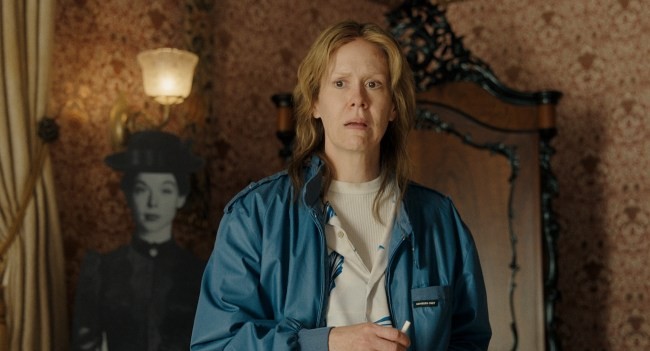
But after seeing her portrayal in “Monster: The Lizzie Borden Story,” Lee’s inclusion feels more perfunctory than planned. Sarah Paulson’s bug-eyed embodiment reads like a loose, almost farcical impression of Theron’s Oscar-winning turn — and not in the camp-adjacent aspirations the series falls back on. Her scenes, as silly as they are earnest, do little more than hammer home a similar point to Patty Jenkins’ 2003 film: Lee was a victim as much as a murderer, even if society was only willing to see the latter.
It’s an idea Netflix‘s anthology has routinely fallen back on in lieu of more incisive commentary, usually inviting the rhetorical question: “Who’s the real monster here?” The series has never been good, and it’s often upsettingly bad, but Season 4 marks the first time “Monster” feels wholly disinterested in its own existence. Even “The Ed Gein Story” skewered Hollywood’s serial killer sensationalism with masochistic passion. “The Lizzie Borden Story” can’t muster much to say beyond observing civilization’s centuries-old systemic oppression of women while acknowledging the fury it evokes.
Women are furious enough to kill! Furious enough to keep killing! Furious enough to see their madness as sanity! Perhaps — gasp! — because it is! (Please watch “Furious” instead, and if you’ve already seen Liz Meriwether’s latest coup, watch it again.)
What little “Monster” has to say about Lizzie Borden is largely superficial. Played by a perpetually blank Ella Beatty, the daughter of Warren Beatty and Annette Bening, Lizzie is the belittled and abused daughter of a disinterested father, Andrew (Charlie Hunnam), and hateful step-mother, Abby (Rebecca Hall). The former made his fortune running a funeral parlor, aka conning mourning families into buying coffins he built and they can’t afford. Andrew is also obsessed with axes, which he regularly uses to lop off the feet of long-limbed cadavers so they conform to his one-size-fits-all caskets. (Sadly, there’s no coffin flops, but at least one widow would certainly have preferred to see her husband’s body bust out of shit wood and hit pavement instead of the revolting screw-up she’s left with instead.)
Andrew whines about the prattling women who’ve infiltrated his home, firmly establishing that all men are, in fact, terrible. Abby, though, is the real treat. She tosses scalding soup in her maid’s face because she made the wrong stew. She wipes every surface of the house with a white glove before steeping the grimy results in a teapot and making the maid drink it. She fires maids every other month or so and makes the new one go by the old one’s name because she can’t be bothered to learn a new one. But she doesn’t just hate maids! She calls Lizzie a “shallow,” “off-putting,” “imbecile” (excerpts from longer, more elaborate insults) and regularly reminds her that’s she’s unloved, unwanted, and a burden to the household until she marries, which will never happen, because her likeliest suitor claims she has “the face of a horse.”
 Ella Beatty in ‘Monster: The Lizzie Borden Story‘Courtesy of Netflix
Within minutes, it’s obvious why Lizzie would grab the nearest axe and chop her parents to bits, but “Monster” still spends hours explaining how she gets there. Time spent with Abby is worth it, since Hall transcends her character’s flat redundancies by raising every moment to the height of hilarity. Her bulging eyes, her piercing shrieks, her casual yet immaculately articulate cruelty all come together to form a cartoonish villain who’s also a commanding delight. Abby deserves her own sitcom, and for one fleeting, glorious moment, it seems like “Monster” Season 4 may have decided to give her one, when poisoned bowls of seafood provoke a bout of projectile puking that would make Regan MacNeil blush.
Kudos to Hunnam for landing the Barf Bowl’s biggest laugh — I can still hear him growling, “It was the cardamom!” before a flood of liquid evacuates both ends of his body — but he can’t extend interest in Andrew beyond his magnificent moment of suffering. The man is simply too predictable and boring, which is the point — men, again, are terrible — but the same point could be made without resorting to the easiest examples. (He cheats, he drinks, he hates himself, yada yada yada.)
Similarly, “Monster” can’t sustain itself once it abandons its hard pivot to straight comedy. Episode-spanning arcs revealing each of the parents’ tragic backstories reveal nothing relevant, and Lizzie’s infatuation-turned-romance with the newest maid, Bridget (Vicky Krieps), feels tacked on and under-explored. (Unsurprisingly, there’s no evidence it really happened either.)
Bridget’s arrival also introduces the first alternate killer plotline: Elizabeth Báthory, aka “The Blood Countess,” a 16th century Hungarian aristocrat who invited her townspeople’s finest virgins to her castle, fed them a hearty meal, and then slaughtered them so she could bathe in their blood and absorb their “power.” The Countess (also played by Krieps) serves as minor inspiration for Lizzie, but other than a few heavy-handed parallels here and there, she’s mainly present to obey the rule of thirds: When it comes to female killers, Lizzie is the primary example, the Countess is the second, and Aileen Wuornos completes the trio.
 Rebecca Hall in ‘Monster: The Lizzie Borden Story’Courtesy of Suzanne Tenner / Netflix
Lee hitchhikes into “Monster” in the fourth episode as Lizzie’s longtime admirer. She tells the driver who picks her up that her name is Lizzie Borden. She forces her girlfriend to read Lizzie’s biography (“The Ballad of Lizzie Borden”) on their anniversary trip to Lizzie’s childhood home. She eventually communes with Lizzie in the attic and again on death row, seeing a soul sister who killed the people who wronged her — only she got away with it.
Even if you’re aware there’s nothing to suggest Lee ever even thought about Lizzie, the repeated cutaways to her story are intriguing for their sheer randomness. Surely, the sole commonality between the two characters can’t be that they are women who killed people? I mean, Lee was raped and took revenge on her rapists. Lizzie killed her parents. The line connecting them both is thin, and yet that’s the only line “Monster” provides.
OK! Sure! By the time all three of “Monster’s” killers share an episode, it’s clear “The Lizzie Borden Story” isn’t going to come together. In the most generous interpretation, Season 4 sees Lizzie as an aberration: Hundreds of years ago, the townsfolk savor punishing the Countess even more than that psycho savored bathing in their daughters’ blood. Then with Lee, in the timeline closest to our present day, her heartbreaking, hard-to-stomach testimony means nothing to a callous judge who sentences her to death three times over. So then and now, whether a female serial killer has no reason or good reason to commit murder, the patriarchy is desperate to punish her; to put her back in her place; to bury her in her own fury.
Except for Lizzie, who’s acquitted. She’s shown using her freedom to open a wildlife refuge for animals, host lavish dinner parties for dozens of guests, and fight for suffrage. Sure, she only gets away with it because the jury refuses to believe a woman is capable of such brutal murders, but once she’s free of her tormentors, look what she does! Look what women can do when they’re not abused, oppressed, and angry about being abused and oppressed! What a world that could be, huh?
Setting aside its twisted, lazy take on feminism — including the unintended implication that women should be allowed to kill any asshole they please — “Monster” Season 4 isn’t just aspiring for little else beyond recycling its own previous commentary; it’s repeating commentary from 20 years ago. In Roger Ebert’s oft-cited review of “Monster” (2003), he writes, “What Charlize Theron achieves isn’t a performance but an embodiment. With courage, art, and charity, she empathizes with Aileen Wuornos, a damaged woman who committed seven murders. She does not excuse the murders. She simply asks that we witness the woman’s final desperate attempt to be a better person than her fate intended.”
“Monster,” the TV series, arguably does excuse the murders, but it also manages to simply state the ideas that “Monster,” the movie, makes us feel.
One is art. The other, well, it’s just an impression.
Grade: D+
“Monster: The Lizzie Borden Story” is available to stream on Netflix.
What's Your Reaction?
 Like
0
Like
0
 Dislike
0
Dislike
0
 Love
0
Love
0
 Funny
0
Funny
0
 Wow
0
Wow
0
 Sad
0
Sad
0
 Angry
0
Angry
0









Comments (0)