

Mount Toba eruption doesn't seem like it could nearly kill our species
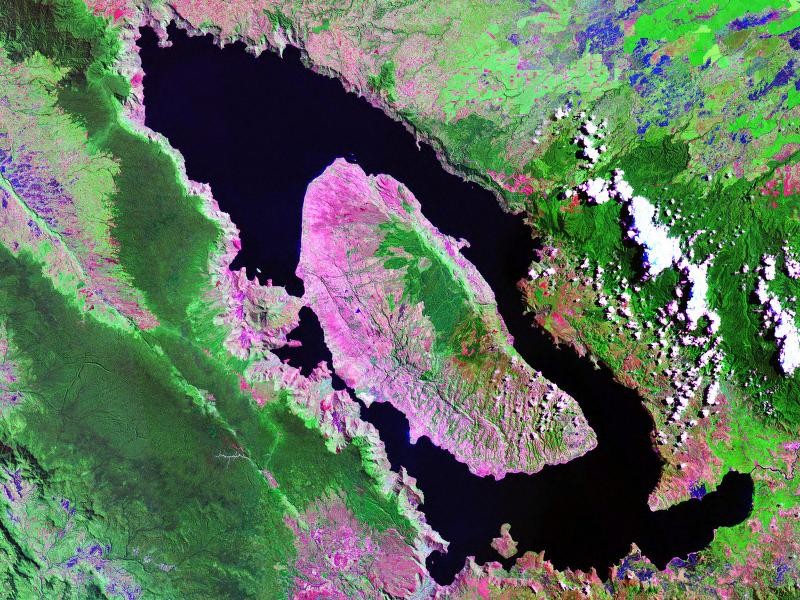
The massive Toba eruption seems to have had little climate impact.
Mount Toba was the biggest volcanic eruption in the last 2.6 million years, and some have suggested it nearly wiped out humanity. Around 74,000 years ago, a caldera on what is now Sumatra emptied thousands of cubic kilometers of magma in about two weeks, roughly a thousand times more than Mount Pinatubo spewed out in 1991. “People thought it might have caused massive cooling of the planet, and hence threatened the survival of our ancestors,” says Jinheum Park, a geoscientist at Johannes Gutenberg University in Mainz, Germany.
Park and his colleagues went looking for the records of that catastrophe in the mud taken from the bottom of a small crater lake on the Kenya-Tanzania border. They found instead that the effects of the Mount Toba eruption lasted under two years and amounted to perhaps half a degree of cooling.
Muddy calendars
Volcanic eruptions inject sulfur dioxide into the stratosphere, where it becomes a haze of tiny droplets that reflect sunlight back into space. Bigger eruptions eject more sulfur dioxide and, in principle, cause more cooling. But this trend stops working when the eruption exceeds a certain magnitude. “Bigger sulfate aerosols settle quickly, because they are heavier,” Park explains. This quick settling makes them less effective in scattering incoming solar radiation.
Estimates of Toba’s sulfur output varied so widely that computer models had the eruption appearing as anything between a near-extinction-level event to a mild nuisance for our early ancestors, depending on the number we punched in. To settle this argument, scientists tried to look at geological evidence: Toba’s ash preserved in seafloor or lake cores. But this also proved tricky.
Underwater mud cores usually don’t work that well when it comes to dating and constraining abrupt, violent events like volcanic eruptions. When sediment settles at the lake or ocean bottom, materials from different years get a bit mixed. Even if we cut a mud core taken from the bottom of the sea into very thin slices and attempt to resolve climate changes at smaller intervals, our slices would reflect the mixed influence of yearslong climate signals. With most such records, we can track how past climates evolved decade by decade. A volcanic winter, even a severe one, would last one to three years.
“It’s really difficult to find any sedimentary archive which registers the regional climate at such high resolution,” Park says. Looking for traces of a Toba catastrophe in standard sediment cores was like timing a sprint with a calendar. But then scientists found a lake with sediment records that worked more like a stopwatch.
Stopwatch lake
Lake Chala is a small, steep-walled crater lake on the flank of Mount Kilimanjaro, fed by groundwater from the mountain’s forested slopes. Its deep water never fully turns over, leaving the bottom starved of oxygen and free of currents. This makes it a nearly perfect hi-res climate recorder, in which sediments are deposited as varves: annual couplets with a light-colored layer rich in silica skeletons from algae called diatoms and a dark-colored layer with fine-grained soils and clays. “It works just like tree rings,” Park says.
The couplets exist because from October through April, the water stays layered and still as the dark materials accumulate. Then, in the cool, dry, windy months from June to September, it mixes. “The lake is 90 meters deep, but during cool and dry conditions the water can be mixed down to about 50 meters,” Park explains. “In that case, the nutrients near the lake bottom come up to the surface, and then the diatoms can make use of them.” Diatoms, fed by that upwelling material, bloom, die, and sink as a pale layer of silica—a layer that’s thicker in cool, dry years when the mixing season runs long.
Invisible ash
Toba’s ash at Chala was identified by earlier work. It is invisible to the naked eye, its particles too sparse and small to form a visible layer. Scientists found them by dissolving away the mud and counting microscopic glass shards, remnants of the molten magma the eruption atomized into ultra-fine and rapidly cooling dust.
At Chala the shards spike abruptly, then vanish. “There is a sharp increase and a sharp peak, so we could rule out any significant influence by redeposition,” Park says. “We were quite sure that it was from direct ash fall.” In X-ray scans, the layer is a sliver 0.3 millimeters thick—thinner than a sheet of paper. Park’s team then worked through the 450 years of mud bracketing that sliver, layer by layer, combining microscope images with chemical scans, isotope readings, and diatom counts every two to three years.
For the 260 years before the ash fell, the team found that the lake was calm year-round, and the climate was warm and wet. Then comes the ash and, sandwiched inside and just above it, two green films a few hundredths of a millimeter thick. “We couldn’t exactly identify what those green layers were, but at least it was not from incompletely decomposed algae, because we couldn’t find any intact remains,” Park says. The team interpreted these layers as material diatoms secrete when they are badly stressed. “We thought the green layers came from the diatoms, as a stress response to the dimmed sky,” Park says. “Because they need light to grow.”
The next dry season after the eruption produced a pale layer 1.2 millimeters thick, with abundant diatoms—a bloom apparently driven by the unusually deep, prolonged mixing a chilled lake surface would cause. The dark layer above it is thin and faint, meaning the rains that followed were weak, probably due to a cooled Indian Ocean sending less moisture inland.
But by the third year, the Chala layers are back to normal. “The light lamina that was deposited nearly two years after the eruption is quite typical for Lake Chala,” Park says. The duration of the cataclysm that was thought might have almost eradicated early humans was likely about 18 months total.
And those 18 months apparently weren’t all that bad.
Half a degree
To figure out how cool and dry the region was, the team measured the ratios among some elements, specifically the silicon-to-aluminum and manganese-to-iron ratios. The silicon-to-aluminum ratio tracked how big the diatom bloom was each year, while the manganese-to-iron ratio tracked how much oxygen the annual mixing drove into the water.
If the climate around Chala cooled by 2°–3° Celsius, Park explains, Chala would stop keeping its neat annual records. Mixing would go so deep that the algae blooms would strip the lake of nutrients, which would prevent the bloom in the following year. “When nutrients would accumulate again, there would be another strong bloom,” Park says. In the sediment core, this should result in thick, irregular banding instead of regular couplets. That’s not what the post-Toba mud looks like.
To estimate by how much the Toba eruption cooled the region, Park’s team compared the changes in the two element ratios they measured to similar changes that occurred during the last ice age. “The amplitude of the change after Toba was nearly a quarter of that threshold,” Park explains. “That’s how we came up with our estimate of approximately 0.5 degrees Celsius.”
The sediment core also reveals the calendar date of the Toba eruption, something earlier models could only guess at. Because pale layers form between June and September and dark ones from October to April, the position of the ash inside a couplet enables relatively precise timing. “The Toba ash was contained within, but still close to the end of, a dark lamina,” Park says. This points to January or February, southern summer and northern winter. Earlier estimates, based on where the ash landed across Asia, had suggested the opposite season.
And this was half-bad, half-good news for early humans living in Africa.
Mild disaster
“Sulfate aerosols in the stratosphere are more effectively transported to the hemisphere that is experiencing winter,” Park says. For our ancestors, this meant the Toba’s sulfate veil drifted northwards and thinned over their heads slightly sooner than it would if the eruption happened in the northern summer. On the other hand, the Northern Hemisphere has far more land, which cools down faster and further than the ocean, so a northern-winter eruption must have cooled the globe a bit more than the same eruption in July. But overall, compared against the broader climate change trajectory, the Toba eruption was a rather mild disaster.
“The eruption did cool and dry the region, just not to such an extent as to significantly threaten the survival of humans,” Park argues. Across the 450-year window his team analyzed, eastern equatorial Africa was already sliding from a warmer, wetter regime into a cooler, drier one, tracking a natural cooling trend recorded in Greenland ice. Against that background, Toba’s impact looks tiny. “Our study shows that the magnitude of cooling and drying after Toba was much smaller, and within the natural range of variation in the last glacial–interglacial cycles,” Park says. “Humans had already experienced and survived that.”
The limitation in Park’s study is that Chala is just one lake. “It records the regional climate signals in eastern Africa, but it doesn’t show the impact on the whole globe,” Park explains. “There should be more studies using a similar approach, at more sites where the Toba ash is found.”
The team also hopes similar approaches will be used to learn more about other huge volcanic eruptions like Los Chocoyos in Guatemala and the Oruanui eruption in New Zealand 26,000 years ago. “They were not as big as Toba, but they were still super-eruptions. It would be interesting and exciting to see what happened,” Park says.
Science Advances, 2o26. DOI: 10.1126/sciadv.adv6851

Jacek Krywko is a freelance science and technology writer who covers space exploration, artificial intelligence research, computer science, and all sorts of engineering wizardry.
What's Your Reaction?
 Like
0
Like
0
 Dislike
0
Dislike
0
 Love
0
Love
0
 Funny
0
Funny
0
 Wow
0
Wow
0
 Sad
0
Sad
0
 Angry
0
Angry
0










Comments (0)