

Nikon's Cheapest Full Frame Beats Its Flagship at One Thing
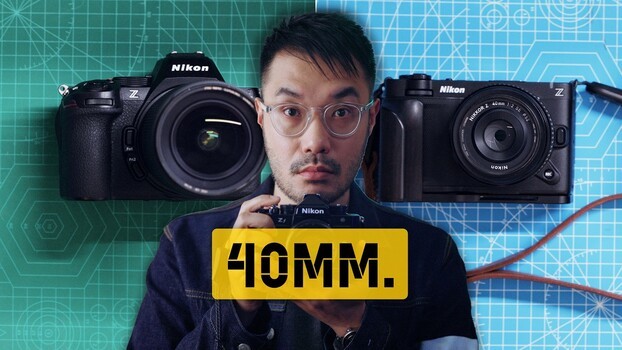
Nikon now sells a full-frame camera under $2,000 that focuses in the dark better than the pricier bodies above it. That claim sounds backward, since the entry-level model is supposed to inherit leftover parts, not outperform the flagship.
Jack Wang carries three full-frame Nikons through a part of his hometown he'd never taken the time to see, each paired with a 40mm lens, to work out which one he'd keep if forced to pick a single body. The Nikon Z 5 II is the cheapest of the group, and it does one thing better than any other full-frame Z camera: autofocus in low light, rated down to -10 EV. Wang tests this in a dark office with the Nikkor 40mm f/2 Z, rocking back and forth while the cameras hunt for his face, and the Z 5 II locks on quickest. The EXPEED 7 processor drives face and eye tracking that once eluded Nikon, now standard across the Z 5 II, the Z f, and the ZR. Its EVF hits 3,000 nits, bright enough to use comfortably while wearing sunglasses.
Handling separates the three more than any spec sheet does. The Z 5 II grips like a Z 6 III, with everything on the right side so Wang can change settings without lifting his hand off the lens. The ZR trades an EVF for a flat, boxy shape and a giant 4-inch LCD, which makes it the easiest to slide into a bag but pushes him toward a set-it-and-forget-it approach with continuous AF and 3D tracking. Wang argues the ZR leads a specific niche of boxy cameras that choose form over function, ahead of the Panasonic S9 and Sigma fp, both of which cut the EVF and mechanical shutter but kept older, slower sensors prone to banding. The Sony a7C line gets close with a tiny EVF, though it leans on electronic front curtain shutters to fit its sensors. Nikon's partially stacked sensor scans fast enough to avoid banding under most lighting, even on electronic shutter.
The 40mm focal length is the thread running through all of it. Wang calls it his everyday standard, wide enough for the geometry and subframing he likes, tight enough to place a face without the distortion of a 28mm or 35mm. He pairs the Z 8 with the 7Artisans 40mm f/2.5, a tiny metal-mount lens he rates about as sharp as Nikon's own 40mm, maybe a touch sharper, though the Nikkor handles flare better. Both show purple fringing wide open. The lens he'd actually choose, and the reason he'd keep the Z f, is the Voigtländer Nokton 40mm f/1.2 Z, an all-metal manual-focus lens whose soft, puffy bokeh gives images a look no other 40mm delivers.
Most major brands now make a 40mm or a crop-sensor equivalent, and that convergence tells you something about where photography is heading. Fujifilm's 27mm f/2.8 lands at roughly 40mm on its sensors, and TTArtisan, Viltrox, and 7Artisans all sell compact 40mms. A 40mm is easier to design than a 35mm which keeps it small and cheap, and small is exactly what the Nikon Z system rewards for daily carry. If you've been circling 35mm or 50mm and finding one too loose and the other too tight, the gap between them is where a lot of working photographers have quietly settled. A single compact 40mm on a capable body covers street, portraits at a distance, and the kind of unhurried documentation of your own city that Wang builds the whole video around.
The Z f still earns its place through execution, standing as the best-resolved retro full-frame design on the market, with brass top dials, a substantial top plate, and a shutter that gives real tactile feedback. Its backup card is a microSD, where the Z 5 II runs dual full-size SD slots, and its EVF is noticeably dimmer than the Z 5 II's. Wang frames the Z 5 II as competing not against other entry-level cameras but against the a7 IV, the a7R V, the Panasonic S5 II, and the Canon R6 II, at a lower price and with few real compromises.
Watch the full comparison above to see which body and 40mm combo Wang commits to after a full day of shooting.
What's Your Reaction?
 Like
0
Like
0
 Dislike
0
Dislike
0
 Love
0
Love
0
 Funny
0
Funny
0
 Wow
0
Wow
0
 Sad
0
Sad
0
 Angry
0
Angry
0











Comments (0)