

Nvidia reveals its mega DSX POD modular 'AI factory' — so could the latest Vera Rubin hardware actually help make data centers more energy efficient?
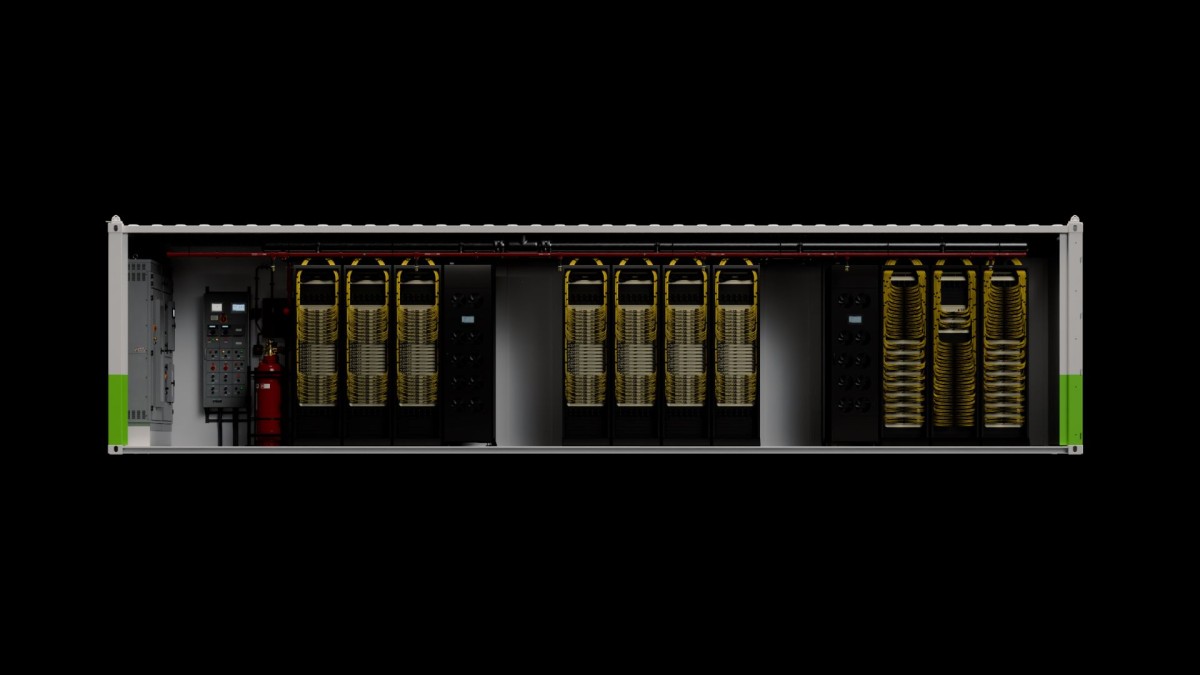
- Nvidia's DSX POD aims to cut AI infrastructure deployment to 14 days
- Factory-built containers move major AI data center assembly away from deployment sites
- Vera Rubin systems form the computing foundation of Nvidia's DSX POD
Nvidia has introduced DSX POD, a modular infrastructure design which brings its upcoming Vera Rubin computing systems together with essential data center equipment.
The system places computing hardware, networking, electrical distribution, and liquid cooling inside factory-assembled containers, reducing the amount of installation work required at deployment sites.
Nvidia claims the approach could shorten deployment schedules from six months to just 14 days, provided locations already have the necessary supporting infrastructure.
Factory-built containers aim to accelerate AI deployment
The DSX POD design moves major integration tasks from construction sites into manufacturing facilities, where equipment can undergo assembly and testing before shipment.
Each container arrives with internal cabling, power connections, cooling pipes and networking installed, allowing operators to connect the unit to prepared infrastructure at their chosen location.
Nvidia CEO Jensen Huang linked faster deployment with the ability to begin generating revenue from AI infrastructure sooner.
“An AI factory creates value when it starts producing tokens — not when construction is complete,” he declared.
Sign up to the TechRadar Pro newsletter to get all the top news, opinion, features and guidance your business needs to succeed!
“With NVIDIA DSX POD, we’re bringing factory-built precision and speed to AI infrastructure construction…so customers can scale capacity and bring revenue-generating production online faster.”
According to Nvidia, reducing installation time allows operators to start training models and running production workloads earlier, potentially bringing forward opportunities to generate revenue.
The reference design starts with Vera Rubin NVL72 systems, which Huang described as comprising seven liquid-cooled computing racks connected through approximately 17 kilometres of Spectrum-X cabling.
However, the 14-day deployment estimate depends on site readiness, meaning power availability, cooling capacity, networking and other supporting systems must already be prepared.
Nvidia claims lower energy and water consumption
Beyond faster construction, Nvidia says its DSX infrastructure platform can improve resource efficiency, although the claimed savings depend on the facility design and operating conditions.
The company claims its cooling approach can eliminate water evaporation during normal heat rejection, using closed-loop liquid cooling alongside outdoor dry coolers to release heat.
Nvidia estimates that a deployment operating at 2GW could save 54 million litres of water daily compared with conventional systems relying on cooling towers.
Extreme temperatures may require additional mechanical cooling, potentially reducing water savings depending on local climate and operating conditions.
Nvidia also claims its DSX MaxLPS technology can deliver equivalent token output using 30% less power through dynamic allocation within an AI facility's available electricity budget.
Another component, DSX Flex, is designed to adjust data center power consumption in response to electricity prices, grid conditions and utility requirements.
Nvidia is collaborating with companies including Dell Technologies, HPE, Lenovo, Schneider Electric and Vertiv to manufacture and supply DSX POD systems worldwide.
Deliveries are expected to begin in early 2027, while Nvidia’s projected efficiency gains still require independent verification under real-world operating conditions.

Follow TechRadar on Google News and add us as a preferred source to get our expert news, reviews, and opinion in your feeds.
What's Your Reaction?
 Like
0
 Dislike
0
 Love
0
 Funny
0
 Wow
0
 Sad
0
 Angry
0








Comments (0)