

‘Odyssey’ Cinematographer Hoyte van Hoytema Was More Interested in the Intimate Than the Epic
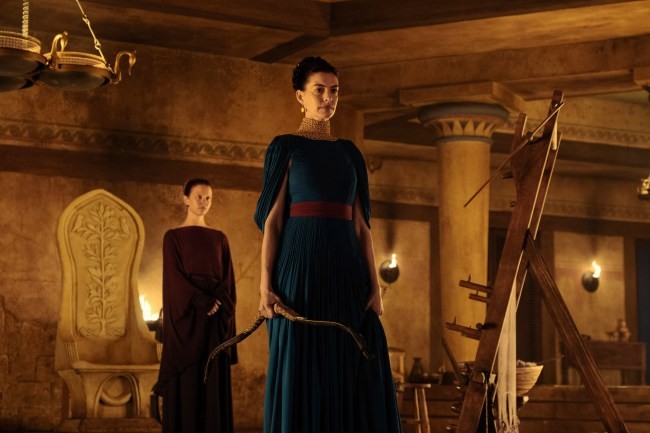
Christopher Nolan‘s adaptation of Homer’s “The Odyssey” was one of the most awe-inspiring cinematic achievements of 2026, an epic worthy of comparison with the grandiose visions of David Lean and Stanley Kubrick. Yet what interested cinematographer Hoyte van Hoytema was less the story’s vast scale than the details of the human faces inhabiting the film‘s sweeping vistas.
“We never really treated it in an epic way,” van Hoytema told IndieWire. “Even though we all know ‘The Odyssey‘ and understand the scale of the story, making some sort of a tourist film was never on our agenda. It was the characters and the visceral sense of their experience that we were interested in, so even standing in the most crazy places in the world — on mountaintops or wherever — we were never motivated by the landscapes. The settings take care of creating the scale and scope of the film — our perspective on the story was a very intimate one.”


Given that, van Hoytema tried not to be seduced by the beauty of his surroundings if it didn’t serve the emotional experience. “It was less about showing how beautiful a beach was than about showing how shitty those men felt when they were on the beach,” he said, noting that a key tool in getting across the characters’ internal feelings was shooting the film entirely in IMAX.
“Shooting an entire film in IMAX has been a pursuit of ours for quite a long time now, and we’ve been tweaking the lenses and tweaking the cameras in order to get there,” van Hoytema said. “We’ve managed to wrangle the equipment and technology around it to enable us to be right there next to you, looking straight into your eyes.”
This again plays into that idea of intimacy versus scale, which was something van Hoytema and Nolan had experimented with in “Oppenheimer.” In that film, IMAX was used not only for major set pieces like the atomic bomb test, but quiet dialogue scenes shot largely in close-up. Van Hoytema says that he and Nolan have long been aware that IMAX has historically been used mostly to depict the wonders of the world, but they wanted to expand its grammar.
“The lenses that we use today are an evolution of different iterations of lenses that we have been building through the years, lenses that focus extremely close and that can open wide so that you can work with natural light or in half-darkness,” van Hoytema said. “We’ve found that IMAX is an intimate format because it’s such a good replicator of the human experience and perspective.”
The biggest obstacle toward shooting an entire movie in IMAX before “The Odyssey” was always the sound — IMAX film cameras are famously noisy, making it difficult to get decent production recordings. “We built a blimp on ‘Tenet,’ but it didn’t work,” van Hoytema said. “This was the first film where we felt that the technology had gotten far enough to actually shoot the entire thing on IMAX. There’s been an evolution in development not only in my department but in the sound department — they have come up with better microphones, better filtration, and in this film it came together beautifully.”
Van Hoytema and Nolan always had a backup plan in case the IMAX cameras became too unwieldy or got in the way of performance, particularly in lengthy dialogue scenes that would outlast the cameras’ short magazines. Once Matt Damon and Anne Hathaway proved that they could pull off a complicated sequence in close collaboration with van Hoytema and the other departments, however, Nolan and his crew were confident they could rely on IMAX as their format of choice. “That day was the hardest, and we shot everything on IMAX, so for the rest of the film we just committed — no plan B,” van Hoytema said.
While van Hoytema and Nolan were enthusiastic about committing to IMAX, it did create massive logistical challenges — not just when it came to getting the heavy camera and blimp in and out of remote locations, but in terms of performance. The actors’ eyelines, for example, were often blocked by the enormous camera. “Here we are bragging about the intimacy we can achieve, and suddenly you’re on set with a gigantic black box in front of the actors, and they can’t look each other in the eyes,” van Hoytema said. “It was a huge problem.”
To solve the problem, van Hoytema and his crew built a system that would allow the actors to see each other. “It was based on a teleprompter that has an angled mirror in front of the lens, and people can look straight into the lens reading a teleprompter because it has projected text on it. But instead of text, we had another mirror, and we had an actor sitting here. So basically what actors see is a little surface with a mirror with the other actor in there, and they can look straight into the other actor’s eye.”
Van Hoytema could fine-tune the eyelines by adjusting the angles of the mirrors in what he called “a very analog but very effective solution. And the actors loved it, because instead of looking at a wall they’re literally looking at their co-stars.” Van Hoytema reiterated the idea that everything in the movie was geared toward character and performance — including, at times, making the actors as uncomfortable as possible.
“It’s not for nothing that Chris loves to go out at sea with a ship and do things that are almost physically impossible,” van Hoytema said. “The more miserable or real or wet the situation is, the more the actors have to react to and play with. And that also goes for my way of working. I love different weather situations. I love different light situations. I love kinetic and physical challenges. It adds something unexpected and something visceral. The camera’s always fighting something and the actors are fighting at that very same moment, so it becomes a weirdly symbiotic relationship to the elements.”
In spite — or perhaps because — of the arduous shoot, van Hoytema didn’t want to see it end. “This was an extremely difficult film, but it was also the film where everything we’d been working toward came together,” van Hoytema. “We were much more light-footed. Weirdly enough, when what you’re doing becomes subjected to elements that you cannot control, you become a bit less precious. And that lack of preciousness is very liberating. We just went in headfirst.”
What's Your Reaction?
 Like
0
 Dislike
0
 Love
0
 Funny
0
 Wow
0
 Sad
0
 Angry
0







Comments (0)