

Oh to Believe in Another World review – William Kentridge’s amazing animated ballet of black comic pain
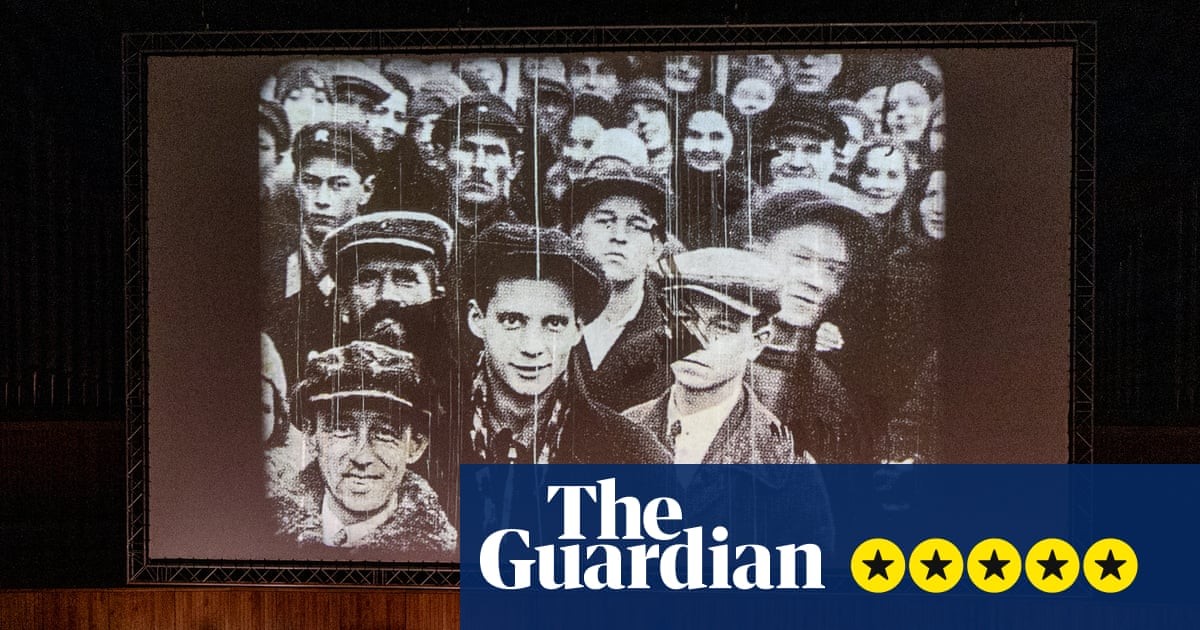
The Baku international arts festival in Azerbaijan is showcasing an amazing cine-musical creation, perhaps the most amazing animation I have ever seen. Oh to Believe in Another World is an hour-long collage animation with live-action choreography by the 71-year-old South African artist and film-maker William Kentridge. It is shown with the live orchestral accompaniment of Shostakovich’s 10th Symphony, and this event is partly in honour of the 120th anniversary of Shostakovich’s birth this year, and partly to honour Shostakovich’s reportedly unrequited love (and lifelong friendship) for his student, Azerbaijani pianist and composer Elmira Nazirova.
The 10th symphony was inspired by Stalin and premiered shortly after his death, so it seems probable that Shostakovich had been at work on it for some time before this, long enough beforehand for at least some of the composition to have been conceived without any sense of Stalin’s death. Could part of it perhaps have been originally intended as an obediently dramatic tribute to Stalin? Yet the music arguably combines fear, awe, revulsion, and a hysterical reaction to the mad energy of Stalin’s genocidal tyranny, a darkly ambiguous respect for the great dictator whose victory in 1945 was a mainstay of the postwar dispensation; perhaps there is also a feeling in the music’s swirl that a great and terrible era has passed away, and with it a kind of grief at all that had been sacrificed to it.
For this, Kentridge creates models and masks of famous and notorious Soviet figures, including Stalin, Lenin, Trotsky and the poet Mayakovsky whose work provides the title and the intertitles, with maxims like: “We’ll chase humanity into happiness with an iron fist.” These masks are variously blurred and scribbled, some blank with the faces just outlined, like constructivist cutouts. Lenin is severe; Stalin has a half smile, Mayakovsky is haunted; Trotsky looks oddly pained and outraged. Some of these faces are small and attached to models, some lifesize and attached to actual human dancers. The humans and the models both become 2-D cartoon-grotesque figures, their stern or noble facial portrait expressions at odds with their absurd rickety flatness, their faces are like posters or placards. Their bodies below caper through a bizarre landscape: a danse macabre of history and tragedy. The models are green-screened into meticulously and brilliantly created model interiors; we enter their tiny world and it becomes lifesize, as fascinating as the dollhouse dioramas in the Thorne Rooms at the Art Institute of Chicago that captivated Orson Welles. The little models become the same height as full-size humans, a hyperreal effect.
We see a dusty old Soviet museum … a wrecked auditorium where a newsreel movie is still playing … an eerily empty swimming pool, where Lenin appears on a high diving board. Then in the first movement, the Moderato, there are photographs of faces: faces of people destined to be eliminated by the state. We see the title, presented in the way as the succeeding intertitles: and we can sense something tragic or heroic about believing in anything at all. Shostakovich himself emerges as another of these puppet cutouts, sinuously conducting his own work. In the second movement, the Allegro, the tempo accelerates and the movie has something of Vertov’s Man With a Movie Camera. In the third movement, the Allegretto, we see Nazirova, Shostakovich’s love from Azerbaijan, dancing. But it is in this movement that Stalin, his poster-face at all times bearing the mild half-smile, takes out a gun and starts shooting. The fourth movement, Andante, Allegro, shows us the masks coming off and Kentridge’s own giant hand intruding into the frame.
My colleague Jonathan Jones has written about Kentridge’s film but what I hadn’t anticipated was how funny it is: the simple, preposterous effect of seeing Stalin’s great big monumental face on top of a dancer’s body, and seeing that face remain unchanged despite the exertions below, staring resolutely ahead at the far horizon of history. It is hilarious, a little like Terry Gilliam’s animations for Monty Python. But is it supposed to be funny? Chaplin showed that the way to defy Hitler was to laugh at him. Kentridge (and Kentridge’s Shostakovich) are doing something similar with Stalin but not exactly the same. It is a ballet of black comic pain.
I have experienced many live-orchestral cinema events for silent movies: movies for which an ambitious new orchestral score has been composed. Many of these have been wonderful events, but on every occasion I have been aware of how the music can never quite match up to what’s on the screen, and to some extent washes diffusely over the action. But Oh to Believe in Another World is something else. It is precisely the other way around. The film has been created for the music. To believe in another world, a better world; that is the yearning exclamation at the heart of the music. The October revolution was pursued by those who wanted to believe in another world and lived to see one come into being. But under the Stalinist tyranny, they were yearning for another world as well, a world to overturn this one. The music mourns that lost idealism and mourns that another kind of idealism is necessary.
What's Your Reaction?
 Like
0
 Dislike
0
 Love
0
 Funny
0
 Wow
0
 Sad
0
 Angry
0







Comments (0)