

Payloads used to dictate the terms of launch. That's finally changing.
“The Starship Pez dispenser demonstrates very smart industrial design and scale.”
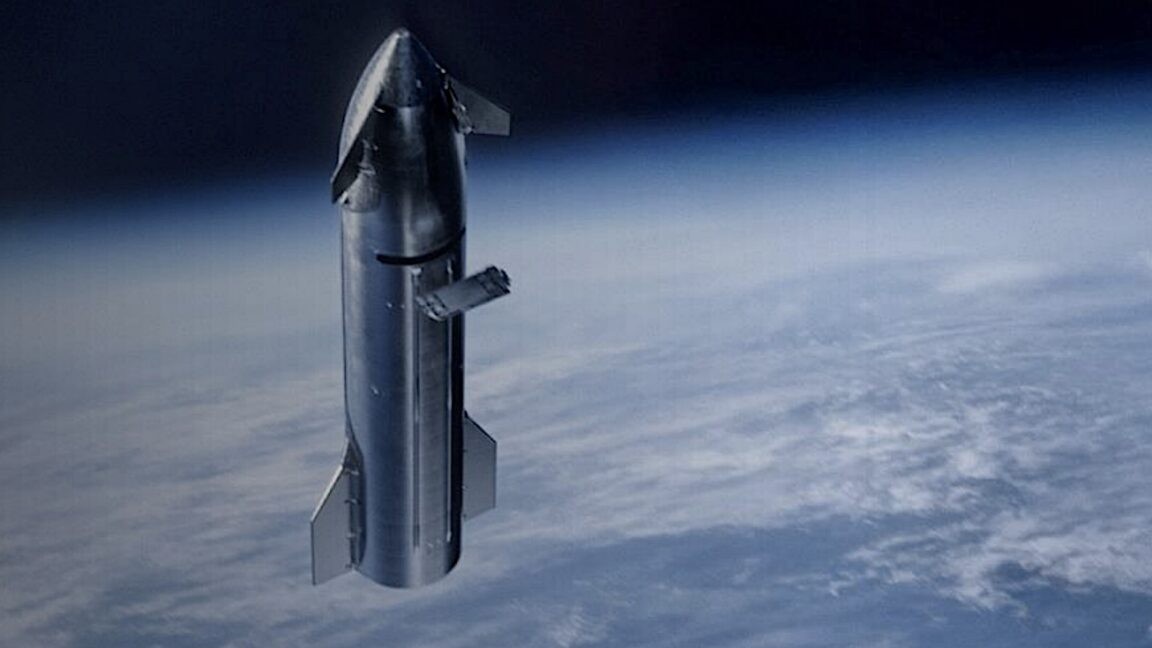
Artist's illustration of Starship releasing a Starlink V3 satellite from its "Pez dispenser" deployment system. Credit: SpaceX
It wasn’t easy to find anyone outside of SpaceX clamoring for a rocket like Starship just 10 years ago. Today, the space industry can’t wait for Starship to finally deliver.
With a payload capacity of more than 100 metric tons (220,000 pounds) to low-Earth orbit, SpaceX’s new rocket is changing the thinking of just about everyone in the space industry. With the unrealized but potentially game-changing benefits of refueling, Starship could carry the same amount of payload to higher orbits, the Moon, or Mars.
It’s important to note that Starship is still very much in its experimental phase, far from proving Elon Musk’s loftiest claims about what it can do. Still, NASA and the US military are considering novel ways to use Starship to fly to the Moon or transport cargo to far-flung war zones. Scientists are eager to use its enormous volume to launch giant space telescopes. Competitors are taking notice. China, the strongest strategic adversary America has ever faced, is looking for its own Starship. Now, some US satellite manufacturers are adapting for the substantial capacity of the world’s most powerful rocket.
This is a reversal of how things usually go in the balance of supply and demand between launch vehicles and satellite operators. Rocket designs have long engineered their vehicles to match trends in the satellite industry. They designed for their customers’ needs, or at least for what their customers were telling them they needed. But in 2026, a new era of abundant super-heavy-lift launch promises to unlock entirely new applications for satellites.
Historically, engineers relied on a few basic assumptions when it came time to design a new rocket. One was that their launch vehicle would deliver a single payload or a small number of satellites to space. These payloads would be stacked on top of their launch vehicle for release at just the right moment, in just the right orbit. Matching satellites and rockets followed a predictable, orderly pattern. Small satellites needed a small rocket, and larger payloads required a heavier launcher.
Perhaps the most fundamental assumption was that these satellites would ride to orbit inside the uppermost part of the rocket, protected by a clamshell-like aerodynamic shroud that would peel away once the launch vehicle soared above the atmosphere and reached the sterile environment of space.
The only launch vehicle to ever challenge these assumptions was NASA’s Space Shuttle, which deployed numerous satellites of all sizes in the first half of its career before it proved a commercial failure. NASA then turned its focus to constructing the International Space Station, a task the Space Shuttle marvelously completed upon retiring in 2011. Ultimately, the Shuttle was outclassed, at least on a commercial basis, by lower-cost expendable rockets. Its unique attributes never had much influence on how engineers designed their satellites.
Today, SpaceX’s Starship rocket is again promising to upend the launch industry and, by extension, the futures of those who build and own satellites. There are other super-heavy-lift rockets coming onto the market, too. Blue Origin’s New Glenn rocket, particularly a yet-t0-fly upgraded variant with more engines, fits in between SpaceX’s workhorse Falcon 9 rocket and Starship.

A Starship rocket and Super Heavy booster lift off from Starbase, Texas.
Credit: SpaceX
A Starship rocket and Super Heavy booster lift off from Starbase, Texas. Credit: SpaceX
Taking advantage
Starship’s first real payloads will be SpaceX’s own next-generation Starship V3 broadband satellites. It can carry up to 60 of them on a single launch. Starlink V3s are based on the same stackable, flat-satellite architecture as SpaceX’s existing Starlink satellites.
SpaceX shunned the conventional boxy satellite designs pretty much everyone else has used for more than a half-century. On the Falcon 9, stacks of Starlink satellites still ride to space on top of the rocket, inside a fairing, and then release all at once upon reaching orbit. The company first showed the utility of the flat-packed, stackable satellite architecture with Starlink beginning in 2019.
SpaceX uses a different approach on Starship, with Starlinks riding inside the vehicle’s fuselage, then ejecting through a small door on the side like a Pez dispenser. Pulleys and cables lower each satellite into position for deployment, one at a time, then the door closes to allow the rocket to come back to Earth.
SpaceX settled on this novel architecture for several reasons. The flat design allows each satellite to have a broader surface area facing the Earth. It also eliminates the need, at least initially, for SpaceX to focus on developing a large payload fairing. Rocket Lab’s smaller medium-class Neutron rocket takes a similarly revolutionary approach to payload fairing design, integrating it with the Neutron’s reusable booster stage rather than the expendable upper stage. With Starship, however, SpaceX intends to make the entire vehicle rapidly reusable.
Other satellite manufacturers are starting to take note, but not all of them. Satellites for China’s Qianfan broadband megaconstellation use a flat-panel, stackable design. Amazon’s broadband constellation, Amazon LEO, uses a more conventional-looking satellite.
Muon Space, a satellite manufacturing startup, announced earlier this month that it is developing a new high-power satellite design to take advantage of Starship’s payload accommodation. Muon Space calls the new platform Condor-Ultra. The company says it is “optimized for stackable mass-deployment from SpaceX’s Starship” for potential use on communications, sensing, and orbital data center-type missions.
“It is designed for stackable deployments through the opening without requiring the whole fairing to open,” said Greg Smirin, president of Muon Space. “That’s sort of what we’re designing to, what us and other customers have an understanding of for [what SpaceX will offer in] the near term, in the sort of ’28 timeframe.”
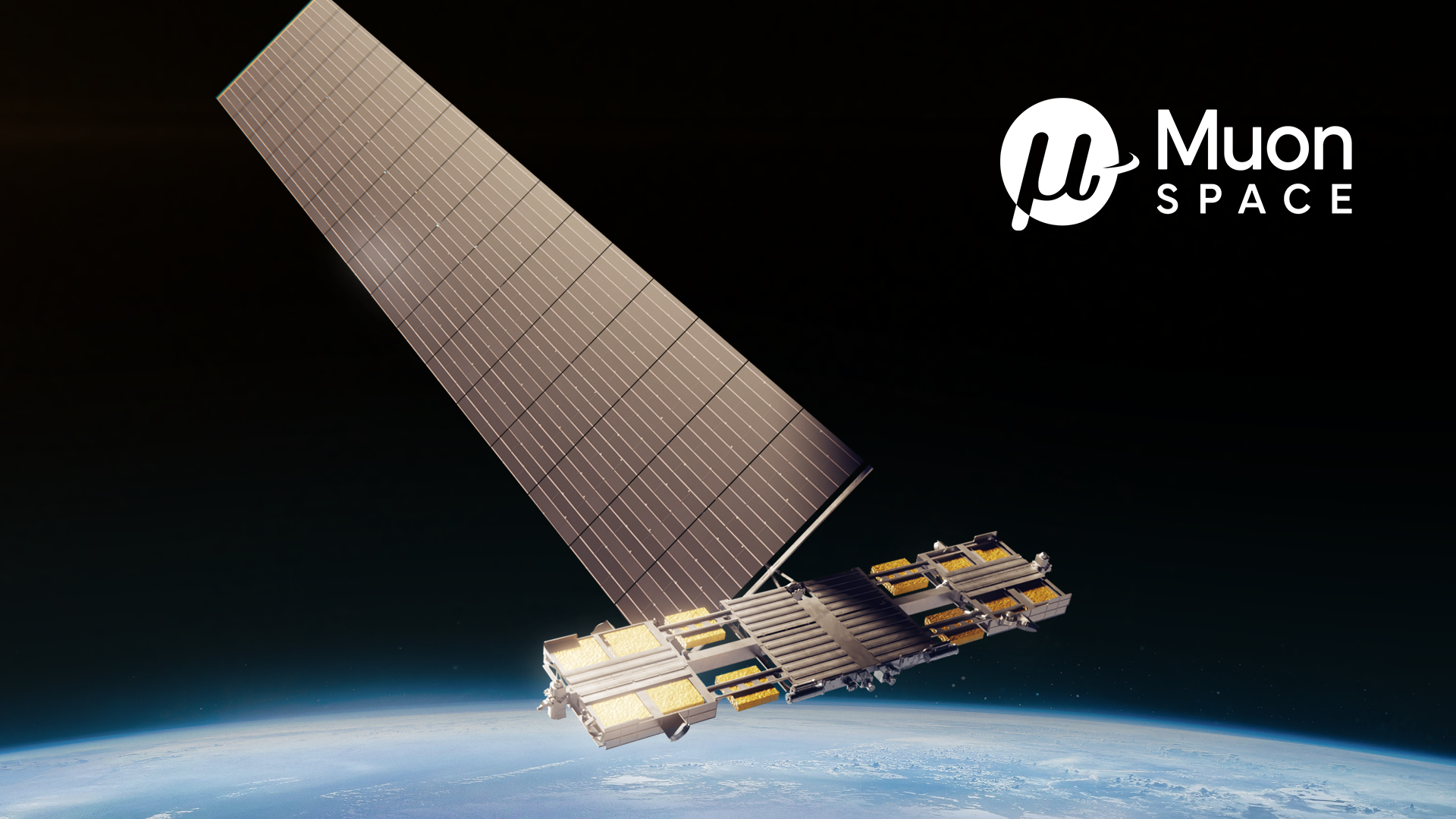
Artist’s illustration of a Condor-Ultra flat-panel satellite with its solar panel deployed in orbit.
Credit: Muon Space
Artist’s illustration of a Condor-Ultra flat-panel satellite with its solar panel deployed in orbit. Credit: Muon Space
Muon’s new satellite design can also fit on medium-lift rockets, such as the Falcon 9 and Rocket Lab’s Neutron. It will weigh about 1.5 metric tons, or 3,300 pounds, at launch.
Smirin said the diversity of future space missions will require some satellites to take more conventional shapes, some of which will need to launch on a rocket with a more conventional payload fairing. SpaceX is expected to eventually offer a different deployment system to accommodate other kinds of payloads that are not compatible with the Pez dispenser.
“There will likely be some other configurations,” Smirin said in an interview with Ars. “This particular one is absolutely designed to work with the Pez dispenser framework. It sort of maps to the high nadir-facing payload face that you want for Earth interaction, that could also work with a stackable Pez dispenser sort deployment.”
Other satellite manufacturing startups are making inroads in flat-panel designs. Last year, Apex announced a new flat satellite chassis called Comet. On its website, the company teases an even larger version of Comet, named Comet XL, “optimized for Starship and the super-heavy launchers of the future.”
Terran Orbital, a commercial satellite builder owned by Lockheed Martin, also boasts a flat-packed satellite design it calls Enterprise. Vast, best known for its plans to launch a privately funded space station, said last month that it’s branching out into satellite manufacturing. The new initiative, called Vast Satellite, is based on a flat-panel design “for high-density launch and batch deployment.”
John Rood, CEO of the space infrastructure and transportation company Momentus, told Ars he credits SpaceX with the “forethought” of thinking creatively about how to better integrate satellites with their rockets. Momentus specializes in building spacecraft to host small experiments or other customer payloads. For example, the company’s newest mission is now in orbit with NASA- and US military-sponsored experiments to test rendezvous navigation sensors and demonstrate how to robotically assemble modular structures in space.
Momentus’ spacecraft can also serve as space tugs to ferry smaller satellites or experiments from one orbit to another. These kinds of missions aren’t necessarily the best fit for a flat-panel satellite.
“I don’t think it’ll be the new industry norm,” Rood said of the flat-panel architecture. “I think, for obvious reasons, given SpaceX’s heft, it is something that will become a bigger and bigger part of the industry, but I don’t know if everything will transition to that… There are compelling reasons to have other types of satellites.”
Just a tank of gas
A new report from the Aerospace Corporation helps elucidate why satellite companies are optimizing for Starship. It’s big and reusable, and once operational, it could cut the cost of launching a kilogram of payload into orbit by an order of magnitude from the Falcon 9. This means costs could come down from a few thousand dollars per kilogram to a few hundred.
Karen Jones, a space economist and lead author of the paper, said her research supports some of those optimistic cost projections. She outlines three scenarios, two of which assume an initial launch cost of $100 million for each fully reusable Starship and Super Heavy booster, with marginal costs of 20 or 35 percent. This is in line with the marginal costs of the smaller, partially reusable Falcon 9, which SpaceX can launch for as little as $15 million per flight on a dedicated Starlink mission.
This would bring the per-kilogram launch cost for a fully loaded Starship down to $133 to $233 after 10 reuse cycles. A more optimistic scenario with a $50 million initial launch cost and 20 percent marginal cost would reduce payload costs to $67 per kilogram for a Starship/Super Heavy launch at full capacity after nine use cycles. That’s less than it costs to fill the gas tanks of most SUVs. If SpaceX can make these more optimistic ambitions a reality, it would validate a claim made by Elon Musk in 2022 that a Starship flight could eventually cost as little as $10 million.
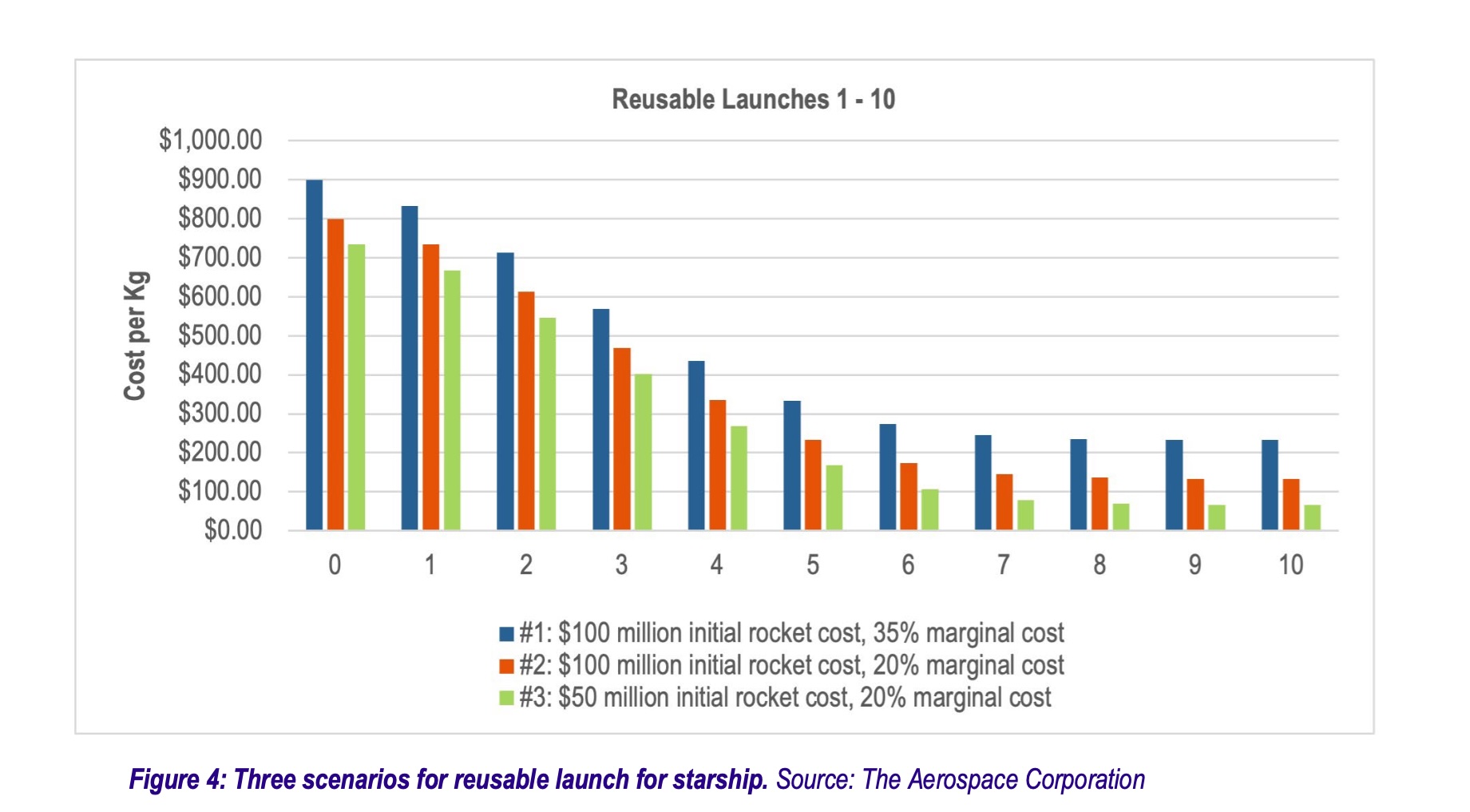
Three scenarios for Starship’s costs, and their resulting effects on cost-per-kilogram of payload.
Credit: Aerospace Corporation
Three scenarios for Starship’s costs, and their resulting effects on cost-per-kilogram of payload. Credit: Aerospace Corporation
“I actually thought I would basically disprove that [claim], and on my first try, I got to $67 per kilogram after nine use cycles,” Jones told Ars. “It’s based upon some significant assumptions in the paper, but it’s not something that’s completely crazy. It certainly wouldn’t be something they’d reach on the first few times, on their first model; but over time, and with a learning curve, why not? I think it’s possible.”
In the paper, Jones writes that SpaceX could achieve these numbers “through a combination of manufacturing and operational learning curves, lower marginal costs, a fully laden rocket, and adequate reuse.” SpaceX has shown it can do it with Falcon 9, but it won’t happen overnight with Starship. Earlier this month, SpaceX launched one of its reusable Falcon 9 boosters for a record-setting 35th time. The company reached nine flights of one booster in 2021, nearly 11 years after the very first Falcon 9 launch.
Ordinary to extraordinary
The first obvious market for Starship to serve will be megaconstellations, beginning with SpaceX’s own. These kinds of missions will help SpaceX bend the learning curve to create and enable still-unrealized markets, like routine trips to the Moon and Mars, orbital data centers, or point-to-point transportation on Earth.
“The here-and-now revenue generation opportunities lie with broadband constellations and connectivity plays, basically building out their current constellations,” Jones said. “We focus on megaconstellations. They can kind of grow the business, and then from that platform, and from that success, some of these more speculative ventures might be able to springboard from that.”
In other words, the ordinary will unlock the extraordinary, Jones said.
So it’s no surprise that some satellite manufacturers are thinking seriously about taking advantage of Starship as soon as possible.
“A FlatSat form factor is going to replace these traditional boxy satellites, and a FlatSat type of form factor will help reduce drag and increase maneuverability,” Jones said. “The actual deployment mechanism, which is the Starship Pez dispenser, to me, this demonstrates very smart industrial design and scale. These FlatSats fit into the Pez dispenser, and this could be perhaps the future space de facto standard for rideshare and mass-produced satellites and constellations.
These “FlatSats” are not a panacea. It’s hard to imagine some missions fitting on a flat-panel design. “It’s not to say that there wouldn’t be other types of satellites and ways to launch telescopes and other types of form factors,” Jones said.
But flat-packed, stackable satellites allow operators to deliver more capability to orbit faster. Starship will take this to the next level with its capacity to launch SpaceX’s more powerful Starlink V3s.
“On a Falcon 9, they can only launch 27 of these V2s,” Jones said. “The Starship can launch 60 of these larger V3s. What this means is bandwidth per launch amounts to 61,000 gigabits per second on Starship versus 2,600 gigabits per second for V2s on Falcon 9. In other words, almost 24 times as much bandwidth can be deployed per launch on Starship versus the Falcon 9 and the V2 satellites. That’s huge.”
Of course, costs are not the same as prices. SpaceX charges commercial customers $74 million for a dedicated Falcon 9 launch, about five times the internal launch cost. This still makes Falcon 9 the most affordable and reliable launch option in the Western world. It’s too early to know where or when SpaceX will set Starship launch prices. Part of the calculation will hinge on the progress of SpaceX’s competitors, such as Blue Origin.
“Certainly, that’s what the industry wants to see, is two equal players,” Jones said. “It absolutely contributes to the economics in terms of price per kilogram.”
“We’ve got these two rocket companies vying for positions,” Jones said in an interview. “I think it’s going to be important that we have competition here, and one company seems to be ahead right now, but whether you’re first to market or a fast follower, I think we would all benefit from seeing this competition between these two companies, Blue Origin and SpaceX. I think that’s critical.”
Some economists believe Starship is simply too big to fulfill all of SpaceX’s lofty goals, but Jones doesn’t buy it.
“Sometimes, when you increase the size of any type of transportation system, it creates something called diseconomies of scale, where the marginal costs start to increase,” Jones said. “Now, I think Starship is going to prove a new price point, but some think that when you get too big, kind of like the [Airbus] A380 airplane that tried to compete with the [Boeing] 747, it created all sorts of demands and types of maintenance.
“Could the Starship follow that path and become not relevant? I don’t really believe it,” she said. “I think that they’re going to have to prove it. They’re going to have to prove over time that they can fly the Starship and continue to see marginal costs decrease, and hopefully the space sector will discover a new sweet spot, but right now it’s the Falcon 9.”

Stephen Clark is a space reporter at Ars Technica, covering private space companies and the world’s space agencies. Stephen writes about the nexus of technology, science, policy, and business on and off the planet.
What's Your Reaction?
 Like
0
Like
0
 Dislike
0
Dislike
0
 Love
0
Love
0
 Funny
0
Funny
0
 Wow
0
Wow
0
 Sad
0
Sad
0
 Angry
0
Angry
0












Comments (0)