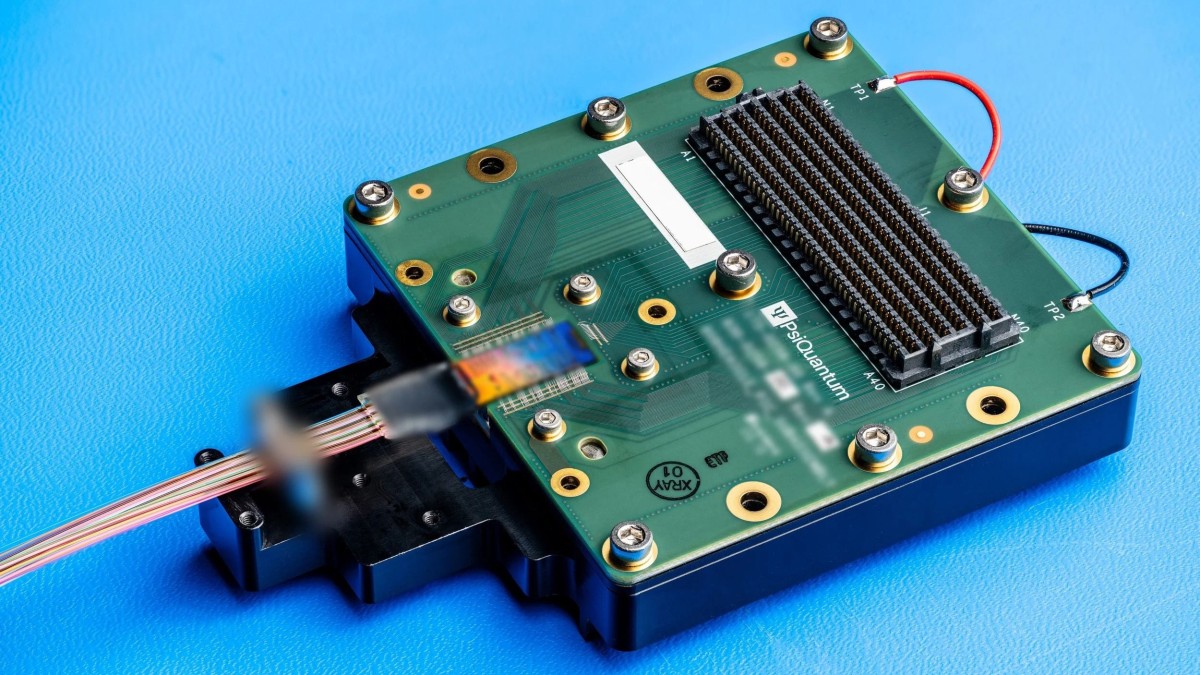
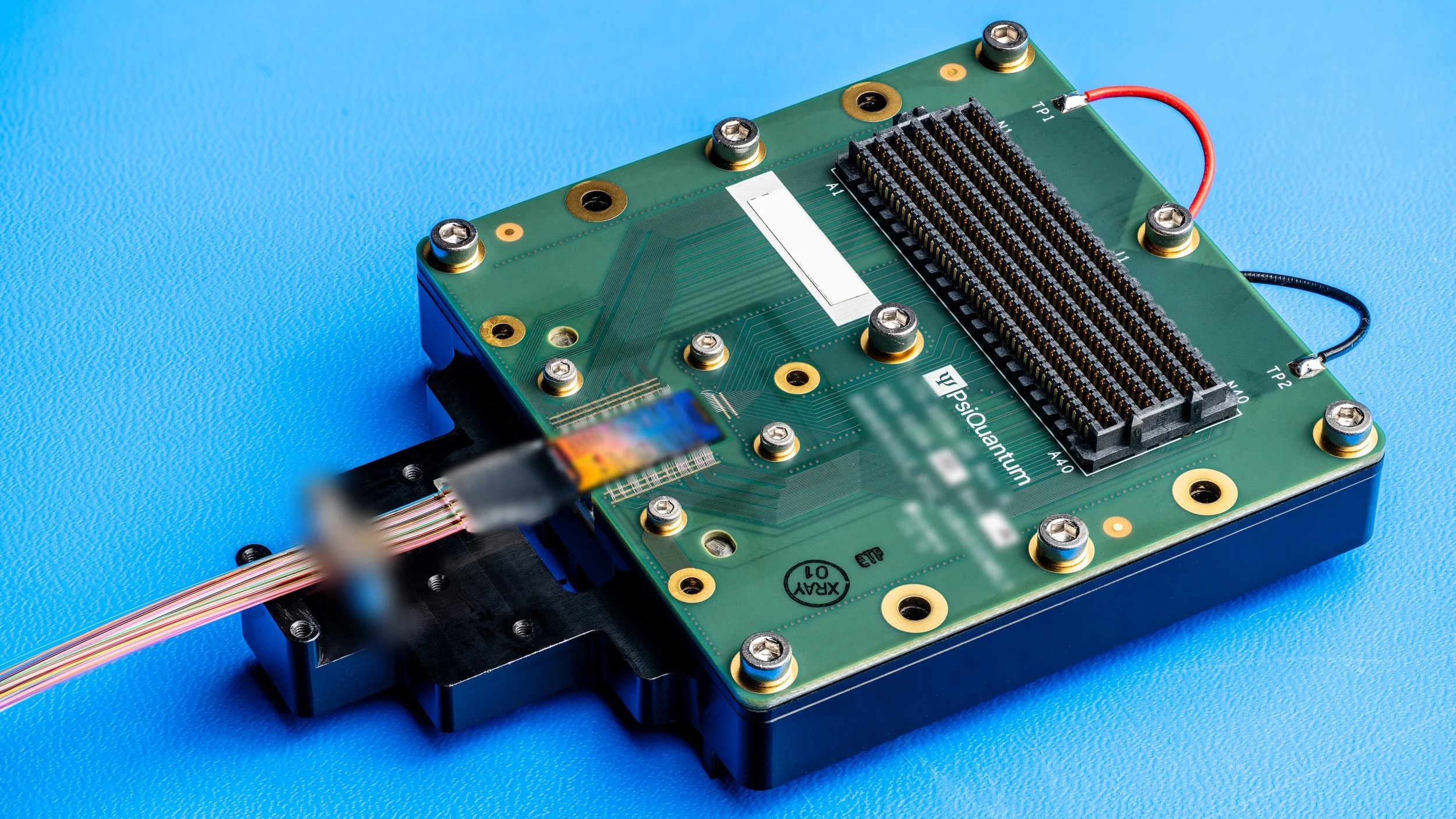
PsiQuantum, a quantum computing company, announced in a release earlier this week that it has turned its low-loss silicon photonics into an optical switch for use in AI data centers. Every optical switch typically comes with loss of light: the more light a switch receives, the less reaches the other side, with the amount of light lost measured in decibels. Typical data center optics can tolerate half the light (3 dB) being lost. PsiQuantum's switch debuted with a demo that typically loses only 1.2 dB of signal, or about a quarter of the light in lab tests, and the all-optical switch can achieve it without an amplifier. The prototype is, however, comparatively small, with eight inputs and outputs (8x8) against competitors’ 32 to 300, but the company says larger devices are in development.
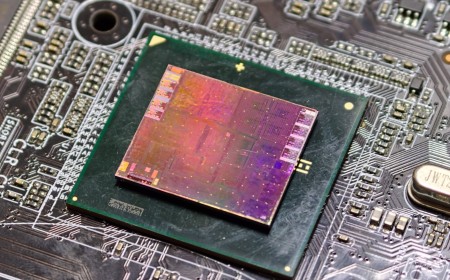
The optical circuit switch (OCS) passes light straight through, from fiber to fiber, without converting it to or from electrical signals. Regular data center switches make that conversion at every hop, which takes power and adds latency. An OCS, instead, uses a fixed light path that it maintains until a change is ordered. Its main penalty comes down to how much light is lost when passing through the switch. PsiQuantum’s switch, which uses circuits etched on a silicon chip with no moving parts, unlike Google’s and Lumentum’s tiny mirrors, or microelectromechanical systems (MEMS), would be used alongside regular packet switches.
Skipping those conversions matters more as AI clusters grow, because moving data between GPUs is quickly becoming a bottleneck. Optics are a high-bandwidth improvement over copper, which has limitations in reach, although a shortage of lasers is a problem for the alternative. Improving communication bandwidth and distance is the goal, so that different racks of GPUs can talk at speed and act as one.
Switches similar to PsiQuantum’s made by Salience Labs and iPronics use built-in amplification and, at least in the former case, are also rated at under 2 dB, or under 37% of the light lost. Google’s mirror-based switch, Palomar, can also typically stay under 2 dB and has 136 ports. Salience’s switch sits at 32 and Lumentum’s at 300, which leaves the eight-port prototype a ways behind on how many fibers it can handle.
Swipe to scroll horizontally
Optical circuit switches by loss and size
Switch
Ports (in × out)
Insertion loss, and what the figure is
Reconfiguration
How it switches
PsiQuantum 8×8 demo
8×8
1.2 dB (about 24% of the light lost), typical in the company’s lab tests
Under 3 ms
Silicon photonics chip, no amplification, no moving parts
Google Palomar
136×136
Typically under 2 dB (under 37% lost) across all port pairings; 2 dB worst case
Milliseconds
MEMS mirrors (moving parts)
Lumentum R300
300×300
Close to 1.5 dB (about 29% lost), typical at start of life, Lumentum’s switching GM told Gazettabyte
Not stated
MEMS mirrors (moving parts)
Salience Labs OC-32M
32×32
Under 2 dB (under 37% lost) port to port, a ceiling, after built-in amplification
Under 300 µs
Silicon photonics chip with amplification
iPronics ONE-32
32 (layout not stated)
Not published
Under 300 µs
Silicon photonics chip with optical amplifiers
PsiQuantum's switch is an 8x8, meaning eight in and eight out, and “every input can reach every output.” It’s also “strictly non-blocking,” so a new connection never disturbs ones already in place. In the lab, it measured a typical 1.2 dB insertion loss, 40 dB of crosstalk (about 0.01% of the light leaking to other ports), and under 3 ms of reconfiguration time, all of which exceed “initial targets set for these devices.” The loss figure is measured fiber to fiber, which includes getting light onto and off the chip but not connector losses, PsiQuantum told Tom’s Hardware Premium.
The platform loses very little light at each component, which matters because a quantum computer can tolerate only so much lost light. PsiQuantum’s 2025 Nature paper reports silicon nitride waveguides losing as little as 0.5 dB per meter (about 11% of the light per meter), splitters 0.5 millidecibels, and crossings 1.2 millidecibels, the last two a few hundredths of a percent of the light or less each.
The company also says chip-to-fiber coupling has reached about 60 millidecibels, roughly 1.4% of the light lost, in its best published lab results, although without a full fiber array attached. Those figures set a best case, not a worst case, for a 64-port switch, since light crosses more components as ports are added and the losses add up.
How much loss is acceptable varies with the optics at the end of each link. Coherent, an optics maker, says that using an OCS can add “up to 3 dB additional insertion loss,” but its transceivers are able to work with that. Lumentum told Gazettabytethat 3 dB is good enough to work with off-the-shelf FR4, DR4, and DR8 optical modules using the switch; those are the standard plug-in options used to link GPU servers and switches, at distances of 500 meters to 2 kilometers. PsiQuantum’s 8x8 is built for the O-band, the wavelength range those modules use. PsiQuantum told Semafor that, to be workable, its switch needed insertion loss under 2 to 3 dB.
The 8x8 prototype was designed for conventional data center traffic and comes in well below the 3 dB loss target in a request from Nvidia for proposals, the company says. The port count marks it as a demonstration vehicle, but PsiQuantum has a 64x64 version taped out with a 72x72 underway and is “actively developing larger devices.” With crossings that lose so little light, the scale-up might hold. PsiQuantum declined to share details on future products, though it says the loss, which may be slightly higher, will stay very low.
Speed remains less important than insertion loss for how OCSes are currently used. Google, which has the most deployments, numbering in the “tens of thousands,” uses its switches to resize TPU pods or to route around failed chips, a job its “millisecond-scale” MEMS switches handle. PsiQuantum’s under 3 ms is within that class, but Salience and iPronics claim less than 300 microseconds for their amplified chip switches, which iPronics highlights for mid-workload network rewiring to hide the switch time while chips compute.
There is quite a lot of room for speed to improve, and PsiQuantum already has a material for that, used in an existing 64-port switch for its quantum systems, which need to switch light at gigahertz rates. The material, barium titanate (BTO), changes how it bends light when a voltage is applied, and the company chose it over lithium niobate, a more common selection, because BTO had the strongest effect it could find. This keeps switching elements short and losses low at speeds roughly a million times faster than the demo. BTO is “not required for the demonstration vehicle or initial products,” which use a thermally switched silicon nitride platform, but it is “an additional path to faster, more advanced future products.”
An argument for starting now is that building thousands of such switches for conventional applications would reduce the risk for the packaging, assembly, and supply chain of parts PsiQuantum builds for quantum computing. AI and quantum computing are “complementary technologies,” it says, and this is the chance to put its technology into action. When PsiQuantum hired Rob Soderbery as an executive vice president in July, it said he would advance its silicon photonics platform, “accelerating its application across AI networking and other next-generation computing infrastructure,” hinting at the roadmap. The company’s CHIPS award was finalized in September for “high-performance optical switches,” among other components.
Co-founder Pete Shadbolt praised Google’s alternative MEMS switch but would prefer to have similar-quality switching on a monolithic chip that needs no moving parts. Nvidia has a stake through its venture arm, NVentures, and collaborates with PsiQuantum on “GPU-QPU integration,” that is, graphics and quantum processing units, as well as silicon photonics. Nvidia also joined rival iPronics’ $125 million round in September to develop its second-generation optical switch.
Right now, inside Google, OCSes rewire AI clusters, and research firm Cignal AI expects most deployments to stay there through the end of the decade; outside of Google, OCS is still at “proof-of-concept and early trial.” The firm raised its market estimates earlier this year, though, roughly threefold for 2026 and by more than 40% for 2029. An opening exists for PsiQuantum in GPU networks, which ties into Nvidia’s interest, though adoption there is expected to be limited until then. The company says samples and testing kits have already gone to several computing companies, including GPU vendors and hyperscalers.
PsiQuantum should have commercial products “announced in the coming months,” along with updates on larger devices, while competitor Salience has already demonstrated 64 ports at this year’s European Conference on Optical Communication. Salience’s roadmap already has 128- and 256-port products. Scaling is always an issue, but if PsiQuantum’s figures, which haven’t been independently verified, hold up at 64 ports without amplifiers, then larger monolithic OCSes are on the way.
Shane Downing is a Contributing Writer for Tom’s Hardware, covering consumer storage, PC hardware, and AI.


 (Image credit: PsiQuantum)
 Like
0
 Dislike
0
 Love
0
 Funny
0
 Wow
0
 Sad
0
 Angry
0








Comments (0)