

Rocket Report: SpaceX completes launch triple-header; Rocket Lab nets big contract
Blue Origin seeks FAA approval for up to 50 New Glenn launches and 50 booster landings per year.
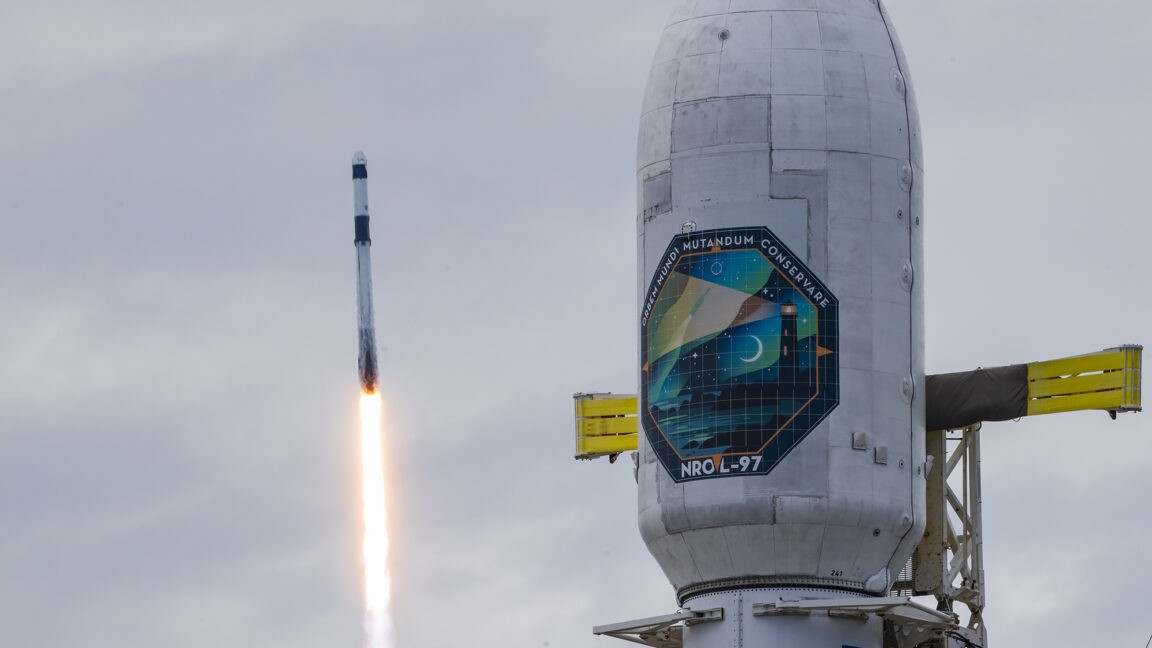
A Falcon 9 rocket climbs into the sky to begin the Crew-13 mission to the International Space Station as a Falcon Heavy rocket awaits its launch window Thursday about 3.5 miles away at Kennedy Space Center, Florida. Credit: SpaceX
Welcome to Edition 9.13 of the Rocket Report!
This week, SpaceX celebrated the first orbital launch of its new Starship rocket. I’m not sure many people, at least those outside of SpaceX, expected it to take 14 flights of Starship before it technically reached low-Earth orbit, but Monday morning’s launch finally added that to SpaceX’s list of accomplishments with its new super-heavy rocket. Starship had gone 99 percent of the way to orbit before, only held back by safety concerns around the possibility of stranding the huge rocket in space.
What was most notable for SpaceX with this Starship flight was that it unlocked a massive growth potential for Starlink, with the first 26 of the network’s new-generation Starlink V3 satellites successfully deployed Monday.
As always, we welcome reader submissions, and if you don’t want to miss an issue, please subscribe using the box below (the form will not appear on AMP-enabled versions of the site). Each report will include information on small-, medium-, and heavy-lift rockets as well as a quick look ahead at the next three launches on the calendar.

Rocket Lab scores its biggest launch contract yet. Rocket Lab has signed what it calls its largest Electron launch service agreement to date, a 20-mission agreement with Synspective, Aviation Week & Space Technology reports. Synspective is a Japanese company with a growing fleet of radar Earth-imaging satellites. It is one of Rocket Lab’s most loyal customers, with the company’s light-class Electron rocket having launched 13 of Synspective’s StriX radar sats since 2020. The most recent Rocket Lab launch for Synspective occurred last Friday, September 25.
Dedicated launch … Rocket Lab’s Electron launch vehicle is sized for dedicated launches of payloads like Synspective’s StriX satellites. The latest agreement extends Synspective’s total bookings with Rocket Lab to 47 launches, including the 13 already flown. “Signing 20 launches in a single deal is a massive vote of confidence not just in Electron but in the launch cadence, mission reliability, and orbital precision that Rocket Lab consistently delivers,” Rocket Lab’s founder and CEO, Peter Beck, said in a statement.
Portuguese company acquires what’s left of Orbex. A Portuguese space technology business has snapped up the assets of Orbex, the Scottish rocket maker that collapsed earlier this year, the Scotsman reports. The buyer, Omnidea, plans to establish its UK operations at Orbex’s former manufacturing facility in Scotland, having agreed to a deal to acquire the assets and intellectual property (IP) of the defunct rocket developer. An initial team of ex-Orbex employees will join the business, with Omnidea planning to recruit further as the operation develops.
No Prime resurrection … Omnidea, once a partner of Orbex, says it plans to use its new Scotland base as a center for “structures development and fabrication” and as a “hub for flight and ground system electronics.” Omnidea is a supplier of propulsion, fluid control, avionics, and thermal management components in the European space industry, but the company is also exploring other markets. It looks like Orbex’s Prime rocket, which never ventured near a launch pad, is still dead.
Keep up with the latest in space exploration and rocket launches.

Crew-13 launches toward ISS. A four-person crew rocketed into orbit Thursday from Cape Canaveral Space Force Station, Florida, heading for a six-month expedition on the International Space Station, Ars reports. Riding a Falcon 9 rocket and Dragon spacecraft, the four crew members departed from Space Launch Complex-40 at Cape Canaveral at 11:10 am EDT. Nine minutes later, they were in orbit to begin closing in on the space station for docking Thursday evening.
Some notes … This mission is nothing particularly new for SpaceX (it’s the company’s 21st human spaceflight launch). But it is noteworthy for a few reasons. The commander, Jessica Watkins, became the first Black woman to lead a mission into space. Her crewmate, Canadian astronaut Joshua Kutryk, went to space while he and his wife are expecting their third child later this year.
It’s rare, but astronauts have been off the planet for their child’s birth before. Most recently, NASA astronaut Randy Bresnik, set to command the Artemis III mission next year, was flying aboard the Space Shuttle Atlantis in 2009 when his wife gave birth to their daughter in Houston. This launch was delayed several weeks to fix a leaky valve on Dragon’s propulsion system, work that involved cutting out the suspect valve and welding in a new one, an unusual but apparently successful repair method.
Canadian company pursues medium-lift rocket. More countries are becoming interested in developing their own access to space, including those that have historically paid US companies to launch their satellites. Canada is no different, and the Trump administration’s seeming obsession with lobbing threats and tariffs across the northern border has only crystallized Canadian interest in sovereign access to space.
This spring, the Canadian government announced the first awards to three companies—NordSpace, Reaction Dynamics, and Canada Rocket Company—to support work on rockets with “light lift” capability. Now, one of these rocket developers, Canada Rocket Company, says it is skipping over the small launch segment and going straight to a more ambitious medium-lift rocket, Ars reports.
R-2 V2? … Canada Rocket Company is following the lead of several US launch providers in going for a bigger rocket. “The advice we got from having spoken with about 150 engineers, from the director of Starship engineering all the way down to some entry-level folks, is that you’re not going to be able to de-risk a rocket development program by building a smaller rocket,” said Hugh Kolias, chief executive of the Canada Rocket Company, in an interview with Ars.
The company’s R-2 rocket somewhat resembles SpaceX’s Falcon 9 in renderings, with nine engines and landing legs that signal a future path toward reuse of the first stage. It could carry up to 12.5 metric tons to low-Earth orbit. If all goes well, Kolias said, the company could be ready to launch by 2032.
SpaceX rideshare launch deploys 130 payloads. An artificial intelligence prototype from Google, a methane-tracker, pharmaceutical manufacturing labs, and more hitched a ride onboard a SpaceX Falcon 9 rocket from Vandenberg Space Force Base, California, on Thursday afternoon, Spaceflight Now reports. The rideshare mission, known as Transporter-18, carried 130 payloads into a polar Sun-synchronous orbit. It was SpaceX’s second launch of the day, following the successful flight of NASA’s SpaceX Crew-13 mission from Florida a few hours earlier.
Bread and butter … Much of the growing ecosystem of commercial satellite startups sees SpaceX’s rideshare launches as key enablers to their businesses, offering relatively inexpensive access to space on a predictable schedule. These kinds of launches, at least on Falcon 9, will likely go away in a couple of years as SpaceX transitions to the much larger Starship rocket. But for now, a bevy of satellite companies continue relying on Falcon 9 launches. The customers on Transporter-18 ranged from tech powerhouses like Google to scrappy startups like Starfish Space, alongside top remote sensing companies such as Planet Labs and ICEYE.

Starship reaches new heights in low-Earth orbit. SpaceX’s Starship rocket thundered into the sky over South Texas early Monday. It was the 14th test flight of the world’s most powerful launch vehicle. This time, however, the rocket’s massive upper stage squeezed out some extra oomph from its Raptor engines and accelerated to orbital velocity, Ars reports.
On all of Starship’s previous flights, SpaceX intentionally dialed back the full capability of the rocket to fly a suborbital trajectory, slow enough for Earth’s gravity to pull the vehicle back into the atmosphere before it could complete a full lap around the planet. After several successful suborbital flights in a row, SpaceX officials decided this launch should go all the way to low-Earth orbit. And it did.
Debuting Starlink V3 … What’s more, SpaceX packed 26 of the company’s newest generation of Starlink broadband satellites into the rocket’s cargo bay. One by one, the flat-packed satellites—too large to fit inside SpaceX’s workhorse Falcon 9 rocket—were released from Starship’s payload deployer using a system of pulleys and cables to eject the satellites overboard like a Pez dispenser spits out candy. SpaceX cut a planned 10-hour test flight to three hours after one of the ship’s Raptor engines failed during ascent, but the vehicle was still able to make a pinpoint splashdown at one of its backup return sites north of Hawaii.
NASA will pay to human-rate ULA’s Vulcan rocket. NASA announced on Monday that it will exercise options to purchase two additional flights on Boeing’s Starliner spacecraft, as well as financially support the company in its efforts to return the crewed vehicle to flight and find a new rocket after the Atlas V vehicle retires, Ars reports. NASA is making the moves to preserve a path for its astronauts to low-Earth orbit as SpaceX nears retirement of its Falcon 9 rocket and Crew Dragon spacecraft. When that happens, Boeing’s troubled Starliner spacecraft will likely be the only commercial means of launching US crews to orbit.
A post-Atlas future … During a news conference on Monday, Dana Weigel, manager of NASA’s Low Earth Orbit Program, said the space agency would pay $359 million to Boeing to help the company complete a rebuild of the reaction control system thrusters that have overheated in flight. It would also certify United Launch Alliance’s Vulcan rocket for human missions. NASA also said it would exercise options to order two additional crewed missions on Starliner, bringing its total spaceflights on the vehicle to six. Any future Starliner flights beyond that would require a new rocket, like ULA’s Vulcan, as the Atlas V rocket is no longer in production.
SpaceX completes three launches in 13 hours. SpaceX pulled off two Falcon 9 rocket launches and a Falcon Heavy mission in less than 13 hours Thursday, marking one of the busiest days ever for the company’s launch teams. The action began, as noted previously in the Rocket Report, with a Falcon 9 launch from Cape Canaveral, Florida, carrying the next four-person crew to the International Space Station. A few hours later, another Falcon 9 lifted off from California on a rideshare mission. The launch of SpaceX’s triple-body Falcon Heavy rocket with a classified National Reconnaissance Office payload from Kennedy Space Center, Florida, rounded out the triple-header Thursday night.
And four landings … This was the first time a Falcon Heavy rocket has launched a payload for the NRO, the US government’s spy satellite agency. Little is publicly known about the payload except that it launched into a highly inclined orbit, flying northeast from Florida’s Space Coast. To add an extra flourish to the launch triple-header, SpaceX returned both Falcon 9 boosters to their launch sites in Florida and California and landed both side boosters from Falcon Heavy back at Cape Canaveral Space Force Station. That makes three launches and four landings (plus a Dragon docking at the ISS) in one day.
Blue Origin foresees growing launch cadence. As Blue Origin continues to recover from a New Glenn pad explosion in May, the company is seeking permission to significantly increase the vehicle’s launch rate, Space News reports. This is a big surprise, but a draft environmental assessment released this week puts some numbers to Blue Origin’s plans. The company is seeking permission from the FAA to increase the rate of New Glenn launches from Cape Canaveral Space Force Station’s Launch Complex 36 from 12 to 50 per year.
Reuse built in … The proposal would include 50 launches of the rocket and 50 landings of the rocket’s first stage on a drone ship in the Atlantic Ocean. It would also allow up to 100 static-fire tests, one for each stage of the rocket for each launch. The proposal also covers recovery of the rocket’s payload fairing, which Blue Origin has not attempted on any of the three launches of New Glenn to date.
Next three launches
October 5: Falcon 9 | SDA Tranche 1 Transport Layer A | Vandenberg Space Force Base, California | 08:17 UTC
October 7: KSLV-2 | NEONSAT 2-6 | Naro Space Center, South Korea | 03:23 UTC
October 9: Long March 12 | Unknown Payload | Wenchang Space Launch Site, China | 19:25 UTC


Stephen Clark is a space reporter at Ars Technica, covering private space companies and the world’s space agencies. Stephen writes about the nexus of technology, science, policy, and business on and off the planet.
What's Your Reaction?
 Like
0
Like
0
 Dislike
0
Dislike
0
 Love
0
Love
0
 Funny
0
Funny
0
 Wow
0
Wow
0
 Sad
0
Sad
0
 Angry
0
Angry
0









Comments (0)