

Scientists Find a ‘Ghostly Green’ Star, and That’s Not the Only Crazy Color
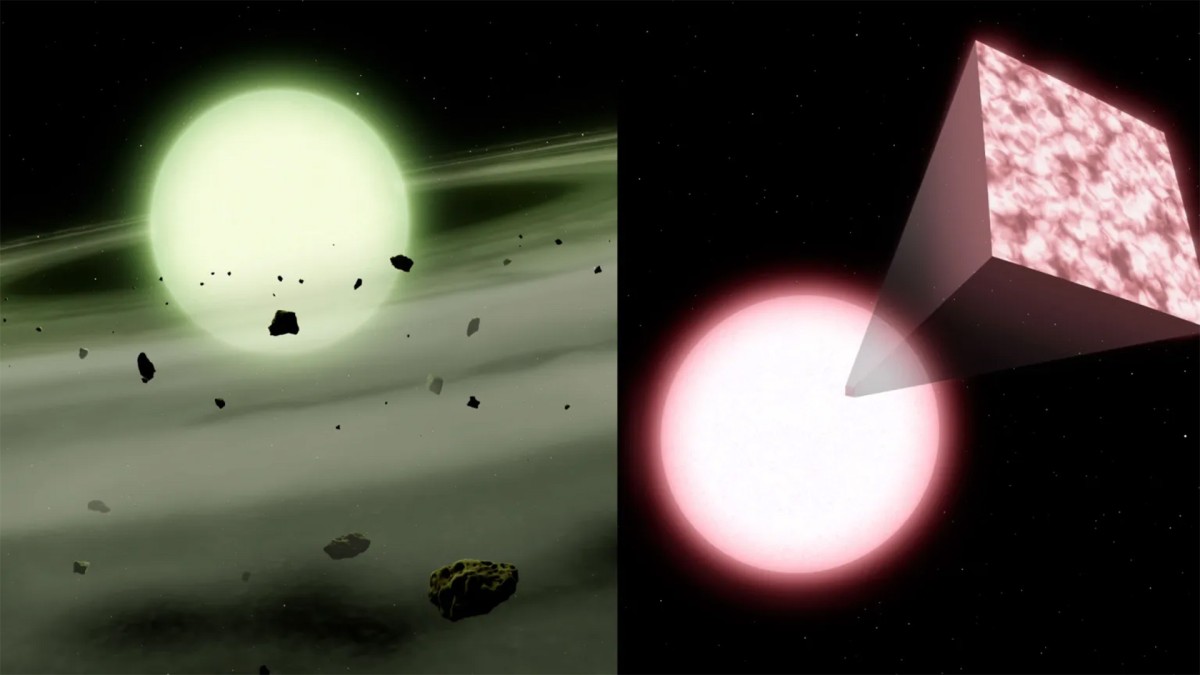
High school science class taught us that stars come in very specific colors. You have cooler stars that are red, orange and yellow. Then you have hotter, larger stars that are white and blue. It turns out that much like the wind in the movie Pocahontas, stars also come in all sorts of colors, including green and pink.
The discovery was outlined in a study published this month in RAS Techniques and Instruments. According to the lead author, Mark Hollands of Warwick University’s astronomy and astrophysics group, the humble white dwarf star is the centerpiece of this chromatic curiosity.
“Most stars, including most white dwarfs, behave like ‘perfect radiators,’ so their color is set almost entirely by temperature. But nobody had really looked into what else might be possible for white dwarfs,” Hollands said in a statement. “It turns out these incredibly dense stars can produce colors nobody expected, and some of them genuinely surprised me.”
Hollands says that the key is density and atmosphere. White dwarfs are among the densest objects in the known universe, and that also includes the atmosphere around the white dwarf. Thanks to the intense gravity, a white dwarf’s atmosphere — which is composed primarily of hydrogen and helium — can have some interesting interactions with trace amounts of other elements that are present.
“For white dwarfs with a cool, helium-dominated atmosphere, as the star gets cooler, the helium becomes more and more transparent, which means you can see further into the star where the gas gets denser,” Hollands told CNET in an email. “When you have trace elements in the star, whether it’s metals like sodium and calcium from a planetary system, or carbon from the core, they interact with the dense helium.”
These interactions cause the trace elements to absorb light across the wavelength, for a wider range of “missing” colors. The result is a white dwarf that could appear in any number of colors based on what trace elements it absorbed.
So, there are green stars out there?
 Most white dwarf stars are indeed white but they can come in all sorts of cool colors. Mark Hollands/University of Warwick
That is precisely what Hollands and his team found in their research. To date, no one has ever seen a white dwarf star with human eyes, and none is close enough to be seen directly. Most analysis of a star is done with spectroscopy, so scientists know what a star is made of and how bright it is. Typically, scientists focus more on the science and things like chemical makeup and brightness, rather than color.
“As astronomers, we spend more time thinking about the technical questions about physics,” Hollands said. “It’s a very simple question to ask, ‘what do these stars actually look like when you visit them,’ something I see members of the public ask all the time. It turns out it wasn’t actually too difficult to answer.”
Hollands and his team used the same data for 151 white dwarf stars and ran it through a simulation that converted it to human color vision. Of those, 146 were pretty normal, averaging about 6,800K in color temperature. These would appear bright white to humans, with maybe the tiniest hint of blue.
The other five results were a lot more interesting: The team found examples of cyan, yellow, purple/violet, pink and, yes, even green. The green star is called WD J1330+6435, and it is a white dwarf that sits in a rocky planetary system. The debris from that system gets pulled into the star, lending it the trace elements needed to turn a “ghostly green,” per Hollands.
Another interesting find was WDJ0902+2010, a star that has a ton of carbon in its atmosphere. According to the study, this cooler white dwarf churns up carbon from its innards, and the carbon in the atmosphere absorbs light across the spectrum. It results in a star that would appear salmon-pink to humans.
Since the researchers could find no other credible reports of a green star being discovered before, WD J1330+6435 is likely the first green star ever discovered. Hollands said that the pink and cyan colors were also likely firsts, as there aren’t any reports of astronomers finding stars in those colors either.
Unfortunately, the stars won’t stay in these colors forever. Hollands says that white dwarfs start out intensely hot — about 100,000 degrees Kelvin — which would give them a “sky blue color.” This changes as the white dwarf cools, and you only get the really cool colors when it reaches about 5,000K or so. Eventually, the high gravity will pull the trace elements into the core of the star, changing it back to its normal white or orange colors.
The lone exception is the pink star. Since its carbon already comes from within the star, the star’s natural convection forces are causing that color. That means WDJ0902+2010 is likely to remain pink for billions of years, whereas the rest will likely shift back to their natural colors after a few million years.

Joe is a freelance journalist. It all started with a long-running affection for building his own PCs, which he did for the first time as a teenager. It evolved into a lifelong enjoyment of putting words on the internet about the subject. He's written for CNET, PCMag, Mashable and SlashGear as a freelance writer, and worked as a Senior Editor at Android Authority for 10 years. When he's not writing about tech and science, he's learning the ins and outs of DIY home repair, gaming, playing his bass guitars and posting help on PC building and gaming subreddits. He is a staunch believer that orange juice should have pulp. See full bio
What's Your Reaction?
 Like
0
Like
0
 Dislike
0
Dislike
0
 Love
0
Love
0
 Funny
0
Funny
0
 Wow
0
Wow
0
 Sad
0
Sad
0
 Angry
0
Angry
0











Comments (0)