

Seestar S30 Plus vs. S30 Pro: What You Give Up and What You Keep
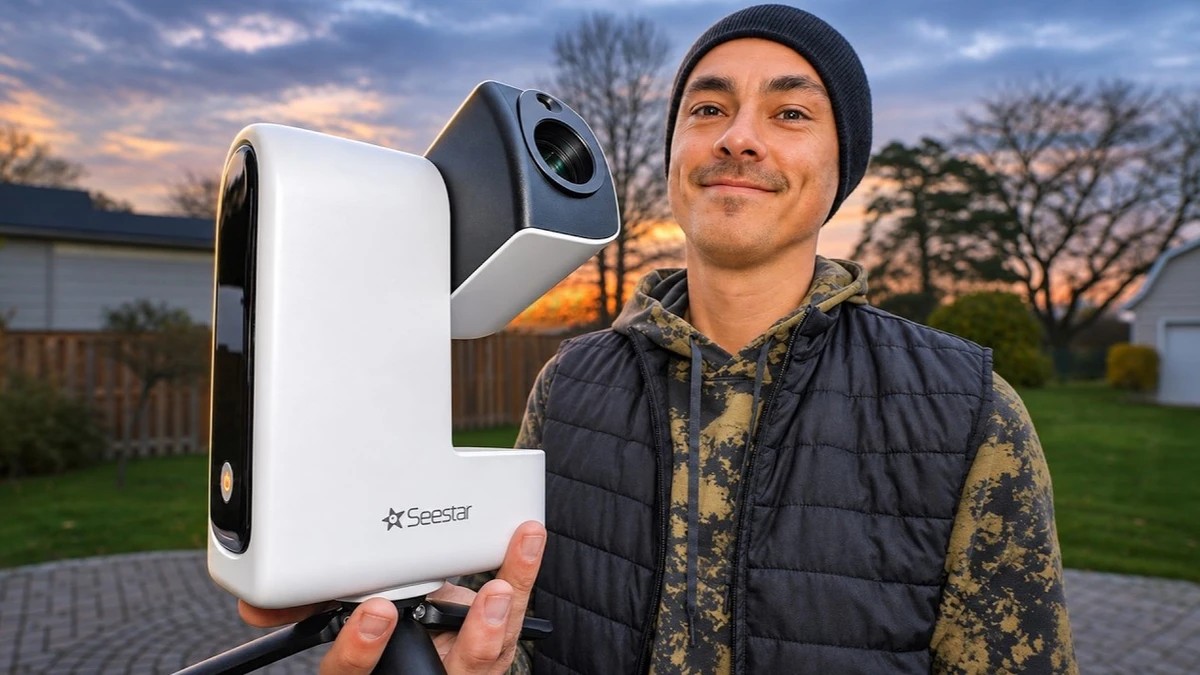
ZWO now sells three versions of its Seestar S30 smart telescope, and the new S30 Plus lands between the original and the Pro in price and capability. If you want a complete deep-sky imaging system that fits in a small case, the differences between those three models decide how much of a galaxy or nebula you can actually get into one frame.
Trevor Jones of AstroBackyard spent about a week shooting with the ZWO Seestar S30 Plus from his backyard, and he describes it plainly. Next to the ZWO Seestar S30 Pro, it gives up resolution, field of view, and storage, while still improving on the original Seestar S30. The main optics match the Pro exactly: a 30mm aperture, a 160mm focal length, and a four-element apochromatic design. Like its siblings, it combines the telescope, cameras, tracking, and stacking in one unit weighing just under 4 pounds. You pick a target in the app, it finds and tracks the object, and you watch the image build on your phone with no eyepiece involved. Large nebulae and big galaxies like Andromeda suit it well, while detailed planetary close-ups are out of reach at this focal length. Since the glass is shared with the Pro, the decision between the two comes down almost entirely to the camera, and to the $200 between the Plus at $499 and the Pro at $699.
The camera is where the gap shows. ZWO calls the system "dual 2K," with each camera producing a tall, phone-shaped frame of 1,440 x 2,560 pixels. That works out to about 3.7 megapixels, between the original S30's roughly 2.1 and the Pro's 8.3. On his phone, Jones couldn't see an obvious difference from the Pro while the Andromeda Galaxy built up in the live stack. On a computer, the story changes: the Pro takes in nearly the entire galaxy, while the Plus crops in noticeably tighter. The files are still large enough for social media and a decent print if you're comfortable in Photoshop, and when Jones compares his own PixInsight stacks with the files the telescope stacks internally, the two come out very close, so either one gives you about the same starting point for further processing. The exception was a Horsehead session where the Seestar kept stacking through high clouds, which ruined its internal file.
Smart telescopes have become one of the fastest-growing corners of astrophotography, with the Seestar line competing alongside the DWARFLAB DWARF 3, the Vaonis Vespera II, and Unistellar's eQuinox 2. A few years ago, a first deep-sky image meant a tracking mount, a guide camera, a laptop, and a steep learning curve. Now the main question is framing, and framing follows a simple rule: field of view comes from focal length and sensor area together. Keep the 160mm optics the same and use a smaller slice of sensor, and you get a tighter view, much like cropping. Andromeda spans roughly 3 degrees of sky, about six full moons side by side, so a wider frame helps there. Smaller targets such as the Butterfly Nebula fill more of a tighter frame, and that crop can work in your favor. Before picking a model, list the objects you actually want to shoot and preview them with a framing tool like the Oculars plugin in Stellarium, which overlays a sensor's footprint on the sky.
Jones tested both tracking modes. In alt-az, 10-second exposures gave sharp stars, and that mode keeps things simple while you learn the app. He prefers EQ mode, where you tilt the tracking axis toward the celestial pole to stop the field rotation that alt-az produces, and he settles on 30-second subs instead of pushing to 60. The included mini tripod handles alt-az fine, but EQ mode needs a photo tripod that can tilt, and you have to switch the mode in the app each time you change setups. For filters, the built-in "light pollution" filter is really a dual-band filter passing hydrogen-alpha and oxygen III, which suits emission nebulae like the Horsehead. Galaxies, star clusters, and reflection nebulae call for the UV/IR cut filter instead, even from a bright city backyard. The wide-angle camera adds star trails, time-lapses, and a handy way to check sky conditions from indoors, though it can't run at the same time as the main camera, and the Plus doesn't support the wide-field mosaics found on the Pro.
The battery is rated for about six hours with the dew heater off. On nights just above freezing, with heavy condensation and the heater running, it dropped to 80% quickly, so Jones ran the telescope all night from a portable power station, and he suggests planning on external power if you image through cold, damp nights. File transfers crawled through his powered USB hub and improved over a direct cable to his PC, though the telescope timed out and shut itself down before he finished looking through the files. Of the 65 GB of storage, about 45 GB is usable, and at roughly 7 MB per FITS file, that holds several nights of data. With the supplied solar filter fitted, he can be imaging sunspots about three minutes after carrying the telescope out of the garage, which makes the Plus a candidate for the next solar eclipse if you leave room for the large video files.
Jones sees the Plus as a good fit for a first-time buyer who wants bigger images than the original S30 without paying for the S30 Pro, and his Andromeda frames from the Plus and the Pro, set side by side in the video, show just how much tighter that crop is.
What's Your Reaction?
 Like
0
 Dislike
0
 Love
0
 Funny
0
 Wow
0
 Sad
0
 Angry
0











Comments (0)