

Sigma’s 50-120mm F2.8 OS DC is an APS-C legend in the making, for just $799
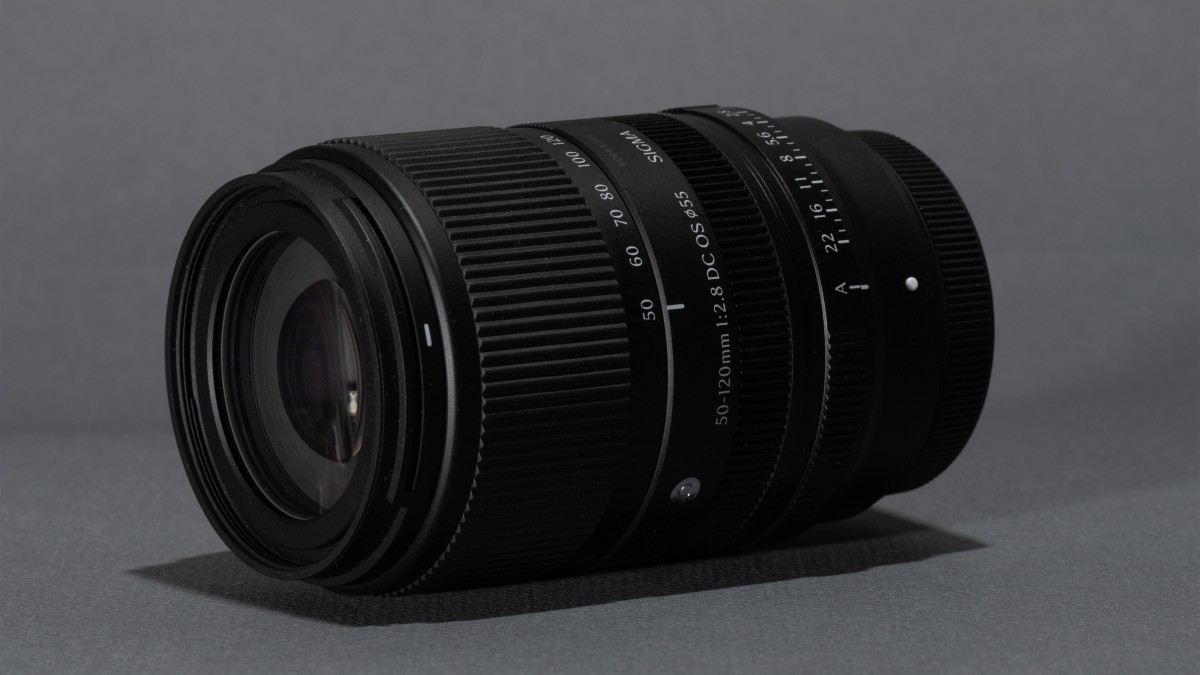
Fast 75-180mm equiv lens is coming to most of the popular lens mounts and is smaller than you can believe
 Richard Butler
Sigma has announced the 50-120mm F2.8 OS DC | Contemporary, a fast telezoom for APS-C mirrorless cameras. The lens delivers a 75-180mm equivalent range for Fujifilm X or Sony E mount cameras and an 80-192mm equiv range for Canon RF users.
The lens is a spiritual successor to the excellent APO 50-150mm F2.8 EX DC HSM from 2006, but manages to add stabilization and downsize considerably.
At just 67mm wide and 99mm long (3.90 x 2.63″) for the E-mount version, the lens is smaller than a standard can of Coke (both the 330ml and 12oz versions). Its length extends by 25% when zoomed to its full extreme but is still only a fraction longer (5mm/0.2″) than Canon’s RF 70-200mm F4 in its retracted form. It weighs 390g (13.8oz), which again is remarkably similar to the weight of a full can of Coke.
 The Sigma 50-120mm F2.8 OS DC alongside the Fujifilm XF 50-140mm F2.8 LM OIS WR, showing the size difference.Richard Butler
The 50-120mm completes a trio of F2.8 zooms for APS-C mirrorless, alongside the existing 10-18mm F2.8 and 18-50mm F2.8 lenses. Despite its longer range and similarly bright aperture, it shares a 55mm filter thread with the 18-50mm. It’s the only member of the F2.8 DC set to have a dedicated aperture ring and image stabilizaton.
That stabilization is rated at 6.5 stops of correction at 50mm and 4.5 stops at the 120mm long end, per tests conducted to CIPA’s standard methodology.
 The Sigma 50-120mm F2.8 OS DC alongside the Fujifilm XF 50-140mm F2.8 LM OIS WR, showing the size difference when the Sigma is extended to its full zoom position.Richard Butler
The new lens uses a “high response linear actuator” for autofocus and has seemed swift and reliable from our usage so far, though we’ve not been trying sports shooting with it just yet.
The optical design utilizes 18 elements in 13 groups, including one fluorite-like FLD element, three super-low dispersion elements and four aspherics. The company says it’s been designed to exhibit minimal focus breathing, to extend its usefulness to video. It features 11 rounded aperture blades to keep bokeh circular.
 The Sigma 50-120mm F2.8 OS DC alongside Canon’s retractable RF-mount 70-200mm F2.8L IS, both lenses extended to 100mm-equivalent positions. A fairer comparison would be the RF 70-200mm F4, which is still 25% wider and 20% longer, in its retracted position. And around twice the price.Richard Butler
The lens barrel features a zoom ring, focus ring and a dedicated aperture ring (on the Sony and Fujifilm versions, at least) with an ‘A’ position. The Canon RF version will have a smooth-rotating control ring instead of an aperture ring.
As part of the Contemporary series it’s been designed to be dust and splash resistant. Its presence in Sigma’s more affordable line also means it’s priced at a remarkably reasonable $799.
Shooting experience
I’ve been shooting with a Fujifilm mount version of the lens for a week or so and I’m still caught off-guard occasionally that I’m using a 70-180mm equivalent, rather than a standard zoom.
 Sigma 50-120mm F2.8 on a Fujifilm X-H2 @ 120mm | F3.6 | 1/500 sec | ISO 160Richard Butler
The aperture ring, the first on one of Sigma’s DC zooms for mirrorless, works nicely with the X-T4 and X-H2 bodies I used it on, though I did wish the lens could be locked in or out of the A position, rather than it simply being spaced a little further beyond F22.
For the size and the price, I was willing to forgive some pretty major image quality issues but didn’t encounter too many.
Close focus isn’t this lens’s strength, with the corners getting extremely soft and swirly if you shoot a flat subject a 50mm. Things are a lot more predictable near minimum focus distance at the long end of the zoom.
The swirliness makes a reappearance in the bokeh at times, but not in a way I found objectionable. In general, I found the bokeh to be soft and attractive, without any fussiness, which isn’t always a given for a fast tele zoom.
 Sigma 50-120mm F2.8 on a Fujifilm X-H2 @ 120mm | F2.8 | 1/350 sec | ISO 125Richard Butler
In general, sharpness seems impressive, despite the use of X-Trans sensors, which our standard lens processing doesn’t always show to its best effect. There appears to be a small degree of pincussion distortion being corrected at both ends of the zoom, but nothing dramatic (it doesn’t appear to account for the close-focus strangeness at short focal lengths).
 Sigma 50-120mm F2.8 on a Fujifilm X-T4 @ 120mm | F5.6 | 1/680 sec | ISO 160Richard Butler
It’s hard for me to be completely dispassionate about a lens that I’ve been hoping someone would make, for years, but I’m genuinely stunned by how small and easy-to-carry Sigma has managed to make the 50-120mm F2.8 OS. I look forward to shooting it for longer, once RF-mount versions are available, to see how it behaves on the EOS R7, since that’s currently the highest-res Bayer APS-C sensor.
As always, we’ve included Raws for download in our gallery, including some close-focus examples and a couple of aperture comparisons, so you can make your own assessment.
Loading gallery…
Want to stay up to date on the latest product news and releases? Add DPReview as a preferred source to ensure our independent journalism makes it to the top of your Google search results.
What's Your Reaction?
 Like
0
Like
0
 Dislike
0
Dislike
0
 Love
0
Love
0
 Funny
0
Funny
0
 Wow
0
Wow
0
 Sad
0
Sad
0
 Angry
0
Angry
0











Comments (0)