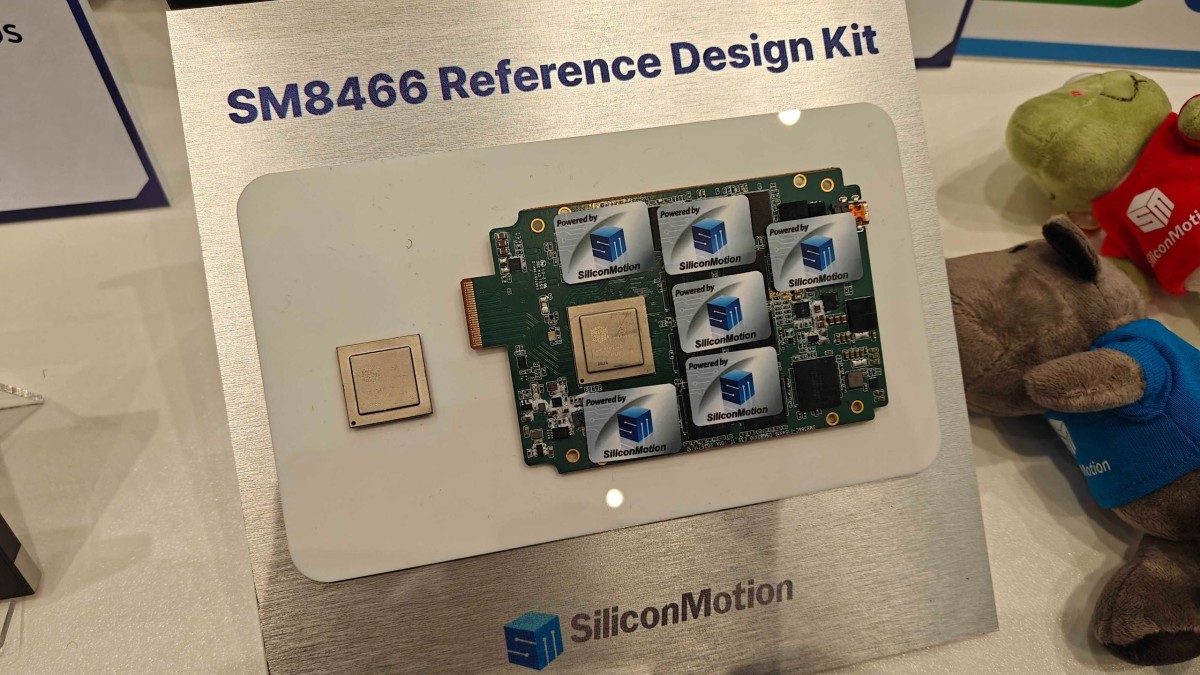
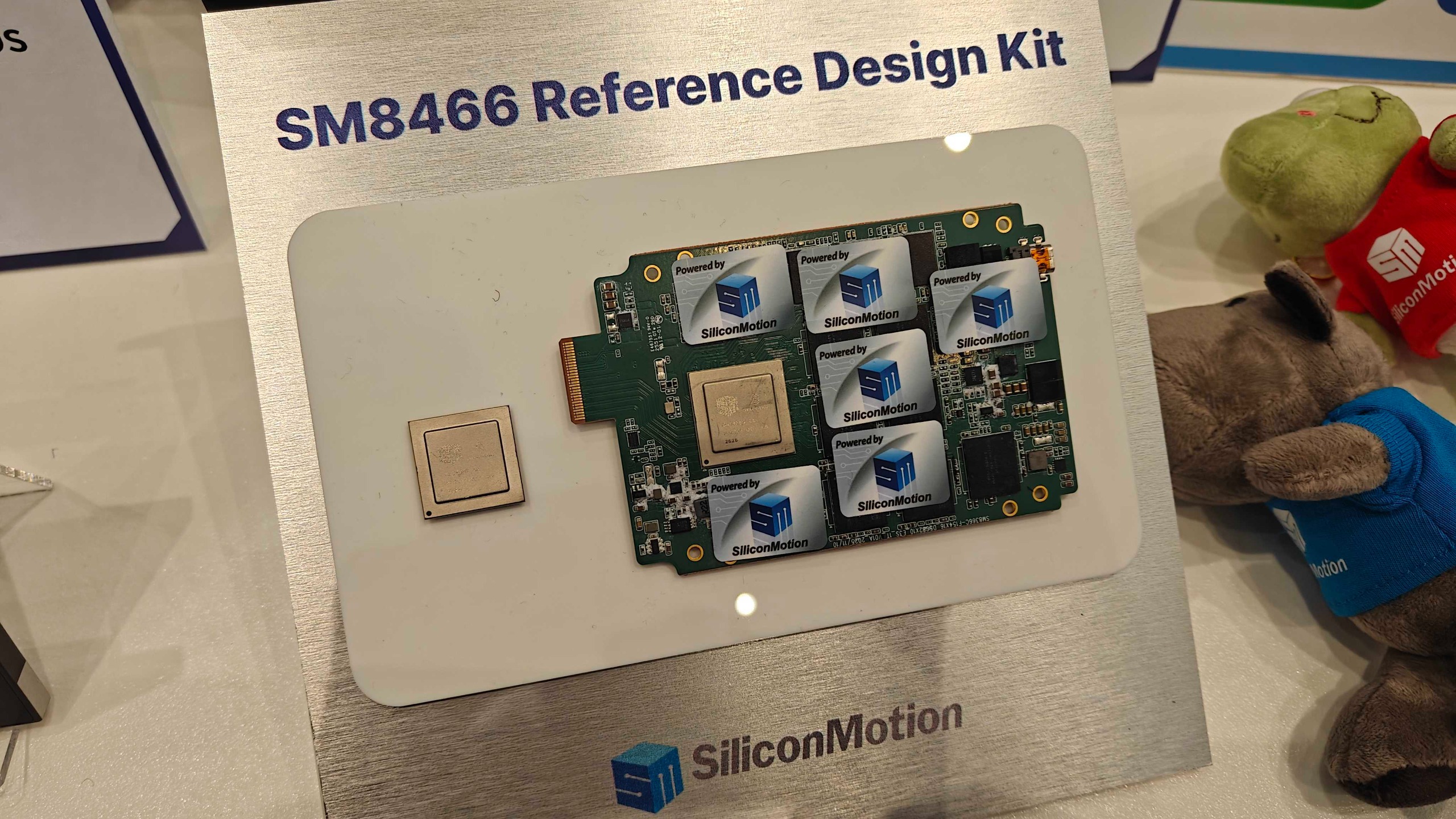
Silicon Motion is showing off its PCIe 6.0 SSD controller for data center applications for the first time at the SC26 conference in Chicago. The final iteration of Silicon Motion's SM8466 controller was taped out recently, and drives based on the chip are due in late 2027 or early 2028. However, the new controller also has a secret weapon designed to ensure consistent performance of SSDs under concurrent workloads that may set it apart from competitors.
The new controller
Silicon Motion introduced its high-end MonTitan SM8466 enterprise SSD controller designed for next-generation data center and hyperscale storage applications at FMS 2025. The controller features a PCIe 6.x x4 host interface and 16 NAND channels to enable sequential transfer speeds of up to 28 GB/s, random performance of up to 7 million 4K IOPS, and capacities of up to 512 TB and beyond as newer 3D NAND devices emerge. Just like other high-end data center-grade SSD controllers released in recent years, the SM8466 complies with NVMe 2.0 and OCP NVMe 2.5 SSD specifications.
(Image credit: Silicon Motion)
To improve performance and reduce latency, Silicon Motion has developed its Separate Command Architecture (SCA), which separates command and address transmission paths within the NAND interface to improve parallelism and increase effective throughput. Additionally, the controller supports Silicon Motion's 2nd Generation PerformaShape technology, which enables programmable performance limits and predictable quality of service (QoS) across concurrent workloads, which is arguably its most important differentiator against rivals who rely on different methods of guaranteeing performance.
In addition to its performance chops, the MonTitan SM8466 incorporates advanced error correction, virtualization, data protection, and security features. The controller's error correction engine supports low-density parity-check (LDPC) codes with 4KiB codewords and Silicon Motion's 16KiB Collaborative Codeword (CoCo) technology to improve data integrity and reliability with advanced NAND flash memory. The controller also supports Single Root I/O Virtualization (SR-IOV), MPF virtualization, SMART diagnostics, and comprehensive data protection mechanisms. Security capabilities include Secure Boot, AES-256 encryption, TCG Opal compatibility, and firmware attestation. Together, these features make the SM8466 suitable for high-capacity data center drives that are expected to deliver high performance, predictable latency, and reliable operation under demanding data center workloads.
The tactical advantage
Silicon Motion's 2nd Generation PerformaShape technology builds upon the original PerformaShape architecture introduced with the company's PCIe 5.0-based MonTitan SM8366 enterprise SSD controller several years ago. The 1st Generation implementation uses dedicated hardware accelerators and two-stage leaky-bucket regulators to control read and write performance in terms of IOPS and throughput, both for individual workloads and for the SSD as a whole. This approach enables data center operators to prevent one workload from monopolizing SSD resources at the expense of others.
PerformaShape 2 retains these capabilities but doubles the number of supported quality-of-service (QoS) sets from 256 to 512 and introduces more sophisticated performance controls to accommodate a larger number of concurrent workloads with different requirements. One of the key additions to PerformaShape 2 is Multi-Dimensional Shaping, which enables the controller to coordinate performance limits across multiple I/O characteristics rather than enforce each limit independently. This gives data center operators greater flexibility when allocating SSD resources among applications with different performance requirements.
Another important enhancement of PerformaShape 2 is support for NVMe TP4176, a proposed extension to the NVMe specification that aims to standardize performance management and QoS controls. Whereas the original PerformaShape relies on Silicon Motion's vendor-specific NVMe commands and a dedicated host driver, TP4176 could eventually enable compatible host software to configure performance policies through a standardized mechanism. The technology is particularly relevant for cloud environments where SSDs serve numerous virtual machines, containers, and applications whose storage requirements can change considerably over time, according to the company.
Anton Shilov is a contributing writer at Tom’s Hardware. Over the past couple of decades, he has covered everything from CPUs and GPUs to supercomputers and from modern process technologies and latest fab tools to high-tech industry trends.


 (Image credit: Tom's Hardware)

 Like
0
 Dislike
0
 Love
0
 Funny
0
 Wow
0
 Sad
0
 Angry
0







Comments (0)