

‘The Further Mis-Adventures of Cliff Booth’ Review: David Fincher’s Breezy Tarantino Spinoff Is a Disappointing Compromise Between Great Directors
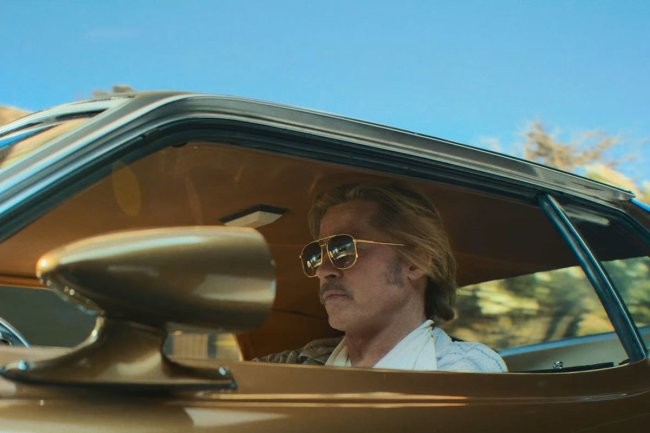
The scratchy “vintage” Netflix logo says everything so well that the rest of the movie almost feels like it’s belaboring the point: “The Further Mis-Adventures of Cliff Booth” is a story about a town where half the people are dreaming up the future, the other half are desperate to mythologize the past, and all of them are stuck together in the ugly compromise we call the right fucking now.
Then again, “story” might be too strong a word for the unbothered zen noir that Quentin Tarantino has spun off from his 1969-set hit “Once Upon a Time in Hollywood,” which memorably ended with former TV Western star Rick Dalton and his longtime stuntman Cliff Booth saving Manson Family victim Sharon Tate from the cruel fate that befell her in real life. Los Angeles was built on the promise that history could be rewritten, and that anyone who made their way onto a studio lot could print the legend, but the present is another beast altogether. It’s feral. Unforgiving. It has to be survived before it can be shaped into a story worth telling, even if that isn’t much of a story at all.


After decades of trafficking in ultra-fetishistic nostalgia (and continued years of refusing to close the book on his own legend), Tarantino has scripted a conditional surrender to the forward march of time — a film whose modest and spectacularly unbothered protagonist invites his egomaniacal and constantly agitated creator to make a certain peace with the inevitable fact of being left behind. And though it was initially Tarantino’s plan to direct that film himself, handing the reins of this breezy showbiz throwback to modern Hollywood’s most unsentimental technician forces “The Further Mis-Adventures of Cliff Booth” into a muted but fascinating tug-of-war between the past tense and the future perfect (even if that scratchy “vintage” Netflix logo articulates the same tension with a greater clarity of purpose than any other part of this perverse collaboration).
Pleasant enough for a movie so dark, and strangely relaxed for a movie so deeply self-conflicted, “The Further Mis-Adventures of Cliff Booth” is ultimately a story — there’s that word again — about someone changing with the times without letting the times change them in return. It takes place over the span of a few days in the summer of 1977 (even though it builds to the October premiere of “Looking for Mr. Goodbar,” which I suppose might have happened a few months earlier in this parallel universe), when “Star Wars” is the biggest force on Earth and the tough guys of yore are being phased out by the very different kind of daring that New Hollywood brought to the table. Once upon a time, Cliff Booth did his business supporting Rick Dalton on the big screen — reborn here as the lead of a David Fincher film, he’s reintroduced working the projector at the New Beverly Cinema like the hyper-chill uncle Tyler Durden never had (digital cigarette burns and all).
If “The Further Mis-Adventures” doesn’t belabor the reel change from one generation of movies to another, that’s because Cliff doesn’t either. He’s just happy to be there — still hot, cool, and at total peace with himself despite an increasingly violent reputation (a state of mind Brad Pitt might relate to). The world around him is a lot uglier than it was eight years ago, as the vibrant celluloid memory palace of Tarantino’s film has faded into the computational muddiness that Fincher has come to mistake for the truth, but that “don’t mean shit” to Cliff.
Drab cinematography and bad disco aren’t enough to unsettle a guy who lied about his age so that he could join the Philippine resistance as a teenager during World War II. A guy who spontaneously killed his own wife in the span of a shrugged-off flashback, and beat up Bruce Lee as part of a controversial backstory that Tarantino can’t quite bring himself to disavow. Besides, Cliff doesn’t want for glory — he delights in sharing a small apartment with his TV-obsessed dad in Marina del Rey (Gus Booth is played by a winsome and wonderful Peter Weller), and always demurs when someone insists that they know him from somewhere, which is all the time. Manning the booth at a half-empty Fairfax grindhouse might seem like a fall from grace, but — as “Anora” favorite Karren Karagulian learns the hard way in the movie’s self-contained opening scene — underestimate Cliff Booth at your own peril.
Of course, that isn’t Cliff’s only job. If anything, the gig at the New Bev is just a convenient front for his far more lucrative work as a Hollywood fixer, which sees him apply his curious but unyielding moral code to a wide variety of situations — even if Fincher’s movie only has the bandwidth to illustrate a small handful of them. Tarantino might be drawn to the discursive plotting of an Elmore Leonard paperback, but after watching any number of Netflix TV shows that should have been shortened into movies, it’s a cruel irony to see two of our greatest filmmakers slush their talents together into a movie that should have serialized into a long-running TV show, complete with a new guest star every week.
Alas, that’s not the world that streaming hath wrought, and so we have to settle for shape-shifting content that seems equally ill-suited to both small and big screens alike, the elasticity of its intended presentation reflected by the ambiguity of a plot that drifts from a casual hangout session to a brutal crime-thriller and a sweetly abrasive romance without ever becoming much of anything. These different energies ultimately collect around a manic and lunkheaded TV actor named Charlie Peters (a very game Scott Caan, channeling his father), who’s compensated for being short by doing all of his own stunts.
Ordinarily that would give him little reason to link up with Cliff Booth, but it turns out that old Charlie got a little too drunk in Manila one night and put a hit out on his wife, Toni (Carla Gugino), who once made her own sad bid for stardom. After sobering up and falling back in love with his bride, Charlie hoped to call the whole thing off, but the two psychotic Filipino hitmen who just landed in L.A. (Matt Groove and JB Tadena as ruthless brothers Mr. Verdusco and Mr. Verdusco) refuse to go home without being made whole, and so it’s up to Cliff to make everyone happy.
Sounds easy enough, but then we get to the most crucial part: Cliff Booth has a crush. A big one. Or maybe tall would be a better choice of words. Her name is Karen Crosby, she’s Charlie’s exasperated agent, and she’s played by a luminous Elizabeth Debicki (sporting her native Australian accent), who’s charmed by Cliff’s modesty and the slight embarrassment of his machismo. He knows exactly who he is in a town where everyone is busy pretending to be somewhere else, and the drawling magic of Pitt’s performance — which he continues to wear like a second skin — is that he always seems to be content with living in the moment at hand. It’s all a big goof, which is exactly why he’ll kill you for getting in the way of a good story.
Karen, on the other hand, is a former critic who resents Hollywood for the same reason that Cliff is so at home there, and their mutual ability to see each other through the spectacle of it all is a perfect template for how Tarantino and Fincher might have found some common ground. Tarantino gets off on memorializing a world gone by (brace for long conversations about Ralph Meeker’s body fat, along with an extended deep-dive into the nuances of network TV in the ’60s), while Fincher tolerates it as an excuse to play with the tech required to make it look like Johnny Carson is talking to Charlie Peters.
Although slapdash and forgettable by Tarantino’s standards, the writing naturally wants to swim in this strange trench of Tinseltown history. The direction, by contrast, seems motivated by finding the most efficient path to shore. Fincher lives for the thrill of solving things only he would see as problems in the first place, and that mindset proves as contradictory to Cliff Booth’s laid-back, leathery ethos as it is perfectly aligned with the Swiss-watch precision of the hitman in “The Killer.”
Tarantino sees this as a séance, Fincher as a math equation, and while the tension between those approaches can be rich in theme, it’s often dull in function. Neither of these name-brand auteurs is willing to let go as much as the movie they’re making together insists they should, so “The Further Mis-Adventures” ultimately dilutes them both instead of sparking some kind of unexpected kismet between them. It’s no wonder that the scenes between Cliff and Karen accomplish exactly that, as each of them surrenders to the lack of control they share with each other. (A dynamic illustrated through the chaos of an Infinity Racing sequence that ends with the movie’s driest visual joke, a too-rare instance of Cliff making good on his insistence that he’s “a little funny.”)
The film is too watchable for that to sting as much as it could, but the small handful of electric scenes where those dueling energies feel complementary — the climactic sitdown between Cliff and the Verdusco brothers comes to mind — are forced to carry the weight of so much wasted potential. Don’t give me Yahya Abdul-Mateen II as a football-player-turned-Blaxploitation-star if you’re just going to kneecap him like that! Don’t let Karen deride American movies as “hamburgers” if you’re going to make us settle for steak tartare.
Of course, “Once Upon a Time in Hollywood” had a similar hard-on for delayed gratification, and for evoking a world that it didn’t have time to more fully explore before it disappeared forever. But that movie was living on borrowed time, this one is striving to live outside of time altogether. “In Hollywood,” Gus says, “two things matter: shelf life, and shelf space.” Neither of those things matter to Cliff Booth — or to the company distributing his mis-adventures. He just wants to make the best of the moment at hand. It can be a lot of fun to watch him try, but it still feels like he’s forced to settle for the present in the end.
Grade: B-
Netflix will release “The Further Mis-Adventures of Cliff Booth” in IMAX theaters on Wednesday, November 25. It will be available to stream on Netflix starting Wednesday, December 23.
What's Your Reaction?
 Like
0
 Dislike
0
 Love
0
 Funny
0
 Wow
0
 Sad
0
 Angry
0






Comments (0)