

Sony FE 600mm f/6.3 GM OSS Review: Telephoto Dreaming
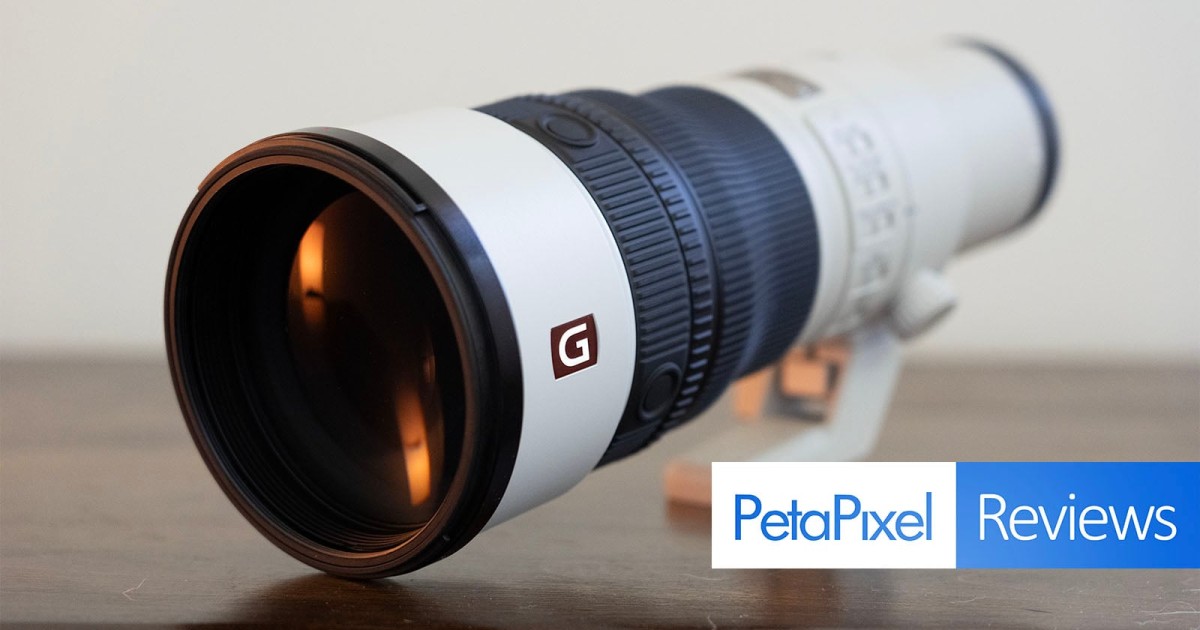
The Sony FE 600mm f/6.3 G Master OSS gives Sony photographers exceptional image quality and serious reach in an impressively compact, lightweight package.

It's compact, lightweight, and razor-sharp.
Pros
- Compact and extraordinarily lightweight
- Very sharp
- Great autofocus
- Good close-up performance
Cons
- The f/6.3 aperture is occasionally limiting
- No Arca-Swiss tripod foot
Sony shooters have long eyed Nikon’s Nikkor Z 400mm f/4.5 VR S and Nikkor Z 600mm f/6.3 VR S lenses with understandable jealousy. While E-mount’s Sigma 500mm f/5.6 DG DN OS Sports helped ease the pains of envy a bit, Sigma’s lens doesn’t quite offer the same high-end continuous shooting performance as Sony’s own lenses. That’s not Sigma’s fault, of course, but the 15 FPS cap with continuous autofocus still exists nonetheless.
While our video review above combines the FE 600mm f/6.3 GM OSS and its shorter sibling, the FE 400mm f/4.5 GM OSS, which was also announced today, each lens gets its own written review because it’s more likely someone will get one or the other, rather than both. But hey, you do you.
 f/6.3, 1/1250s, ISO 3200
Sony FE 600mm f/6.3 GM OSS: How It Feels
The Sony FE 600mm f/6.3 G Master feels incredible in the hand. Sony’s recent G Master lenses have somehow managed to feel lighter than they should, yet still ruggedly built. It’s not always easy to make a light lens feel premium, but Sony has pulled it off yet again.
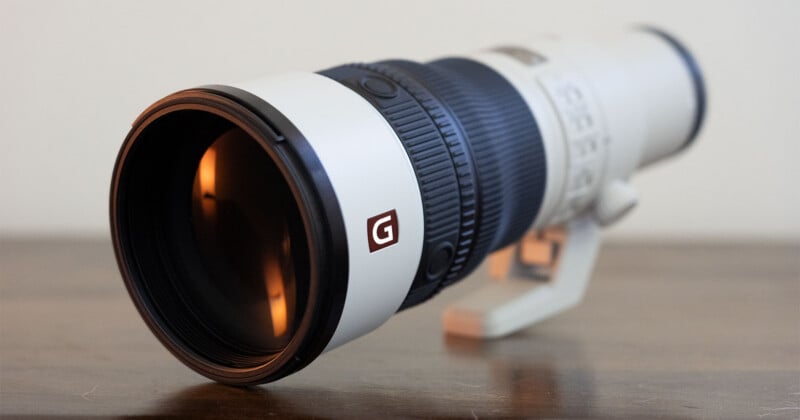 The Sony FE 600mm f/6.3 GM is a compact, lightweight telephoto prime
The FE 600mm f/6.3 GM somehow weighs just 995 grams (2.2 pounds) without its removable tripod foot, which is not only nearly 30% lighter than the Nikkor Z 600mm f/6.3 VR S, itself very portable, but a mere one gram heavier than the FE 400mm f/4.5 GM.
That is made even more impressive by the fact that the FE 600mm f/6.3 GM OSS is 21 millimeters (0.83 inches) longer than the FE 400mm f/4.5 GM. The lens is 263 millimeters (10.35 inches) long in total.
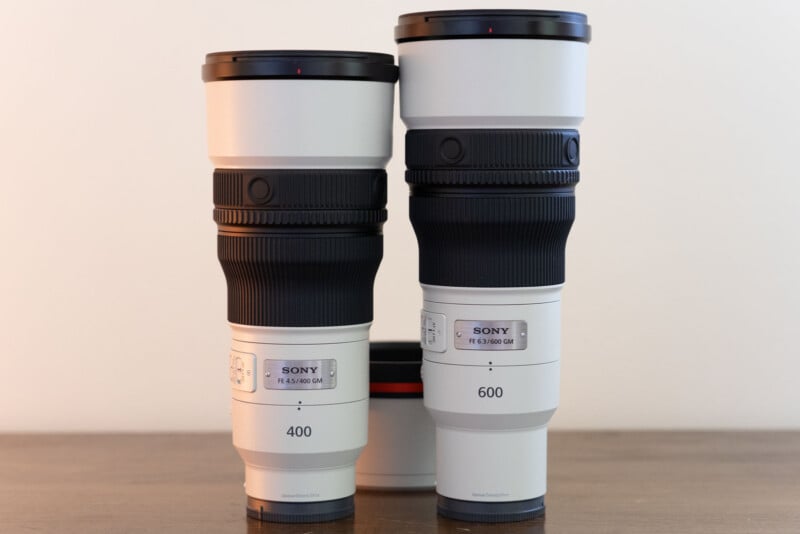 The 600mm f/6.3 (right) is barely longer than the 400mm f/4.5 (left)
I don’t know what witchcraft Sony is employing at its Japanese headquarters, but it’s crazy. I joked with Chris Niccolls that both new Sony telephoto lenses felt hollow. Trust me, though, they are not.
In fact, looking at the front of the lens, it’s pretty clear there is quite a bit of glass in here. The 600mm f/6.3 GM accepts 95mm front filters, which, while big, are not that hard to track down. I much prefer this solution to drop-in filters, which are proprietary, costly, and not at all convenient to use.
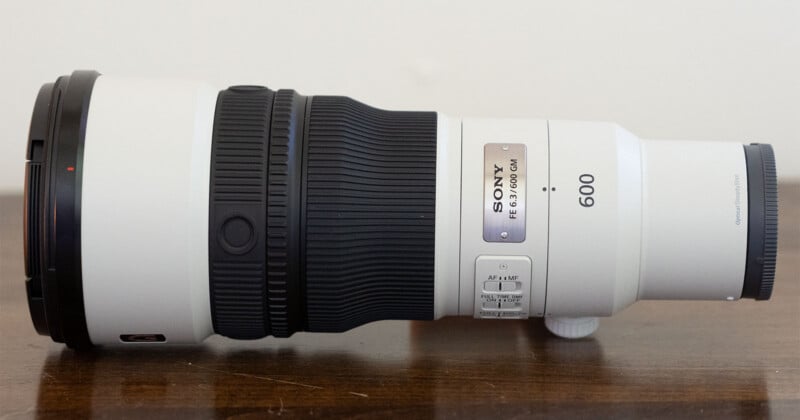
Although the FE 600mm f/6.3 GM is shockingly lightweight and compact, it still has all the expected control features of Sony’s other recent GM telephoto lenses. It has four customizable focus hold buttons, a customizable control ring, an ample focus ring, and a bunch of switches on its side.
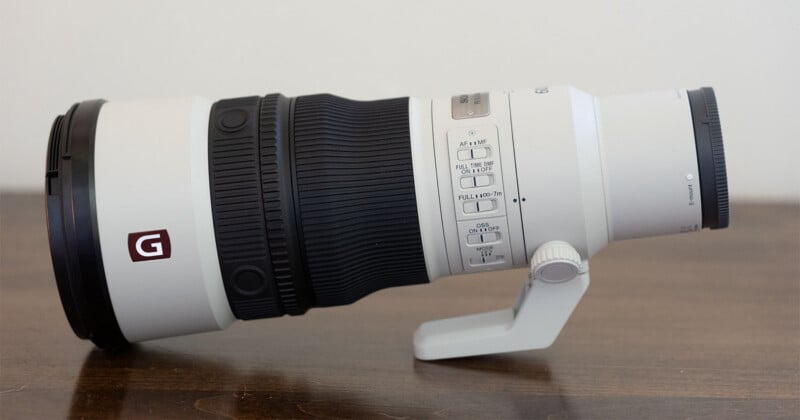
The lens’s five switches control focus mode (AF versus MF), full-time DMF (on or off), focus range, OSS (on or off), and OSS mode. The rotating tripod foot is removable, although the collar itself is built into the lens.
The tripod foot is by far my biggest complaint about the Sony FE 600mm f/6.3’s design. It’s not an Arca-Swiss compatible foot. This is par for the course for Sony, and I’ve moaned about it plenty of times before.
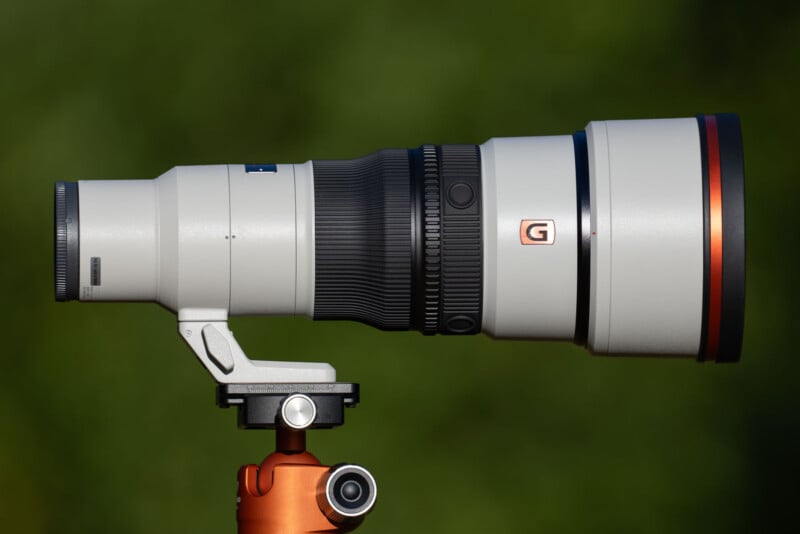 It sure would be nice to attach the lens directly to a tripod.
Since it still hasn’t been addressed despite people like me complaining, I doubt it will ever change. I will continue to object. However, Nikon long subscribed to the same anti-Arca-Swiss theology as Sony and only recently changed its mind, so maybe there’s still hope.
One other minor quibble I have with the lens’s feel is its focus ring. While I am happy to rely on autofocus in most telephoto situations, there are rare occasions when I want to override AF or use full manual focus. In those cases, I want the focus ring to be very precise and offer a bit of resistance. I think the FE 600mm f/6.3’s focus ring feels too loose.
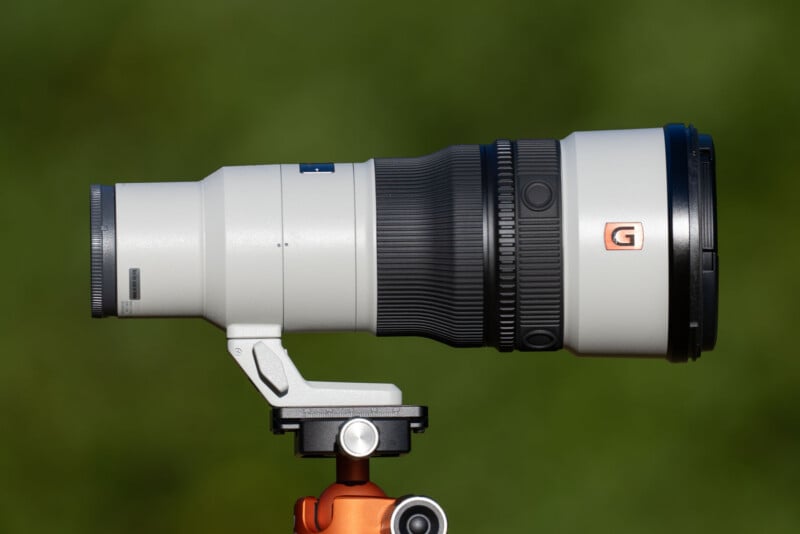 Without the lens hood, this lens looks so stout.
These two critiques aside, the Sony FE 600mm f/6.3 GM’s design offers far more impressive qualities than it does disappointing ones. The lens looks good, feels great, and is, again, shockingly lightweight. Sony wanted to make a portable telephoto prime that’s easy to handhold, and the company undeniably achieved it.
Sony FE 600mm f/6.3 GM OSS: How It Shoots
The Sony 600mm f/6.3 GM incorporates 24 elements arranged across 17 groups, including 3 Super ED and one ED element. The lens also includes Sony’s advanced Nano AR Coating II. These all combine to great effect. The FE 600mm f/6.3 GM lens is extremely sharp. If you can keep the ISO down, which is not always easy with an f/6.3 aperture, this lens will deliver excellent detail.
 f/6.3, 1/1000s, ISO 3200 | Photo by Chris Niccolls
By the way, as a brief aside, the FE 600mm f/6.3 GM has almost the same optical formula as the FE 400mm f/4.5 GM. The 600mm lens adds two more elements in a single group near the lens mount, but is otherwise the same lens as its shorter counterpart. That’s some efficient optical engineering.
As for bokeh, the lens lives up to the expected GM billing. While the bokeh is not the best or cleanest I’ve ever seen, it’s very good. Again, in some situations, f/6.3 may not be fast enough, both in terms of light-gathering and also blurring the background. How soft your background is depends heavily on a few factors, not least of which are how far away you are from your subject and how far away that subject is from the background.
 f/6.3, 1/500s, ISO 2000 | Photo by Chris Niccolls
 f/9, 1/500s, ISO 3200 | Photo by Chris Niccolls
In optimal situations, when you are close to your subject, you can get a very soft, non-distracting background.
 f/6.3 isn’t quite fast enough to make a nearby background totally blurry | f/6.3, 1/800s, ISO 640
 But a more distant background totally melts away | f/6.3, 1/1600s, ISO 2000
Speaking of getting close, another thing the FE 400mm f/4.5 and 600mm f/6.3 G Master lenses share is their minimum focusing distance. Both lenses focus as close as 2.5 meters (8.2 feet), which in the case of the longer 600mm prime lens, means a maximum magnification of 0.25x. It’s not a macro lens, but it’s really strong performance for a lens of this type.
 The FE 600mm f/6.3 GM can focus close enough for shots like this, but it’s not a macro lens. | f/6.3, 1/500s, ISO 320
 f/6.3, 1/500s, ISO 640 | Photo by Chris Niccolls
With regard to focusing in general, thanks to a pair of XD (extreme dynamic) linear motors, one motor for each of the focus groups, the FE 600mm f/6.3 GM is lightning quick. Focus proved fast, precise, and decisive in every situation I threw at it.
 The 600mm f/6.3 GM has great autofocus capabilities | f/6.3, 1/1600s, ISO 1000
The lens also works with both of Sony’s SEL-series teleconverters, the SEL14TC and the SEL20TC. As expected of an f/6.3 lens, these will slow the lens down a lot.
With the 1.4x teleconverter, the lens becomes an 840mm f/9 lens. That’s not great for many situations, but it may work for some scenarios. The 2x teleconverter provides a 1200mm equivalent focal length, which is nice, but it comes with an f/13 aperture, which is not nice at all. Again, it might work sometimes, but f/13 is agonizingly slow.
Overall, the Sony FE 600mm f/6.3 GM shoots very well. It’s an impressive lens with no real optical faults. Obviously I sometimes want an aperture faster than f/6.3, but you can’t realistically have that with a 600mm full-frame lens that weighs less than a kilogram. What you get instead is a telephoto lens that captures sharp, detailed photos and, in many situations, delivers pleasing background blur. It also does all that while being very easy to handhold and delivering reliable autofocus performance at up to 120 frames per second.
 f/6.3, 1/800s, ISO 1600
Who Should Buy the Sony 600mm f/6.3 GM OSS?
This is an interesting question. For starters, if you’re interested in the Sony FE 400mm f/4.5 GM but want more reach, you should buy the Sony FE 600mm f/6.3 GM and be happy with your decision.
But more seriously, I think photographers who want extensive telephoto reach but don’t want a big, heavy lens should seriously consider the Sony 600mm f/6.3 GM. This is a good focal length for many wildlife scenarios, and even some outdoor sports. Overall, I think the 400mm f/4.5 is the better choice for sports, but the 600mm f/6.3 is the superior wildlife option.
 f/6.3, 1/800s, ISO 3200
I think f/6.3 can be limiting at times, especially around sunrise or sunset, but with the high ISO performance of modern cameras, it’s not necessarily a deal breaker. But you will definitely notice it unless you’re a full-sun, middle-of-the-day type of photographer.
 With bright light, f/6.3 is plenty fast | f/6.3, 1/1600s, ISO 640
 But in dimmer environments, like this wooded trail, f/6.3 can be a limitation | f/6.3, 1/400s, ISO 12800 | Photo by Chris Niccolls
I think wildlife photographers, especially those who prioritize sharpness and keeping their kit weight down, will really embrace the Sony FE 600mm f/6.3 GM. Is it a slam-dunk choice for everyone? No, certainly not. There are plenty of reasons why some photographers may still prefer a telephoto zoom lens, even if it weighs more. But now there’s a new lightweight option that leaves very little on the table in terms of performance.
Are There Alternatives?
While there’s no direct competitor to the Sony FE 600mm f/6.3 GM OSS, plenty of viable alternatives make similar promises.
For starters, there’s the new Sony FE 400mm f/4.5 GM OSS, which isn’t much shorter but is a bit faster. That might be the better option for some users.
There’s also the Sony FE 200-600mm f/5.6-6.3 G OSS. It has the same maximum focal length at the same aperture, but is older and heavier. I’ve used the Sony 200-600mm lens a lot over the years and found it reliably good, but somewhat lacking in resolution. The FE 600mm f/6.3 GM performs much better in that regard and has better autofocus, too. The 200-600mm zoom is also $2,100, so much cheaper than Sony’s new $3,700 FE 600mm f/6.3 GM lens, too.
If money and weight are no object, the Sony FE 600mm f/4 GM OSS is technically an alternative. However, it’s $14,100 and weighs over three times as much as the 600mm f/6.3 GM. I’m including it in this section to highlight how impressively light and affordable Sony’s new lens is rather than to provide a legitimate second choice. It keeps things in perspective.
While we’re on the topic of expensive telephoto E-mount lenses, I’d be remiss not to mention the $6,600 Sigma 300-600mm f/4 DG OS Sports. It has the same reach but a much faster maximum aperture and the versatility of a zoom. It’s about four times heavier, though, so there’s that. I think if someone is weighing the choice of buying both of Sony’s new prime lenses, then they may want to think about a zoom like this, since it’s about the same price in total.
As for third-party lenses, the obvious contender is the Sigma 500mm f/5.6 DG DN OS Sports. This lens is fantastic and costs $3,000 after a $300 instant savings, as of this writing. It’s a really awesome lens, but it weighs about 400 grams more and has a bit less reach. The biggest knock against it is that because of Sony’s third-party lens limitations, the Sigma tops out at 15 frames per second with continuous autofocus. This may be a big deal for some shooters, especially wildlife and sports photographers.

Should You Buy It?
Yes. The Sony FE 600mm f/6.3 G Master is an excellent telephoto lens. It’s compact, lightweight, and razor-sharp. If you can live with the f/6.3 aperture and don’t want a zoom, you’ll be a very happy camper with the Sony 600mm f/6.3 GM.
Affiliate Disclosure PetaPixel articles may include affiliate links; we may earn a commission if you buy through one.
What's Your Reaction?
 Like
0
Like
0
 Dislike
0
Dislike
0
 Love
0
Love
0
 Funny
0
Funny
0
 Wow
0
Wow
0
 Sad
0
Sad
0
 Angry
0
Angry
0








Comments (0)