

‘Teenage Sex and Death at Camp Miasma’ Is Bloodthirsty for Artifice
[Editor’s Note: This piece contains spoilers for “Teenage Sex and Death at Camp Miasma”]
The expertise involved in making a film is varied and wild. For instance, “Teenage Sex and Death at Camp Miasma” writer and director Jane Schoenbrun has a blood guy. Also, a snow guy. Also, they are the same guy.
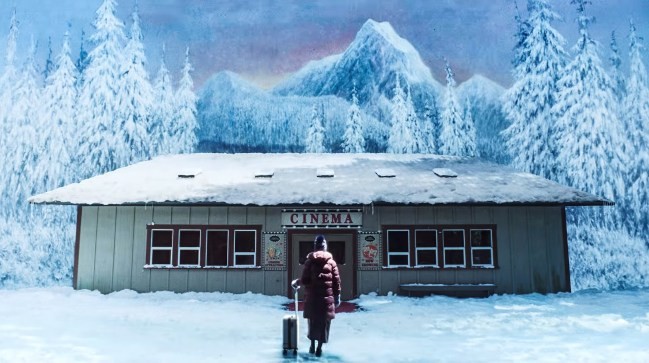
For this, they drew on the expertise of special effects supervisor Kyle Moore, the “snow guru of British Columbia,” to help them shoot summer-for-winter in the director’s third feature, an erotic slasher film that is a lot more about love than it is about fear or the horror of staring into the darkness. Schoenbrun uses the language of horror films to explore more affirming ideas of working through gender dysphoria and coming home to pleasure in one’s own body; and a key way to track this throughout the movie is through the quality of the blood and guts on display.


Schoenbrun tracks the quality of the gore throughout “Camp Miasma,” not in a simple arc but based on how they want the audience to feel in a given scene and the level of safety they want the audience to have to enjoy what they’re watching on screen. This is something they also did with the monsters of “I Saw the TV Glow.”
“I would talk about the monster scale, meaning how shitty versus how awesome each monster should look,” Schoenbrun told IndieWire on an upcoming episode of the Filmmaker Toolkit Podcast. “Most contemporary entertainment movies would maybe answer that question with, ‘Every monster needs to look awesome.’ That’s the Ice Cream Monster in ‘TV Glow,’ right? That’s our 10 on the scale. It looks hyper-contemporary. But when we see him again at the end of the movie, it’s like a one.”
 ‘Teenage Sex and Death at Camp Miasma’ ©Mubi/Courtesy Everett Collection
“Teenage Sex and Death at Camp Miasma” begins with enough gore to run the monster scale all the way up to 11. After watching a camera get set up from the camera’s POV and hearing the breathing of Little Death (Jack Haven) — melding both the movie’s monster and its viewpoint into this living, breathing thing — we get a very traditional slasher attack on an unsuspecting couple out for a walk in the woods. When Little Death stabs into their victim, there’s a geyser of blood, way more than could fit inside a human body.
“That was a very early founding principle of the movie long before I had plot and character and things like that. This movie needs to start in the first minute with a giant oil well-style geyser of blood, and part of it is signalling excess and campiness. It puts you in cartoon-land a little bit,” Schoenbrun said. “It’s also a mission statement in relation to what’s come before in my filmography. A huge part of the joy of this film for me was breaking free of my own expectations of what my movies need to be [and embracing] this idea of play.”
 ‘Teenage Sex and Death at Camp Miasma’Mubi
The playfulness necessitated blood that runs all over the scale, from very contemporary and slick, CGI-style gore — Schoenbrun set out to shoot the slashing spree that occurs exactly halfway through “Camp Miasma” like a Michael Bay horror music video — to the fakest, schlockiest, most ‘80s-tastic fake blood that would fail at its purpose if it looked too red.
“[The killing spree sequence] is really enjoying an artifice that connotes like state-of-the-art or something,” Schoenbrun said. The sequence, which required meticulous prep from all departments for every step of it, is designed to not just bowl the audience over, but filmmaker and horror fan Chris (Hannah Einbinder), who sees the first “Camp Miasma” film in a completely different light as former Final Girl Billie (Gillian Anderson) screens it for her. We watch Chris absorb what’s happened with completely new eyes.
“And then immediately we go into this scene that’s intentionally mis-shot to be colored wrong and not sufficiently lit, and it’s supposed to be a scene straight out of not even ‘Friday the 13th.’ The eighth rip-off of ‘Friday the 13th’ that went straight to video in 1987 or whatever. I actually had to keep asking for shittier and shittier blood,” Schoenbrun said. “I was like, ‘I want the blood that comes out of the guy who gets killed in that scene’s mouth to look like pink yogurt.”
It’s a good gag. But Schoenbrun does it, and the film plays with levels of artifice, because it actually helps the audience attune to the emotions that the characters are working through. “ I’m interested in constantly calling attention to the artifice. Because if every moment is artifice, it kind of puts you in this space of being shocked when something real emerges,” Schoenbrun said.
For where that something real lies, you should also pay attention to the blood, and where it ends up.
“Teenage Sex and Death at Camp Miasma” is now playing in theaters.
What's Your Reaction?
 Like
0
Like
0
 Dislike
0
Dislike
0
 Love
0
Love
0
 Funny
0
Funny
0
 Wow
0
Wow
0
 Sad
0
Sad
0
 Angry
0
Angry
0






Comments (0)