

The a7R V, a7 V, and a7R VI Compared by Someone Who Bought All Three
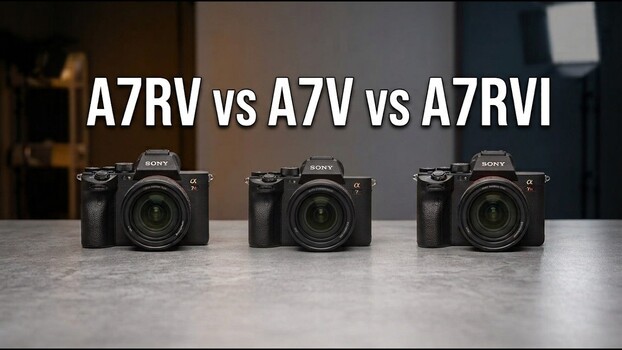
Choosing a Sony body in the $3,000 to $5,000 range means weighing resolution, speed, and battery life against a price that keeps shifting on the used market. The a7R V, a7 V, and a7R VI look nearly identical in the hand, yet they behave very differently once you start shooting.
Having bought all three with his own money, Luca Petralia walks through the physical differences, the stills performance, and the video capabilities before landing on a recommendation tied to your budget and your work. He points out small things first, like the a7R VI's dedicated button-illumination control and its reworked mode dial with an asterisk position that stores ten extra custom setups per shooting scenario. Storage separates the tiers, too. Both the a7R V and a7R VI carry dual hybrid slots that take CFexpress Type A or SD, while the a7 V drops to one hybrid slot and one SD slot. Petralia thinks a $3,000 camera should have matched the others there, though he stops short of calling it a deal breaker.
Battery life is where the a7R VI pulls ahead in a way that surprised even Petralia. The a7R V and a7 V share the older NP-FZ100 battery, while the a7R VI uses Sony's newer NP-FW100. In a week of shooting nearly 1,800 frames in a single session, he still had 40 percent left, and he simply couldn't drain it in one outing. That new battery costs more, third-party versions won't appear for a while, and it makes the body slightly larger, which meant his existing cage no longer fit. The stacked-sensor architecture drives the bigger gains: the a7R V uses a conventional CMOS sensor, the a7 V a partially stacked sensor, and the a7R VI a fully stacked one. That difference makes the electronic shutter genuinely usable on the two newer bodies, unlocking 30 frames per second at full bit depth with a blackout-free viewfinder.
If you shoot in dim rooms or after dark, the dual base ISO on the a7 V and a7R VI is the spec that quietly reshapes your workflow. A single base ISO sensor is cleanest at one sensitivity, but a dual base sensor gives you a second point where the signal-to-noise ratio resets. The a7 V's second base sits at ISO 8,000 and the a7R VI's at ISO 5,000, both alongside a base of 800. That means when a scene pushes you toward ISO 3,200, you're often better off jumping to the higher base and pulling exposure back with an ND filter, shutter, or aperture, because the file comes out cleaner despite the higher number on the dial. It runs against the instinct to keep ISO as low as possible, and it's a habit worth building if either of these bodies ends up in your bag. The same thinking has spread across Sony's lineup and into rival cameras from Panasonic and Nikon, so learning to read dual base ISO now pays off well beyond these three.
On video, Petralia is candid that he ran his channel on the a7R V for a year and a half without trouble. The newer sensors still change the math. The a7R V caps 4K 60p with a heavy crop, while the a7 V delivers 4K 60p with no crop using angle-of-view priority, and 4K 120p in Super 35. The a7R VI adds only a very small crop at 4K 120. Oversampling differs as well, with the a7 V pulling 4K from 7K, the a7R VI from 5K, and the a7R V using line skipping. He's clear that you won't spot line skipping in normal viewing unless you pixel-peep side by side.
His verdict splits along budget and intent, and it's worth hearing him lay out exactly who each camera suits, including why a used a7R V near $2,000 to $2,500 might be the sharpest value of the three and which body he's keeping versus selling. Watch the full breakdown in the video above for his complete recommendation.
What's Your Reaction?
 Like
0
Like
0
 Dislike
0
Dislike
0
 Love
0
Love
0
 Funny
0
Funny
0
 Wow
0
Wow
0
 Sad
0
Sad
0
 Angry
0
Angry
0












Comments (0)