

‘The Basics of Philosophy’ Review: Paul Schrader’s Lurid Study of a Predatory Intellectual Is Quietly Explosive, but Not Dangerous Enough
Everything I try to write about Paul Schrader’s “The Basics of Philosophy” comes out all wrong.
Here is a movie where pedophilia and homosexuality are put in such intimate proximity that I can only anticipate another scandal coming the filmmaker’s way — if enough people see it. It’s a lurid study of a sexually abusive academic, played by Jack Huston, that edges on quietly explosive, but isn’t quite dangerous enough. It’s offensive, but also not. And to be offended at all would mean that you misunderstood the writer/director’s entire project, or that you understood it entirely. It’s Ragebait the Movie, but on the other side of the click, all you might end up finding is bait.


For probably the only time other than 2007’s “The Walker,” in which Woody Harrelson played a gay, male escort (not a gay male escort) on Capitol Hill, Schrader infiltrates the homosexual world head-on with “The Basics of Philosophy.” But he has no clue how it operates, which leads to clunky but still fascinating material. He is at least curious about it, elevating this oh-dear-god timely, tawdry tale of abuse come up from beneath the covers to certainly his best film since “The Card Counter.” Mind you, that was only two films ago, with the racially provocative “Master Gardener” and the dusty elegies of “Oh, Canada.”
Schrader’s 26th directorial effort is also his first since a former assistant accused him in 2025 of sexual misconduct, allegations he denied. You are invited to read “The Basics of Philosophy” as a reflection on, a mea culpa of, or at least an acknowledgment of that episode in his life. But if you’re not familiar with that backstory — hardly extra-textual given how ferociously autobiographical much of the director’s “The Basics of Philosophy” feels with all its heaviness on religious guilt — there’s still plenty to feel icked out by or trolled over here.
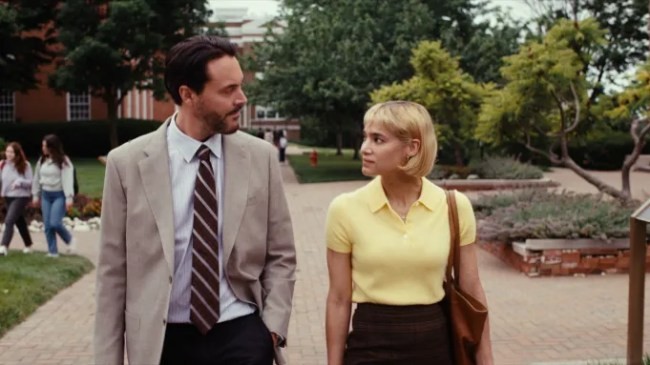
Jack Huston stars as university professor John Jorissen, a Spinoza academic who teaches a philosophy intro course to disaffected coeds at the fictional Ridgemont College in Missouri. He’s in a torpid situationship with his colleague, Professor Rebecca Richards. She’s played by Sofia Boutella in another one of the Schrader women roles who exists only as a prism to refract male anxieties, a foil to a man’s moral quandaries. (That her chosen field is psychology is only revealed late in the game by campus dean Richard Gere.) Rebecca is amorous alright, but their relationship is sexless, tentative, and we don’t know why.
These are educated people, John and Rebecca, but they’re one of those couples who act like they’ve always known each other, but also like they’ve never met at all. There’s enough closeness that Rebecca is front-row-seated at the funeral of John’s father Melvyn (Bill Pullman), along with her young son Will (Nolan Stewart). Speaking on the dais of a decorously religious service, John is paralyzed when he sees a face whose familiarity he quickly works to organize, only to realize it may not be a friendly one.
He’s played by Daniel Zovatto, and whom we learn to be Miguel, the now grown version of someone who was once a 14-year-old pupil of John’s back when our philosophy teacher was a music instructor some years ago. Black-and-white flashbacks piece together their relationship, and they’re just misty-lensed and blurred enough to invite you to consider whether the events as remembered are a fabrication or a distortion. As it happens, John always wanted to be a piano teacher only (and cinema has certainly taught us a horrifyingly great deal about those). But a cascade of awfulness yanked him out of that dream, and into the one Melvyn always wanted for him: to be a philosophy professor.
How to proceed, to get to the wick of the thing, without spoiling as much as I seem to: This movie asks you to look at pedophilia and homosexuality next to each other, and, in a pleasingly terrible way, without any of the tools to rip them back apart the way they belong. Other than with our own appalled dismissal. Schrader asks more of you than that, though. But he also knows via his own perverse amusement that in the wrong hands on either side of an ideologically cluttered aisle that his latest movie will cause a diabolical shitstorm of debate. Or, for those on his level or a step ahead of it, maybe just bemused chatter at a coastal dinner party in desperate need of a conversation steroid shot.
What’s empirically clear is that “The Basics of Philosophy” is the best-looking Schrader picture since “First Reformed,” which was shot by Alexander Dynan. Cinematographer Sean Price Williams floods the frame at times with oversaturation, and vibrant lights worthy of a melodrama. And to that point, it’s an extension of Schrader’s Man in a Room movies that include “First Reformed” but also “Taxi Driver” and “The Card Counter,” where the mask a man wears is his profession, and in the case of this film, that mask falls violently off with the death of John’s father.
Huston’s performance is fascinatingly ambivalent. He’s Hollywood royalty, establishing his own bona fides via the scarfaced hitman in “Boardwalk Empire” while also being the nephew of actors Anjelica and Danny, and grandson of director John. There’s the frisson of excitement flashing across John’s face when he reunites with Miguel in a diner after the funeral — “I came to pay my respects,” Miguel says. “They make florists for that,” John replies. But there’s also the tremor and terror of consequence. Elsewhere, Huston exudes a terrifying blankness while writing his Spinoza magnum opus paper dressed literally in a suit with an upright piano in the room, and a Chekhov’s google search of Nembutal in his browser history.
The issue, though, is that despite impeccable technical execution, “The Basics of Philosophy” is too narratively muddled to stick the landing. And that has much to do with Schrader’s portrayal of repressed homosexual life. When John trails Miguel to a gay dive bar — sorry, a gay line-dancing dive bar — in downtown Missouri, your moral panic meter might set in over what exactly Schrader is chasing after what the already harrowing other thing he just said a minute ago.
The filmmaker’s representation of queer nightlife is dated to the point of kitsch. Take a hustler (Shiloh Fernandez) named Claude, plucked straight out of William Friedkin’s “Cruising,” or better yet a porny low-rent remake of it, whom John meets at the bar. I’m not going to fault Schrader for failing to articulate accurate gay vernacular of whatever period — it’s not his project, and why would it be — but this self-identified bottom owns a gun shop, has a psychology degree, and says things like, “I’m going to go shake my booty” before swiveling his ass over to the dance floor. That’s like when, in “Cruising,” Al Pacino asks his leather trade how big he is, and the guy says, “Party size.” The interaction feels wildly improbable even with respect to a movie that doesn’t claim to create a probable world. Had Schrader had a better handle on his movie’s appealingly sleazy gay underbelly, the moral hot water he wants to throw us in would’ve hit more scaldingly.
A recent movie that more effectively traced the unfortunate Venn diagram between acceptable sexuality and aberration that can often scramble a society’s ability to grasp their distinction was Elliot Tuttle’s “Blue Film” from last year. In that micro-budget indie, a pedophile teacher reacquainted himself through sordid means with the former student he once desired. It was a bracing, sharp shock to see the two in a room together, but “Blue Film” was more confident in its argument because it came from a gay filmmaker. What that movie had was the pang of gay shame. And Schrader’s style is too remote, his point of view too far afield, to capture the same.
Where “The Basics of Philosophy” most resonates is in the hardly oblique homages to the 80-year-old filmmaker’s own much-opined-about personal religious burden. The idea that you can’t run from your own depravity and that perhaps the only way to secure virtue into the beyond is to die before you’re exposed for living badly. Ring a bell? “The Basics of Philosophy” is flawed, but restlessly fascinating, and a movie to which some will say, “…Welcome back?” And others, “Get gone.“
Grade: C+
“The Basics of Philosophy” premiered at the 2026 Venice Film Festival. It is currently seeking U.S. distribution.
What's Your Reaction?
 Like
0
Like
0
 Dislike
0
Dislike
0
 Love
0
Love
0
 Funny
0
Funny
0
 Wow
0
Wow
0
 Sad
0
Sad
0
 Angry
0
Angry
0










Comments (0)