

The Cheapest Way to Expand Your Micro 4/3 Lens Collection
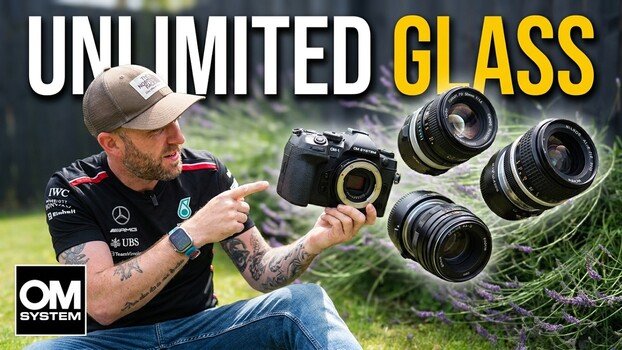
The Panasonic Lumix GX8 is a Micro 4/3 camera, and that small sensor size gives it one genuinely unusual advantage: you can mount almost any lens ever made on it, from almost any manufacturer, as long as you have the right adapter.
Coming to you from Chris Baitson, this hands-on video puts that claim to the test by pairing the Lumix GX8 with a Helios 44, a Soviet-era 58mm M42 screw-mount lens, to shoot bees and lavender in a backyard garden. Because the Micro 4/3 sensor is so small, the image circle projected by virtually any lens, whether it's Canon EF, Sony FE, or a decades-old film lens, is larger than what the sensor needs to capture. Baitson uses a simple M42 to Micro 4/3 adapter to make the connection, and it works without any electronic trickery. He does flag one important caveat: autofocus lenses paired with autofocus adapters can behave unpredictably, which is why fully manual lenses like the Helios 44 tend to be the cleaner, more reliable choice for this kind of lens adaptation.
At 58mm on a 35mm film frame, the Helios 44 becomes the equivalent of a 116mm field of view on the Micro 4/3 sensor, so your lens choices shift significantly when you go this route. Baitson shoots wide open at f/2 in aperture priority mode to minimize camera shake and uses the GX8's direct area focus assist, which lets you zoom in on a specific part of the frame while adjusting the focus ring manually. That level of precision wasn't possible in the film era, and it makes adapting old glass to modern mirrorless bodies more practical than it might sound. One technique Baitson demonstrates specifically for fast-moving subjects like bees is worth paying attention to: he locks the focus approximately where he wants it, switches to burst mode, and gently rocks the focus ring back and forth while holding the shutter down.
The honest case for lenses like the Helios 44 has nothing to do with optical perfection. Baitson is upfront that these lenses are often soft and imprecise, but he picked up his copy, bundled with a camera body, for £16 on eBay. Plenty of M42 lenses can be found for under $10. The Helios 44 in particular is known for producing a distinctive swirling bokeh in the right conditions, and that kind of character is something modern, clinically sharp lenses simply don't replicate. For video, the soft rendering and smooth manual focus ring can give footage a more cinematic quality that's hard to achieve otherwise.
Check out the video above for the full rundown from Baitson, including the actual images and footage pulled straight from this lens-and-camera combination.
What's Your Reaction?
 Like
0
Like
0
 Dislike
0
Dislike
0
 Love
0
Love
0
 Funny
0
Funny
0
 Wow
0
Wow
0
 Sad
0
Sad
0
 Angry
0
Angry
0








Comments (0)