

‘The Life of Jorge Luis Borges’ Review: A Playful Five-Hour Documentary Turns the Argentinian Writer Inside Out
It’s often said that calling a movie “boring” is bad criticism. There are better descriptors for trance cinema, for things that are slow or obtuse. Conversely, if the term is meant as an insult, then a critic should describe the underlying mechanisms which produce the boredom in question.
But “The Life of Jorge Luis Borges,” Mariano Llínas’ three-part, five-and-a-half hour documentary about the iconic 20th century writer, is boring. This is its modus operandi, its goal, and its atmosphere. This is a film that allows, wants, even demands that the viewer become distracted, tired, and fidgety. Active ambivalence is the best mindset with which to approach such a daunting viewing experience.


On one level, the title alone serves as plot summary enough. The film is anchored by a chronological (though not comprehensive) journey through the Argentinian author’s life and practice. Whether it proves illuminating as a portrait of the man is questionable. Llínas has been offered unprecedented access to archival materials, locations, and experts on Borges. Still, he is playfully and explicitly unconcerned with anything obligatory. Certain details, such as a lost footnote that only exists in a single edition of the volume as a handwritten addendum, interest him greatly. Other aspects, like his time in Spain, are excised altogether. The result is both extremely insightful, and also a film where the man is essentially a MacGuffin.
Part One seeks to answer a simple question: When does Borges begin? Is it at his birth? At the loss of his virginity? At the moment when he first re-drafts a sentence fragment on paper? At the line when he first inserts himself into his own stories? Though we arrive at several possible answers, the most insightful scene here comes when Llínas attempts to balance the light meter correctly on a blue-green issue of SUR Magazine through various cameras, monitors, and screens. It is impossible to see clearly and yet it is the process behind the attempt that is worthwhile.
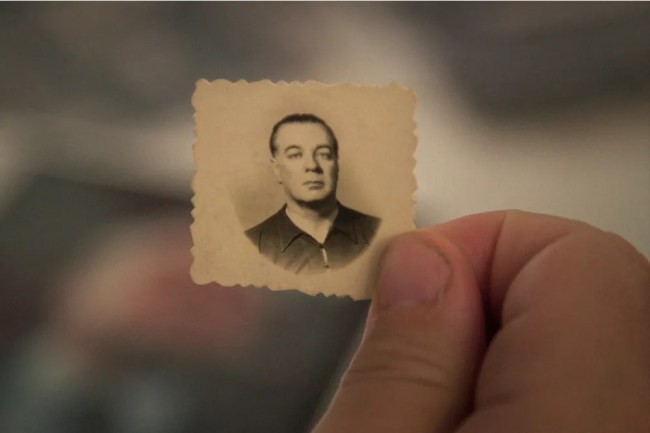
Borges is most visible in relief, carved from the negative space in the footage. He appears in blueprints, in Llínas’ tangential observations on the geese or petty arguments with his editor on a glitchy bit of footages, in the landscapes and the architecture of Argentina’s transitory spaces. The film’s preferred mode is describing objects as they appear on screen, displaying text before reading it aloud before paraphrasing it. This is best exemplified by the film’s signature match-cut, between a magnifying glass held in front of a physical book, and a skeuomorphic digital magnifier atop some low-resolution photo scans (The procedural-adjacent infatuation with research recalls this year’s “Chronovisor”). Elsewhere, Llínas films the modern-day streets, statues, and buildings where Borges once lived and visited, accompanied by casual pontifications on the author’s values and habits. That these places are guaranteed to feel unrecognizable when paired with the text they once inspired loses its formal luster the seventh or eighth time (i.e., a mere fifty minutes into the epic).
This is the kind of stuff a filmmaker includes when they’re not in a rush. Llínas is best known for his dramatic projects, namely the 14-hour “La Flor” (a film so massive it could accommodate a mummy mystery and an entire remake of Jean Renoir’s “Day In the Country”). El Pampero Cine, the independent filmmaking collective of which he’s been a member for nearly a quarter-century, is responsible for mystifying picaresques like 2022’s “Trenque Laquan,” and goofy experiments like last year’s “Pin de Fartie.” Though this resists any strict genre, it is mostly a comedy. Llínas mugs the camera for laugh lines in the narration, rattles off a comically long list of Borges’ lovers, reveals halfway through that the score has been played, in part, off a toy xylophone. I“The Life of JLB” is best approximated not as a historiography, or a mystery, but a comedy.
Throughout the film, Llínas gets around, both literally and thematically. Borges’ tendency to draw from life quite directly means that much of the film finds Llínas and Co. tracking down specific locations in the hopes they might reveal some deeper truth. He goes to an unremarkable HIlton in search of a column mentioned by Borges in passing. In Austin, they visit a kitschy country dive bar in hopes of recapturing some romantic notion of the Texas past that Borges too mourned. Llínas and his wife, actress Laura Peredas, circle a neighborhood in vain looking for a statue while being pestered by their children. The camera crew presses the lens against the glass of a building to which they are refused access, but eventually conclude that the shot is no good: “Too much reflection,” they say.
These types of meta-textual interjections are as much the core of the film as any one historical revelation. At one point, when hunting down a specific rural house by an unnamed train station, Llínas is disappointed upon finding the house he had predicted would match Borges’ description is named “La Buena Suerte;” In Llínas’ eyes, this disproved his theory singlehandedly, because there was no way Borges could refrain from including a detail that perfect in a bit of prose back in the day. The joke, it’s implied, is that this is too perfect for Llínas to exclude from a film now.
Several characters join Llínas over the course of his adventures: Ernesto Montequín, a researcher and essayist; Nicolás Helft, who once possessed the largest collection of Borges’ private manuscripts; Ignacio Codino, Llínas’ young editor; Pederes, who he employs to play the part of Borges in a table read of a magazine interview with the writer about Guillermo Villas. The people in the film (llínas included) are basically there for scale, the way Shia Labeouf is there in the “Transformers” movies to look small next to Optimus Prime.
Even more figures appear as ghosts. A large portion of Part Two is spent at the National Library, recreating specific shots from footage of an old Hugo Santiago interview. The library looks the same in the 2020s as it did back when Santiago was alive, but, according to him, everything about the layout is a forgery. The most memorable moment in the film comes when Santiago, Llínas’ mentor, is revealed to have directed a film based on an unrealized Borges manuscript, “The Lads,” that had taken hold of Llínas’ imagination. Upon this revelation, he bemoans that his protege Codino would never meet him. At that moment, the audience is asked to remember the moment which opened this sequence: a surprise birthday cake presented to his crew mate, followed by an image of Hugo Santiago standing in that very spot years earlier, filmed from the exact same vantage.
Around the end of Part Two, when Llínas commissions a new, bespoke melody to a lost song Borges mentions in passing, any pretensions of accuracy or literal investigation have vanished. Part Three is almost entirely cinematic marginalia, an ekphrastic project inspired by what aspects of the earlier material had so fascinated Llínas’ camera. The important bits are the footnotes, the sketches and scratched-out drafts.
Perhaps why the comparatively slim amount of time spent on Borges’ late-in-life political foibles and fascist sympathizing is so uninspired — restrained, workmanlike, intentionally unprovocative, compulsory. But the remaining five hours are a perpetually amicable, intermittently thrilling jaunt — a minor work, in the sense that Lucy Ives once wrote about in “The Baffler” — a deeply imperfect film that inspires through its questions and possibilities rather than its answers. There are multiple hours of fundamentally extraneous footage. But that sprawl is core to the film’s charms.That it is self-indulgent and repetitive, that it is boring, is basically irrelevant. Rarely has a film ever so thoroughly self-selected by its very existence to only be watched by people who are, in some way or another, already bought into the overall fixations of everyone involved. The experience of watching the film was ambiently excruciating, like twiddling your thumbs at a bus stop on a humid day. But the experience of remembering the film as I write this has left me with retroactive affection for it.
Fifteen minutes in, Llinas coyly puts a shot on screen that I will not spoil here, proclaiming in voice-over that this is the ending – “The earlier you put the ending, the better.” When the actual ending rolls around, it finds the crew on a fictionalized hunt for some mysterious object that might prove the ultimate resolution to their research into Borges. But they can’t agree on what would make a good object, so the edit is left only with the image of a staged country stroll that shifts, imperceptibly, to something “real.”
Grade: B-
“The Life of Jorge Luis Borges” premiered at the 2026 Toronto International Film Festival. It is currently seeking U.S. distribution.
What's Your Reaction?
 Like
0
Like
0
 Dislike
0
Dislike
0
 Love
0
Love
0
 Funny
0
Funny
0
 Wow
0
Wow
0
 Sad
0
Sad
0
 Angry
0
Angry
0










Comments (0)