

‘The Row’ Review: One Man’s Tragedy-Inspired Voyages Across the Pacific Are Turned Into a Branding Exercise
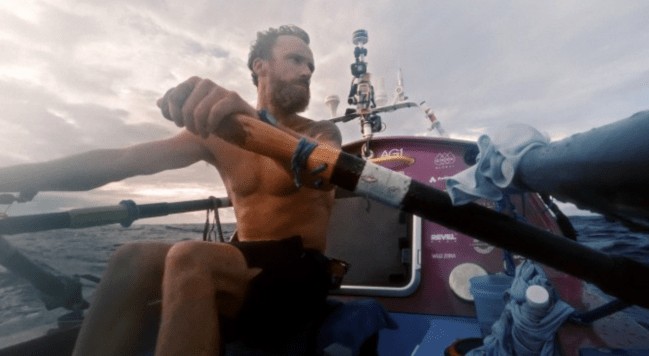
Terence “Tez” Steinberg, per his own words, processes emotions through movement. An endurance athlete, Steinberg spent a decade completing various marathons and Ironman triathlons to help manage his mental health following a depression spell during college. In 2020, Steinberg successfully rowed over 2,500 miles from Monterey, California to Kaneohe, Hawaii alone in a 23-foot rowboat across 71 days. Three years later, he embarked on a second solo rowing expedition, this time from Honolulu to Australia, a nearly 6,000-mile journey that lasted over 126 days.
Bryan Fogel’s documentary “The Row” chronicles both of Steinberg’s voyages, framing them as therapeutic ventures for the athlete to confront the trauma in his life. Steinberg’s first row came four years after his father took his own life; his second transpired in the wake of a sudden heart attack as well as his mother’s respective suicide. In voiceover, Steinberg claims that the ocean spoke to him as a setting where he could face his pain head on. Each crossing was not just an opportunity for him to test his physical strength and mental resiliency, but also a chance to heal psychological wounds.


Steinberg’s personal pain is not in question. He suffered emotional isolation in his childhood following his parents’ separation, and his relationship with his mother and father seemed to falter as he entered adulthood. To lose them both to separate suicides while facing his own mortality as an active athlete requires true fortitude. It’s understandable why someone as physically ambitious as Steinberg would want to push his body to the limit as an emotional response to tragedy.
At the same time, his specific choice to embark on solo rows suggests a recklessness that “The Row” barely acknowledges. Steinberg boats in Fogel’s film and on his own website, that he was the first person to row from California to Hawaii with no prior experience. While it’s objectively impressive that he survived at all, the drama of his myriad trials — like his row seat breaking early in the expedition or the visual and auditory hallucinations he experiences while rowing in the dead of night — is undercut by the sheer fact that they’re self-inflicted. It doesn’t take an expert in any field to conclude that the mental benefits Steinberg might feel on the water cannot possibly be outweighed by the mortal catastrophe he willing invites. He basically admits this when he says that rowing across the ocean won’t “fix” him.
Of course, that doesn’t stop him from doing it again under even more dangerous circumstances. It’s borderline unbelievable that no one insists, let alone suggests, that Steinberg should not be undertaking a lengthier crossing, alone, while recovering from a heart attack. If anyone did, Fogel did not include their comments in “The Row,” except for Steinberg’s sister indicating vague concern about her brother’s intentions. His doctor over a Zoom call doesn’t dissuade him from his mission, but strongly implies (though not explicitly states) that if he has another episode in the middle of the Pacific ocean, he will probably die before anyone can rescue him. Not to worry, he has a pharmacy of prescriptions that he’s bringing with him on the boat!
I wager that I’m supposed to be in awe of Steinberg’s determination and grit, but I’m mostly appalled by his myopia. It makes it difficult to sympathize when he’s screaming in frustration after his tiller arm, the boat’s steering mechanism, breaks less than 30 days on the water, or when he almost collides with a tanker, or suffers physical deterioration as a result of heat, exhaustion, and obviously his weakened heart. After the tiller arm breaks, he addresses his camera to say that he’s taking an off ramp to the Marshall Islands because he can’t hack the quest and wants to return to his family. It’s the most rational decision he makes in the entire film, so naturally he doesn’t follow through with it and plunges forward to Australia anyway. On the first row, Steinberg keeps comparing the ocean to an alternative reality and asserts that “we’re not meant to be out here.” Not only does he not listen to his own words, he seems to repeatedly suppress his own survival instincts.
A better film would further explore Steinberg’s risk-seeking behavior, and how it possibly relates to his own fraught family history, like, say, “Free Solo” did nearly a decade prior. But Fogel is too enamored with his subject to delve below the surface of his psychological profile. He treats the spiritual facet of Steinberg’s voyages as sacrosanct and doesn’t even mildly interrogate his choices other than permitting his immediately family to provide some superficial commentary. Moreover, Steinberg necessarily focuses more on survival than his mental journey while on the water, often rendering it a superimposed retrospective framework. All of these aspects render the film a fairly shallow viewing experience on emotional and formal levels. (Bland animation, talking-head interviews, and training montages are interspersed between Steinberg’s own boat footage.)
Subsequently, “The Row” practically invites questions about its process. I accepted at face value that Steinberg shot all the footage on the boat, although some exterior and POV shots beggar belief. But it’s unclear whether Fogel’s film played up the true danger of his ventures. He apparently had access to “physician and logistics teammates” if he really needed to be rescued. Until Steinberg briefly spoke to his family over FaceTime on the second row, and later when he had to be towed across the Great Barrier Reef, “The Row” makes it seem like he’s completely out of contact with the outside world. Steinberg’s guardrails don’t make his journey any less remarkable. But the fact that Fogel doesn’t depict in detail the logistics of his preparation or the various backup plans in case of emergency, preferring instead to stage his voyages as a truly unaccompanied endeavor, paints his film in a slightly dubious light.
This underexamined focus on Steinberg’s awe-inspiring efforts contributes to a self-aggrandizing element to “The Row.” Fogel likely decided not to incorporate Steinberg’s longtime work as a management consultant, or his current vocation as a keynote speaker for high-profile companies and the World Economic Forum, in the film because it distracted from its focus on grief. (However, it does why “The Row” has a stealthy “motivational” tone.) But it’s baffling that he didn’t integrate Steinberg’s nonprofit the United World Challenge, which sponsored both expeditions and helped fund scholarships to the United World College and works to address ocean plastic pollution, into the film beyond a logo on his boat. (Meanwhile, an AG1 sponsorship receives prominent placement in the film’s end credits.)
Is the idea that if “The Row” included Steinberg’s business background and his financial patronage that it would cheapen his mental health journey? By eliding it completely, the film seems like a vanity project designed to promote Steinberg’s personal brand, in which he has a financial stake. Steinberg’s personal anguish isn’t phony, but Fogel’s choice to shape it entirely through that narrow lens ends up suffocating “The Row.”
Grade: C
“The Row” premiered at the 2026 Telluride Film Festival. It is currently seeking U.S. distribution.
What's Your Reaction?
 Like
0
Like
0
 Dislike
0
Dislike
0
 Love
0
Love
0
 Funny
0
Funny
0
 Wow
0
Wow
0
 Sad
0
Sad
0
 Angry
0
Angry
0











Comments (0)