

The Underrated Fujifilm Lens That Does More Than Close-Ups
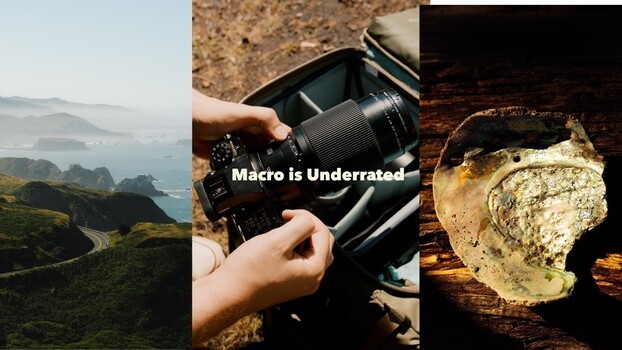
Most photographers rank a macro lens near the bottom of their wish list, filed under a specialty they'll get around to someday. That instinct sells short a piece of glass that can carry travel work, portraits, and landscapes all at once.
That's the argument Samuel Elkins makes for the Fujifilm GF 120mm Macro, a lens he calls his quiet favorite across the GFX system. The 120mm focal length lands at roughly 90mm equivalent on full frame, which sits in a comfortable middle ground. It's long enough for tight macro detail, yet works as a medium telephoto for landscapes and portraits. A switch on the barrel lets you lock focus to the macro range or open it up from around three meters to infinity, so the lens shifts jobs depending on the shot. Elkins normally leans on Fujifilm's zooms for ease of use, and pairing them with this one prime gives him a kit that covers most of what a shoot demands.
The lens tops out at f/4, and Elkins treats that as a fair trade rather than a drawback. On a hospitality shoot at the Harbor House Inn in Northern California, he found the tightest macro frames turned into some of the strongest images from the whole trip. Something clicks when a close detail shot sits next to a wide establishing frame, and the story of a place starts to feel complete: the food, the room, the light. He describes the images as tack sharp, and the lens as light enough to carry without complaint.
Portraits benefit too. Some of his favorite frames from the past year came from a beekeeper shoot, where he shot tight crops of bees against human hands and honey being squeezed, all lit by natural light. That contrast and clarity, he explains, would flatten out at 50mm and lose the character the macro gives it.
The real takeaway sits underneath the gear talk, and it connects to a broader shift in how working photographers think about their kits. For years the conversation centered on faster apertures and wider zooms, chasing coverage and low-light speed. Elkins points at something different: a single unfamiliar focal length can retrain your eye. Macro forces you to hunt for texture, tide pools, rock formations, and small details you'd otherwise walk past, and that habit bleeds into how you frame everything else. Photographers building toward a printed book or a cohesive body of work know that variety of scale carries a series. Wide, medium, and extreme close-up frames give an edit rhythm, and a macro lens hands you the tightest end of that range in a way a standard zoom can't touch. If your work lives in food, travel, hospitality, or editorial, that textural layer is where the difference shows.
Elkins is honest that this was his first real experience shooting macro, which makes his enthusiasm read less like a spec sheet and more like a genuine change in how he works. Watch the video above to see the beekeeper frames and the coastal images that convinced him this lens stays in the bag for good.
What's Your Reaction?
 Like
0
Like
0
 Dislike
0
Dislike
0
 Love
0
Love
0
 Funny
0
Funny
0
 Wow
0
Wow
0
 Sad
0
Sad
0
 Angry
0
Angry
0





Comments (0)