

The weird, wonderful world of Miles Buckle, Instagram's parallel universe of video games
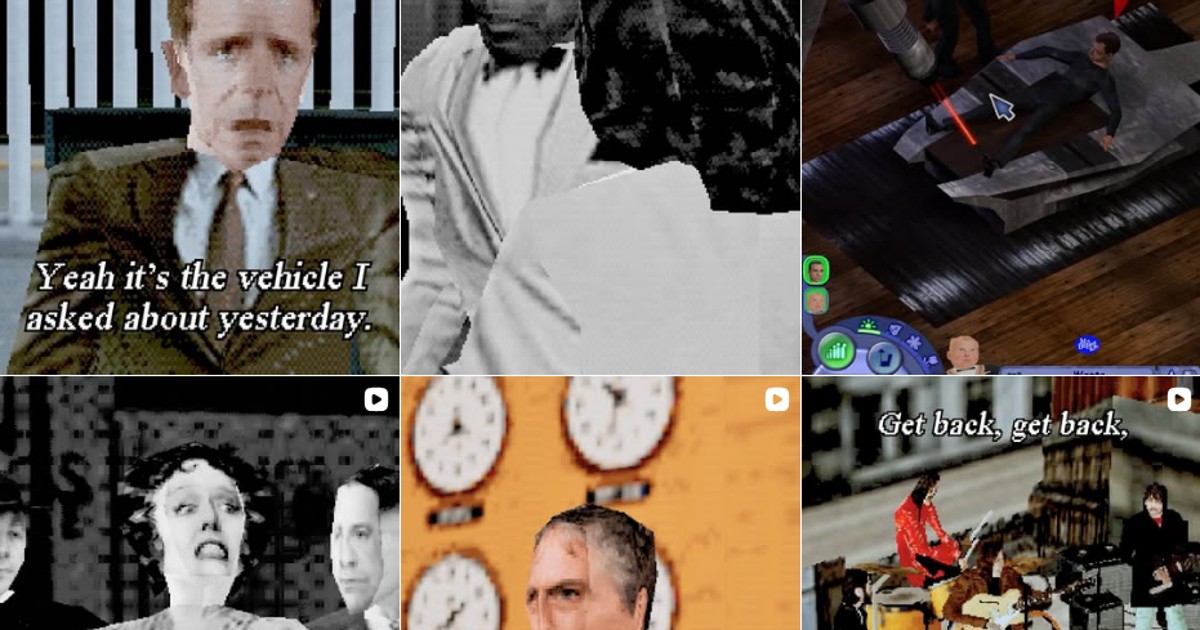
A feed of incredible, but totally imagionary retro-style video games becomes a window into nostalgia and fiction.
 Image credit: Miles Buckle / Eurogamer
Going through Miles Buckle's Instagram feed is like stumbling into a parallel universe where cinema's greats – Lynch, Hitchcock, Fellini, Kubrick – are reimagined in the familiar but distinctly different visual language of video games. The "here's Johnny" scene from The Shining, where Jack Nicholson terrorises Shelley Duvall, recreated in the stilted comedic style of The Sims 2. The opening sequence of Twin Peaks told through the landscapes of SimCity 2000 – one of several "orthographic experiments" that Buckle has done using the most iconic Maxis game of my childhood. A low-poly Peter Finch doing the Oscar-winning "I'm a human being, god dammit!" monologue from Sidney Lumet's classic Network. Perfect fever dreams that can't and won't exist outside of these short clips.
As a twelve-year-old, Buckle soaked up Minecraft animations and parody songs on the internet, and posted his own Minecraft art experiments on YouTube. "I remember a family friend showed me Blender, I don't know quite what they were using it for, but I quite quickly got obsessed with the idea of being able to make something genuinely without limits," Buckle says. "Things like Lego or Minecraft… they're very creative for building. But… you're confined by the bounds of what the thing is meant to look like, especially with Lego. You're also then confined by what you actually own." Through the holy trinity of Lego, Minecraft, and Blender, his journey toward 3D art was purely about wanting to make things the way he wanted them to look. But what really set him down the low-poly path was, unsurprisingly, a Twin Peaks fangame demo on itch.io, Into the Night, which was removed after the copyright banhammer came down.
For his university degree show last year, Buckle, who studied graphic communication design at Central St. Martin's in London, showed his final project, a short game called Nights Bridge, on a plastic-molded cream-griege desktop computer from the ancient times. "I bought a PC from the 90s off eBay," the 3D artist and animator tells me on a video call. "I took the parts out and put in modern hardware, so the monitor and the tower were like, 30 years old, and it had the keyboard and everything." He remembers all of it being obstinately heavy – it was a click-and-collect pickup situation, and he hauled it all home on foot.
Most of the other students in the programme were focused on things like typography and bookmaking, and Buckle recalls that while the project was received well at the degree show, most people were interested in the technical side of his project rather than the concept. Nights Bridge was an interactive narrative work exploring the nature of memory and graphic fidelity – a fleshed-out version of an earlier project. Buckle describes a mundane setting based on chores – "you're cooking, you can have a bath, you can collect your post and stuff," he says – the experience of existing in a world, being bored, before you start noticing odd little things happening around you.
"When you remember something, especially from your childhood, you remember it in a really specific way. It's not necessarily how it actually happened… and I was attaching that idea to graphical fidelity," Buckle says. "So I had the present, which was quite hyper-realistic, and then you go back a few years and it was kind of PS1 graphics, then you'd go back even further and it was like Mario side-scroller. As the fidelity of the memory got worse, so did the visual representation of it." I ask Buckle if it's playable anywhere, and the answer is, sadly, no. He still has the project files, but was unable to properly export it out of Unreal at the time, and probably won't be able to upload it anywhere because of all the copyrighted elements it uses.
Working on Nights Bridge, Buckle became interested in the linear nature of film as it evolved over the years from black-and-white to colour and CGI, and the way we approach technology in deliberate stylistic decisions. "There's a kind of understanding now of if I were to make a film in black-and-white tomorrow, you're not going to think, oh, you couldn't afford to do it in color. You're going to think, you've chosen to do this in black-and-white," he says. "I think with video games, there's still this place where if you see an 8-bit game come out or you see something that's got PS1 graphics, the assumption probably is, oh, it's an indie game, they're a small team or something. So I was thinking, how can you make something where they might still have that assumption, but it is justified by the narrative of the game, or the concept of the game?"
There's something wonderfully intangible about Buckle's mashups, not simply because they're fun and speak intimately to extremely online followings of cult artists, but because of real thought given to the original vision and technical parameters of each medium and the periods they came from. For instance, Buckle's clip of Fellini's 1973 film Amarcord, reimagined as a late 90s/early 2000s isometric game, taps into the dreamy, surreal quality of the film while going a step further to infuse its atmosphere with the slice-of-life comedy and eccentricities associated with a specific era of adventure games (I'm looking at you, Prague chapters of Microids' Still Life); Fellini films are, if anything, the perfect period playground to unleash the best and brightest NPC behaviors imaginable, and have arguably inspired many an artist concerned with animating the minutiae of a living, breathing world.
"I'm drawn to films they would never make a video game of," Buckle says. "It's quite frustrating because you think, someone owns the rights to this, and this would never be allowed to happen… it's a shame that there isn't the kind of space for that." There have, of course, been several video game versions of story tropes that we hold dear: Rear Window was based on a story by Cornell Woolrich (writing as "William Irish") who made his name doing the kind of pulpy detective fiction, in the company of Raymond Chandler et al, that molded the entire stylistic trajectory of modern murder mysteries and the detective genre.
(If there was ever a licensed Rear Window game, I know in my heart of hearts that it would probably be shit, because of the way modern game development sacrifices every good idea to gormless businesspeople funding the work. There was, in fact, a Vertigo video game, which was crushingly mid, namely because you simply cannot expect tightly-directed, industry-defining art from a bygone era, produced during markedly different circumstances, to survive the explosive clown car of bad compromises, corporate malfeasance, and cruel mismanagement that currently define both the film and game industries.)
The thing, then, that I love most about Miles Buckle's Instagram, is the intense yearning and wishful thinking it triggers in me. There will never be a world where we will get the Amarcord game, nor do I truly want one, because it would close that powerfully magical gap between reality and fantasy. I would rather continue thinking about how perfect it would be, roaming the streets of the titular town with its weird little inhabitants all trying to survive Mussolini's Italy. There is something singularly powerful about an imaginary game that can only exist in the ether of one's mind, and while I share that overwhelming "I would love to play these games for real" sentiment that many of Buckle's followers express, I don't know if the world would, or should, let them be made.
Of course, if there was a chance that one of these games could be made, Buckle should be the person to do it. He would, if given the freedom and budget, love to make an adaptation of a film ("maybe Hitchcock or Fellini"). But right now, he's been wrapped in doing videos inspired by the 2005 Mattel toy, Pixel Chix, a Tamagotchi-meets-Polly Pocket sort of handheld dollhouse with dot-matrix LCD elements. It originated from a Japanese Sega gadget called 24H Pictohouse – a sort of interactive house-shaped alarm clock that eventually morphed into a life simulation toy featuring a digital "Gal" to take care of.
"If you just took the concept, making a video game that's sort of an apartment building, of these little windows of people…some sort of mystery game, I think could be quite cool," says Buckle. "Because I'm also really interested [in the Pixel Chix toy], the relationship between the screen and the physical set behind it and how some parts of it are real. So there'll be someone in a bed and you can see the duvet is part of the LCD… and then the bed frame, let's say, is a plastic mold. I'd quite like to do something where there's a mechanic where you have to interact with that environment, but some bits are fixed and some bits are digital." He has, of course, already tested some of this idea out using a scene from Billy Wilder's The Apartment (1960).
"When the technology is so quick… there's these little periods of time that don't get explored enough because a new console comes along or a new idea becomes really popular, so everyone's trying to do that thing," says Buckle when we discuss the recurring popularity of handcrafted games, or games made with older forms of technology. "So I don't even necessarily think it's just nostalgia… I think that certain genres of games – or maybe more art styles of games – should be returned to because they didn't get the full scope of what their potential was."
What's Your Reaction?
 Like
0
Like
0
 Dislike
0
Dislike
0
 Love
0
Love
0
 Funny
0
Funny
0
 Wow
0
Wow
0
 Sad
0
Sad
0
 Angry
0
Angry
0







Comments (0)