

Trump ads paid for by US government allegedly violate anti-propaganda laws
FCC unlikely to stop Trump ads described as illegal taxpayer-funded propaganda.
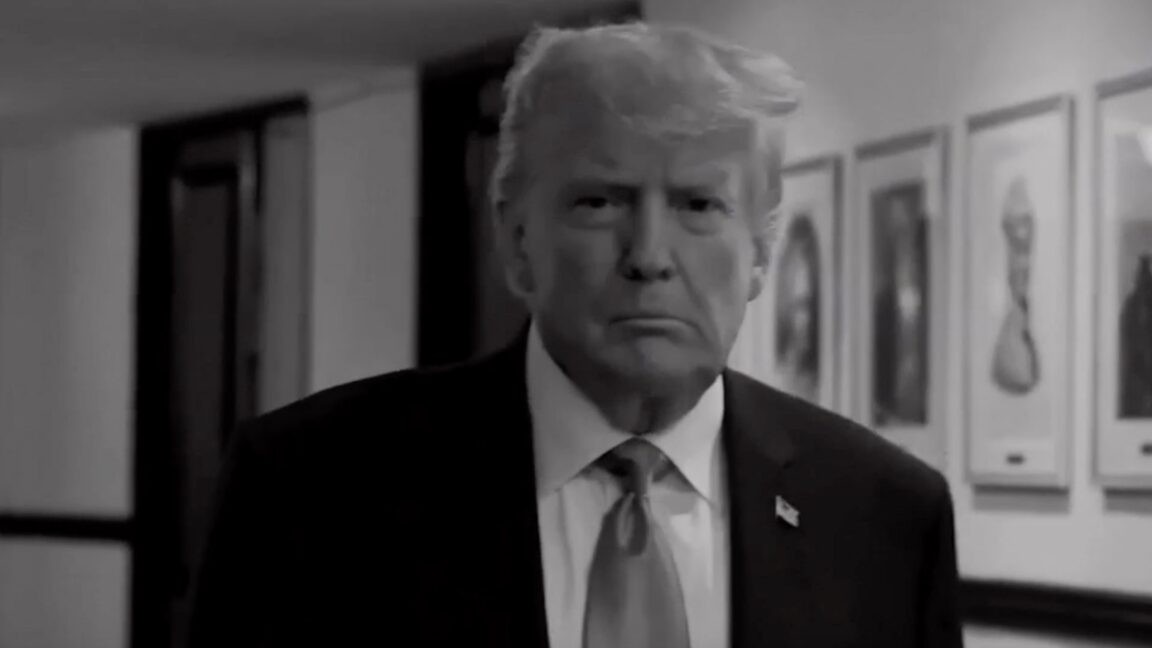
Screenshot from a Trump commercial paid for by the US government.
Broadcasters should be ordered to stop running Trump commercials that appear to violate US laws, consumer advocacy group Public Citizen said today in a complaint to the Federal Communications Commission and Federal Trade Commission. The ads appear to violate laws against using taxpayer funds for propaganda and a law that restricts political activity by federal government employees, the group said.
“The most recent of these taxpayer-funded campaign ads, entitled ‘The Final Battle,’ is a copied version of an ad that the Trump campaign committee issued in the 2024 election,” Public Citizen wrote. “In dead serious black-and-white footage, Trump is seen marching down a corridor with a stern look, while the audio blares: ‘This is the final battle. With you at my side, we will demolish the deep state. We will expel the warmongers from our government.’ A notice at the bottom of the screen announces: ‘Paid for by the US government.’”
Trump also says in the ad, “We will cast out the communists, Marxists, and fascists. We will throw off the sick political class that hates our country, we will rout the fake news media, and we will liberate America from these villains once and for all.” It uses the same video and audio from an ad Trump used in 2024, with the main difference being that the 2024 version was paid for by Trump’s campaign committee instead of the US government. The White House claims its recent ads are public service announcements.
The updated version of the “Final Battle” ad aired during NBC’s Saturday Night Live, Fox News Sunday, and several college and NFL football games this past weekend, the Public Citizen letter said. Department of Homeland Security funds were used to pay for the ads, according to a Wall Street Journal report that said, “President Trump personally pushed for the ads and has been involved in their creation.” The other ads include one in which Trump says, “America will never be a communist country,” and another in which he says, “the United States of America is the most successful, most accomplished, most exceptional nation ever to exist in human history.”
Public Citizen, the nonprofit founded by Ralph Nader in 1971, said it “strongly urges the Federal Communications Commission and Federal Trade Commission to direct broadcasters to stop broadcasting these apparently illegal campaign advertisements.” We contacted the FCC and FTC about the Public Citizen letter today and will update this article if either provides any comment.
Broadcasters likely wary of FCC threats
It’s highly unlikely that the FCC or FTC would order broadcasters to stop running the Trump ads. FCC Chairman Brendan Carr’s history of attacking broadcasters that Trump dislikes suggests he is more likely to threaten the licenses of broadcasters that refuse to run the ads. Both Carr and FTC Chairman Andrew Ferguson also backed Trump’s expansion of power over nominally independent agencies like the FTC and FCC.
Senate Democrats said in a letter to Homeland Security Secretary Markwayne Mullin today that Trump is “illegally using Americans’ tax dollars to fund government propaganda and to put ads from his 2024 campaign back on the air. So far, it appears DHS has dedicated $20 million to this outrageous scheme, tapping funds provided to US Customs and Border Protection in Republicans’ ‘One Big Beautiful Bill Act’ for commemorative events relating to border security.”
The senators’ letter cited an estimate from analytics firm AdImpact “that over $1.7 million in federal funds have already been spent simply airing these ads.”
Broadcasters would likely be wary of rejecting the Trump ads. ABC owner Disney, which is fighting an FCC proceeding that could block renewal of its station broadcast licenses, said in a lawsuit that its editorial decision-making has been affected by FCC threats.
ABC’s The View hasn’t aired any interviews of political candidates since the FCC began the proceeding, and Jimmy Kimmel said he put an interview with a Democratic candidate on YouTube instead of broadcast TV so that local ABC stations wouldn’t have to deal with fallout from the FCC. The FCC historically exempted interviews on daytime and late-night talk shows from the equal-time rule, but the Trump FCC has upended that long-standing policy.
Equal-time rule doesn’t apply, group says
The equal-time rule prohibits broadcast stations from censoring or rejecting political ads paid for and sponsored by legally qualified candidates. However, Public Citizen said the rule doesn’t apply because Trump is not a candidate and that broadcasters should avoid airing ads that violate federal law:
Broadcasters may be held liable for airing any advertisement that is in violation of federal law. Federal law explicitly prohibits using appropriated public funds for government propaganda, self-aggrandizement, or partisan political advertising. Yet, that is exactly the nature of Trump’s recent campaign ads that began airing on September 23, 2026. Furthermore, Donald Trump is not a candidate for any elective office. The FCC and broadcasters are not constrained by the special rule protecting candidate advertisements.
Defending the use of government funds, the White House claimed the ads are “public service announcements.” The ads are “about reminding Americans to love their country and understand what makes it worth defending, at home, at our borders, and abroad,” the White House told media outlets.
But the ads do not qualify as public service announcements, Public Citizen said. “They do not refer to any specific governmental program and they do not serve the purpose of informing the public about any specific governmental program,” the group said. “Instead, the ads are designed to boost the image and character of Donald Trump right before the 2026 midterm elections, and by association to benefit the president’s political party in the upcoming election.”
Public Citizen separately filed a complaint with the US Government Accountability Office (GAO) and Office of Special Counsel (OSC). It alleged violations of “federal laws prohibiting the use of government expenditures for propaganda purposes (5 U.S.C. §3107 and related appropriations laws) and the Hatch Act.”
The Hatch Act prohibits federal employees from engaging in some kinds of political activities. It does not apply to the president, but Public Citizen said “the ad was conceived, produced and distributed by White House staff using government resources for partisan purposes.”
“You cannot use taxpayer dollars for political ads”
When contacted by Ars, the GAO did not offer any comment on the Public Citizen complaint. “Our work is done at the request of congressional committees or subcommittees or is statutorily required by public laws, per our Congressional Protocols,” the agency said. We also contacted the OSC and will update this article if we get a response.
US Rep. Jamie Raskin (D-Md.) last week said the Trump ads “may be felony criminal theft and conversion of government property for political campaign purposes,” and “a Hatch Act violation for any government employees who worked on it or used government resources to make it. It is blatantly unethical under numerous federal ethics provisions proscribing the use of government resources for political campaigns.”
Four Democratic Senate and House lawmakers told the White House in a letter, “The law is not complicated. You cannot use taxpayer dollars for political advertisements.” Senate Majority Leader John Thune (R-S.D.) reportedly said that although he likes the Trump ad’s message, “It shouldn’t be paid for with taxpayer dollars.”
Sen. John Kennedy (R-La.) similarly said he opposes using government money for Trump ads. He has also criticized Kristi Noem, the former secretary of Homeland Security, for a $220 million ad campaign.
“I don’t think any public official, including President Trump or Kristi Noem or John Kennedy, should spend public money on private ads for themselves,” Kennedy said in a CBS interview. “Now, the White House sees it differently, but I don’t… you can’t spend public money to promote yourself.”

Jon is a Senior IT Reporter for Ars Technica. He covers the telecom industry, Federal Communications Commission rulemakings, broadband consumer affairs, court cases, and government regulation of the tech industry.
What's Your Reaction?
 Like
0
Like
0
 Dislike
0
Dislike
0
 Love
0
Love
0
 Funny
0
Funny
0
 Wow
0
Wow
0
 Sad
0
Sad
0
 Angry
0
Angry
0











Comments (0)