

Understanding ICM, Part Two: Image Integrity
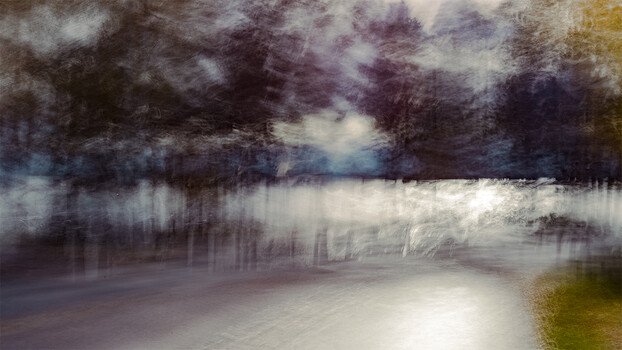
Beyond the gesture lies the question of what survives the movement. This part moves from the mechanics of the camera to the discipline of the image, identifying the "points of failure" where structure, color hierarchy, and spatial layers collapse into visual mud. It defines the "indexical anchor" as the boundary between a durable photographic image and a decorative dissolve.
ICM, or intentional camera movement, is often described through a split between expressive effect and disciplined technique. In the first part, this split was outlined. That conflict does not remain at the level of discourse. It becomes visible in what happens to the image under movement.
The Anchor of the Medium
Motion blur itself is rarely what carries value here. Value gathers around an image in which something remains after movement: retained form, a recognizable scaffold, a suggested subject, or at least the idea of a scene. These distinctions already exist inside the field. They are not an external theoretical superstructure. Nor do they exist as a gathered system. They appear in scattered form, as recurring evaluative formulas through which stronger results are already separated from weaker ones.
The field comes closest here to the difference between image-dissolving motion blur and image-bearing motion. In one case, movement dissolves the image into effect. In the other, movement reorganizes the image while preserving enough internal organization for further reading. This distinction is already sensed. What is still missing is a clear system and a stable terminology.
A recognizable scaffold matters for a reason different from the viewer's simple wish to "recognize something." Comfort is not the point, and neither is everyday recognizability. Its role is that of an indexical anchor. What remains recognizable matters because through it a trace of the image's connection to a real scene is preserved. This indexical residue keeps the image inside the photographic medium and separates it from generative forms of visual art. For that reason, a recognizable scaffold cannot be reduced to banal figuration or to the demand to leave more objecthood in the frame.
The issue is wider than form in the narrow sense. After movement, different kinds of support may remain in the image: an anchor form, a residue of the scene, a suggested subject, a direction of space, a readable relation between masses, a retained light logic, an object anchor, a minimum of spatial orientation.
This criterion matters as a question of the minimum viability of the result. Evaluation shifts from the gesture itself to what survives the gesture. Intentional movement is insufficient. Expressive appearance is insufficient. A quick visual hit is insufficient. The question is whether enough image survives after movement for the frame to continue working as photography rather than only as a brief effect.
The field still does not have a gathered system for describing this distinction with precision. It has no stable vocabulary for readable motion, retained structure, layered depth, durable image organization, or indexical residue after motion. It can recognize a stronger and a weaker result, but it still cannot break that difference down into clear image criteria. The distinction between strong and weak ICM already exists in practice. It remains incompletely formulated and terminologically unstable.
The Real Point of Failure: Image Breakdown
The problem of ICM does not appear in movement alone. It appears in what movement does to the image. The point of failure is image integrity. Failure does not happen at the level of intent. It happens where movement breaks the image itself. Contour breaks, and chromatic relations break with it. In a complex scene, movement damages not only outlines, but the color relations on which the image depends.
Competing surfaces, layered textures, mixed colors, and multiple depth cues collapse into visual mud. Forest, city, shoreline, layered texture, competing surfaces, multidirectional color patches, and complex depth all collapse easily under movement. The issue is not that the result turns "ugly." The issue is that the image loses the relations that make it readable.
Complex scenes expose the real limits of the technique. In a simple scene, movement can remain convincing for a long time and still not reveal the method's limit. Failure in ICM often shows itself as loss of pulse, loss of color hierarchy, and flattening of layered space. In a complex scene, it becomes clear at once whether motion blur transforms the image or only dissolves it. This is where the test happens: whether the scene can withstand the intervention, or whether it collapses before a new visual order emerges.
Mass discourse romanticizes motion blur as almost guaranteed expressiveness. It rarely addresses how often movement simply destroys the chromatic and spatial organization of the scene. The real point of failure in ICM lies here. Neither the boldness of the gesture nor the degree of painterliness decides the result. The question is whether enough internal organization survives after movement, whether color relations hold, spatial layers remain readable, and the image continues to work as an image.
Strategies of Avoidance
The same types of scenes recur in ICM with striking regularity: sky, water, horizontal fields, large homogeneous surfaces, restricted tonal ranges, monochrome. These conditions reduce the number of competing color zones, intersecting textures, and conflicting depth layers, and with that the risk of destroying chromatic relations and the collapse of image organization described in the previous block.
In more complex scenes, where surfaces are oriented in different directions, colors mix, and depth becomes layered, the same type of movement much more often leads to image breakdown. This contrast between simple and complex scenes is not accidental. It reflects a pattern in how the technique is used.
Repeated choices of scene and condition begin to function as a form of risk management, even when they are not articulated in those terms. They narrow the range of situations in which movement is likely to destroy the image, and as a result, the stable visual vocabulary of ICM forms around what more easily preserves internal organization under motion blur.
Many canonical-looking ICM images arise precisely under these conditions. What they show is not the outer limit of the technique's expressive possibilities, but its most stable zone of application. This does not make such images false, but it does change the way they are read. They indicate where the technique works reliably, rather than where it reaches maximum complexity.
As scenes and conditions become restricted in this way, the variability of composition decreases, and results begin to resemble each other at the level of their internal organization. Even carefully executed works often begin to resemble one another in color, depth, and the narrow range of relations that survive under motion. This is where the link becomes visible: between scene choice, reduced risk of breakdown, and the repeatability of the result. It is this link that strengthens the perception of ICM as a decorative technique, even when it is executed with control and skill.
Task vs Effect
ICM is rarely discussed as an answer to a specific visual task. Unlike techniques such as panning or motion freeze, it usually enters discourse through look rather than function. The field is far more willing to describe how ICM looks than what it is supposed to do to the image.
Because of this, problem-solving logic does not disappear from practice, but it does not become the main frame through which the practice is described. The technique exists, the gesture exists, the parameters exist, but the task itself remains unnamed. In stronger work, movement is used to change the sequence in which the image is read. Color relations shift, depth reorganizes, and the scene no longer functions as a straightforward description, yet does not disappear. This difference is often visible in practice, but it is rarely named as a task. As a result, discussion shifts away from the condition of the image and toward the force of the first effect.
Once a technique is no longer tied to a clearly named task, it becomes much easier to read as effect. The absence of a task-level definition intensifies both the cultural suspicion around ICM and the internal instability of the term itself. That is why ICM so easily oscillates between serious practice and decorative trick.
Screen Against Time
Contemporary circulation of ICM is largely screen-first. In that environment, immediate legibility and rapid visual impact are what get rewarded. Motion blur is especially well adapted to this mode of reading, because the effect of movement is read faster than the internal organization of the image. Blur-based images therefore gain an advantage under conditions of rapid viewing. A frame can produce a strong first impression before it becomes clear whether any internal organization is actually present.
Print or prolonged viewing bring a different question into view. The issue is no longer how striking the image looks immediately, but whether it continues to open up or exhausts itself after the first visual response. The distinction therefore does not pass simply between screen and print. A more precise opposition runs between instant recognition and sustained looking. The field rarely asks whether an ICM image can withstand time, although this remains one of the strongest separators between decorative effect and a structurally durable image.
The choice of medium becomes significant only in relation to the condition of the image itself. When an ICM image preserves elements of a real scene, a residue of structure, depth, and relations between layers, these things require scale if they are to remain discernible. On screen, especially in fast viewing, they often collapse into a generalized effect of movement. Enlargement makes a different test possible. It becomes visible whether microstructure survives inside the movement, whether color relations remain, and whether spatial organization still holds. The question therefore concerns time, but also scale. Can the image work at a size where the viewer studies detail instead of registering the overall effect?
This is where ICM images begin to diverge most sharply. Some fall apart into unorganized mass when enlarged. Others begin to work with greater complexity and make their structure available to longer looking, almost as in painting. In that sense, the shift from effect to image becomes visible not only through time, but through scale as well. The image stops functioning as an instant visual response and begins to withstand longer and more detailed viewing. ICM stops reading as gimmick at the point where enlargement does not destroy it, where the image remains capable of functioning as an image at scale.
To be continued.
What's Your Reaction?
 Like
0
Like
0
 Dislike
0
Dislike
0
 Love
0
Love
0
 Funny
0
Funny
0
 Wow
0
Wow
0
 Sad
0
Sad
0
 Angry
0
Angry
0








Comments (0)