

What Photography Asks of You
I've never been able to decide whether writing is more demanding than photography or the other way around. Every few years I convince myself I have the answer, and then something happens that proves me wrong.
There are mornings when I can spend four hours writing a single page, moving commas around as if they were furniture in a house I no longer recognize. By the time I stand up from my desk, I feel strangely exhausted, not physically, but in a way that's harder to explain. It isn't the kind of tiredness that comes from effort. It's what remains after you've spent hours arguing with yourself.
Photography looks easier from the outside. You leave the house, put a camera over your shoulder, and start walking. Compared to writing, it almost seems like an escape.
It isn't.
The street has a way of reminding you that you don't control very much. You don't decide who will walk into the frame, where the light will fall, or whether two strangers will cross paths at precisely the right moment. You simply arrive and accept whatever the day decides to offer. Some afternoons, the city seems to hand photographs to you one after another. Other days it remains completely silent, and no amount of experience changes that.
People often ask whether street photography can be planned. I don't think it can, at least not in the way many imagine. You can choose the neighborhood. You can decide to go out at sunrise instead of noon. You can learn how people move through public space. But the photograph itself belongs to chance far more than it belongs to you.
Perhaps that's what keeps me interested after all these years.
Every time I walk into a crowd, I know I'm about to negotiate with uncertainty.
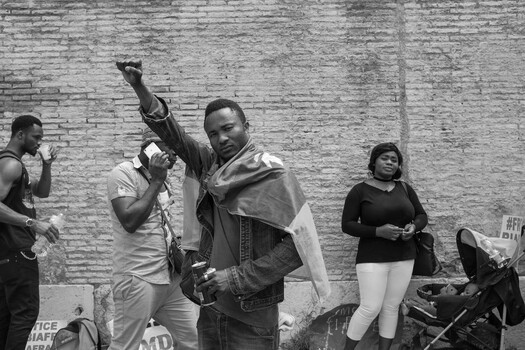
I remember photographing a demonstration in Rome years ago. Thousands of people, banners, police officers, speeches, noise everywhere. Anyone could have documented what happened that morning, and many did. What interested me wasn't the event itself. I found myself waiting for something quieter, almost invisible. A gesture that echoed a classical painting. A face isolated for a fraction of a second. A composition that transformed political chaos into visual order without changing the truth of what was happening. If you want to build that kind of range across unfamiliar situations, The Well-Rounded Photographer: 8 Instructors Teach 8 Genres of Photography is a useful place to start.
Those are the moments I still think about.
Not because they're spectacular.
Because they reveal something that existed for less than a second.
The strange thing about photography is that we're never looking with empty eyes. Every photograph we've admired, every film that left a mark, and every novel that built an image in our imagination continues to travel with us. We don't imitate them consciously, but they're there all the same. They shape our instincts before we even realize we're making decisions.
People like to imagine originality as the absence of influence. I've come to believe the opposite is true. Originality begins when all those influences become impossible to separate from your own experience. Eventually, they stop belonging to other people. They simply become part of how you see.
The difficult part isn't learning exposure or composition. Those things matter, of course, but they can be taught. What's much harder is accepting that every photograph says something about the person who made it.
Every frame is a small confession. Not necessarily about what you believe, but about what you notice. And what you notice says more about you than any artist's statement ever could.
The same is true of writing.
Whenever I publish an article, I know someone will disagree with it. Someone else will misunderstand it completely. Another reader will skim through it and move on without remembering a single sentence. That's never really bothered me. If anything, it's part of the deal. Creative work has always required a certain willingness to expose yourself without knowing what will come back.
People sometimes describe artists as if they're at war with the world. I've never seen it that way. The real conflict happens somewhere quieter. It's between the work you know you're capable of making and the work you actually produce. Between the photograph you imagined and the one you took. Between the sentence you wanted to write and the one that finally appeared on the page. That distance never completely disappears.
And maybe it shouldn't.
I often think that's the reason I continue writing and photographing instead of choosing one over the other. Photography teaches me to trust what happens before language has time to interfere. Writing forces me to return to those same experiences and understand why they mattered in the first place. One discipline catches the world while it's moving. The other sits with it afterward. Together, they've become less like professions and more like ways of paying attention.
People occasionally tell me they enjoy my photographs, and I'm grateful every time I hear it. But when someone writes to say that a paragraph stayed with them for days, that it reminded them of something they had forgotten about themselves, I feel something different. Maybe it's because I started as a reader long before I became a photographer. Maybe words still feel like home.
In the end, I've stopped trying to separate the two, because they are part of the same process, and the process leads to identity.
Whether I'm carrying a camera through the streets or sitting alone in front of a blank page, I'm really doing the same thing.
I'm trying to understand why certain moments refuse to let go of us, and whether it's possible, just once in a while, to give them a form that might stay with someone else.
The photographs that accompany this essay come from a demonstration held in Rome by members of the Biafran community, people asking the world not to look away from a tragedy that has unfolded for decades.
Everything I have written here exists inside those photographs, although without a single sentence. The uncertainty, the search for order inside disorder, the awareness that every meaningful frame lives for only a fraction of a second. Those images are, in many ways, the essay before it became words.
What's Your Reaction?
 Like
0
Like
0
 Dislike
0
Dislike
0
 Love
0
Love
0
 Funny
0
Funny
0
 Wow
0
Wow
0
 Sad
0
Sad
0
 Angry
0
Angry
0






Comments (0)