

Why a Bird Photographer Keeps Choosing Canon's RF 200-800mm Over Sharper Lenses
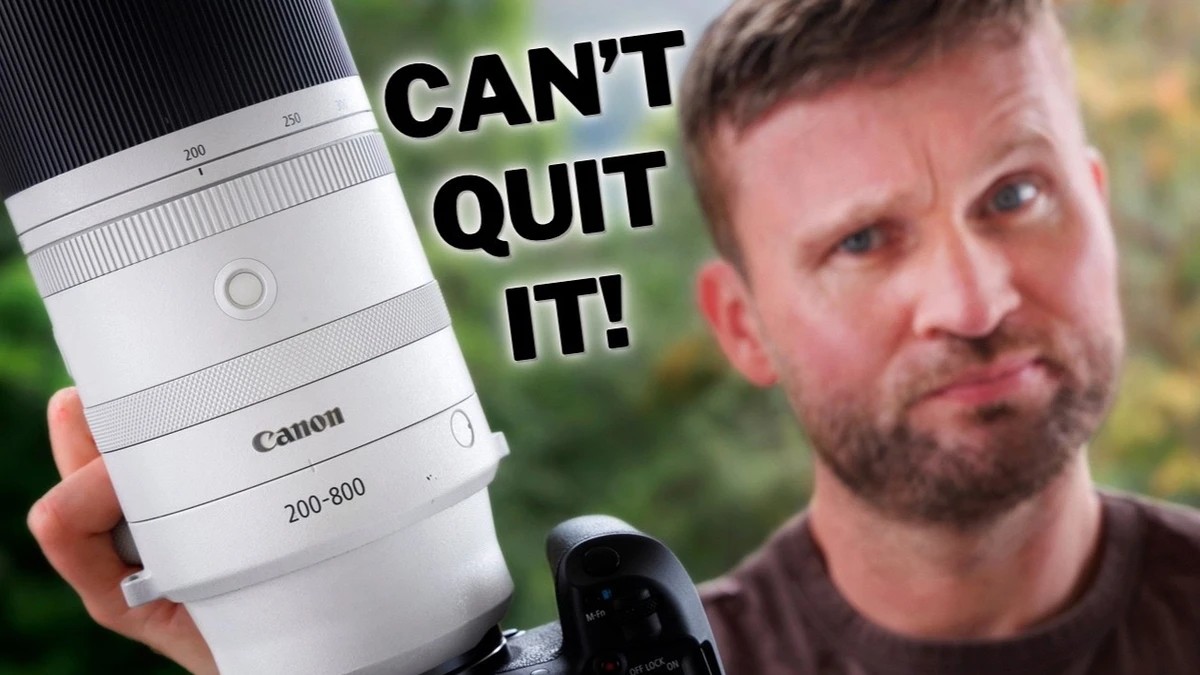
Canon's 200-800mm is big, stiff to zoom, and slow at the long end, yet no other Canon lens covers that range in a single barrel. If you shoot birds or wildlife, knowing when that range beats sharper, faster glass decides what you carry every time you head out.
Jan Wegener calls the $2,249 Canon RF 200-800mm f/6.3-9 IS USM the most frustrating lens he owns, then explains why he keeps choosing it over his $3,099 Canon RF 100-500mm f/4.5-7.1 L IS USM and $14,499 Canon RF 600mm f/4 L IS USM. He usually takes it when he wants reach without commitment, on a walk or when he doesn't know what he'll find, and grabs the L lenses when he knows great birds will be there. His case starts with a pair of topknot pigeons he had chased for years. One morning, the male kept flying low toward a small tree in an open field, where he hung upside down from thin branches and snapped off sticks for a nest. Wegener had walked over with the 100-500mm, and at 500mm, he could get the wider frames but not the tight head portraits that show off the bird's wild crest. Moving closer would have made the angle too steep, so he added a Canon Extender RF 1.4x.
With the extender on, he finally had his portraits, right up until the pigeon took off and he couldn't zoom out far enough to follow it. Every time he removed the extender, the bird settled into a perfect spot for a close-up. Every time he put it back, the bird moved somewhere that called for a wider frame. He briefly considered the 600mm prime with the extender, which would have given him excellent portraits at 840mm and made nearly everything else impossible. The 200-800mm sitting in the car came with known costs: fewer keepers at 800mm, autofocus that tends to jump on and off the subject, and fine detail that falls a little behind his L lenses. He was already missing shots, though, so he ran back for it.
On a Canon EOS R5 Mark II, the zoom let Wegener move freely, pull back whenever the pigeon flew, and push to 800mm for the head shots. Up close, his files at 800mm hold up better than the lens' reputation suggests. His approach to the sharpness gap is practical: shoot plenty of frames in the field, then sort through them at home for the best ones. He also caught the pigeon's last trip of the day, flying right past him with a branch in its beak. It never came back, since topknot pigeons apparently consider a handful of sticks a finished nest, so its work was done by 8 a.m.
The pattern repeated the day before he recorded, when a group of lorikeets feeding on flowers sat too far away for 500mm and at an awkward angle. Another sprint to the car for the 200-800mm got him the video clips he wanted. At an egret rookery, the same lens lets him stay put and frame anything from the whole colony to a single nest, and the extender stretches it to 1,120mm with surprisingly good results in decent light. Against a distant background at the beach, the difference between f/9 and the f/13 you get with the extender barely shows. Low light is a different story. There, f/9 holds the lens back, and pushing the ISO very high often gives flat files with flare in bright areas, so it wouldn't be his first choice. A good editing workflow can restore contrast and vibrancy, pull out detail, remove noise, and even improve frames that came out softer than he hoped. That's how a pink robin he photographed at high ISO in a dark rainforest went from an ordinary raw file to an image he's very happy with.
He thinks some of his dislike is warranted. The lens has shortcomings, and he'd love Canon to make a higher-end L version, perhaps with an internal zoom, better optics, and better handling, which he would gladly pay for. Even so, he'd buy this one again, and he thinks it makes sense for many other Canon shooters, especially anyone who doesn't already own an expensive collection of lenses, since it packs enormous reach and flexibility into a relatively small, affordable package. Going from 200mm to 800mm without swapping lenses or adding a teleconverter is what keeps bringing him back to it.
You can watch the whole topknot pigeon sequence, branch and all, in the video.
What's Your Reaction?
 Like
0
 Dislike
0
 Love
0
 Funny
0
 Wow
0
 Sad
0
 Angry
0










Comments (0)