

Why Boredom Might Be the Best Thing for Your Street Photography
Most street photography outings involve long stretches where nothing worth photographing happens, and how you handle those stretches shapes what you bring home. If you've ever walked for two hours, felt the pressure build, and started shooting anything that moved, you already know the problem.
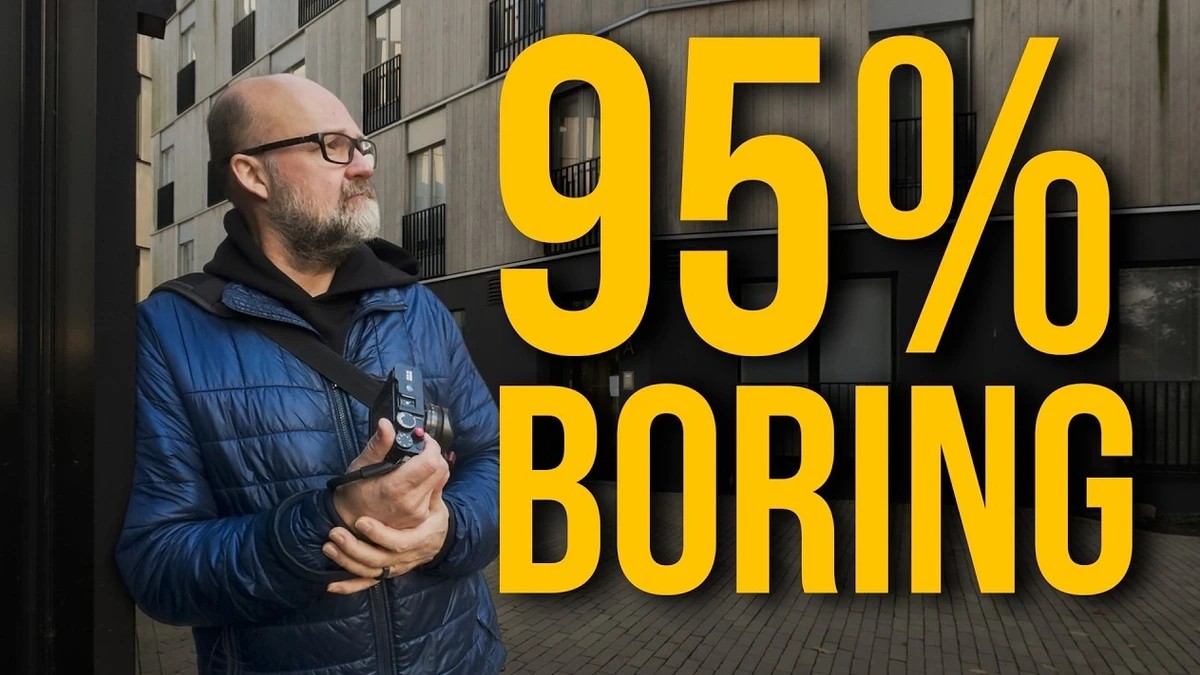
Street photography is roughly 95% boredom, according to Peter Forsgård, and he argues that the dull part is where your eye gets trained. He points out that reels and photo walk clips, his own included, show the moment an image gets made and skip the hours of walking that led up to it. Finished work hides the same thing. An exhibition of 50 prints sits on top of something like 10,000 frames that never left a hard drive, and you never see those. Keeping that ratio in mind changes how a quiet afternoon feels, since a walk with no keepers starts to look like the ordinary state of the craft. Forsgård goes further and asks you to embrace the rejects too, since the keepers don't exist without them.
Forsgård separates two kinds of shooting that look similar from the outside. In his first hour out, he rarely makes much, so he takes warm-up shots of whatever catches his interest to get his eye moving. That's a deliberate part of his routine, and he usually heads out with an idea or one of several ongoing projects in mind. Later in the walk, if boredom sets in and he starts shooting just to have something on the card, those are panic shots, and he says that's where most bad images come from. The signs are physical: you walk faster, cover more ground, and drift without direction. He calls that restlessness the enemy, and his advice is to stay bored and let it sharpen your attention instead of trying to escape it.
Part of why the empty time has grown for him is a change in what he's after. Shooting people stepping into a pocket of light or walking past an interesting building was easy in a city, and a few minutes on one spot would produce plenty of frames. Forsgård's response to those images now is "so what?" Unless something about the person or the background makes the picture talk to you, he finds them thin, so he chases gestures, emotion, and people interacting with each other. Those moments are much rarer, which means more walking between keepers. He also keeps a running project on the graffiti-painted electrical boxes around Helsinki, about 700 of them across the city, some worn and some in good shape, which gives him something to work on when the street goes quiet.
The ancient Greeks had two words for time. Chronos was the steady count of hours, and kairos was the right moment, the opening you either catch or miss. Forsgård has leaned on that pair before, and it maps cleanly onto a street walk, where the kairos moments only show up inside a lot of chronos. Film-era photographers lived with this ratio in plain view, because every roll came back as a contact sheet showing the misses beside the frame that got printed. The 2011 book Magnum Contact Sheets collected those sheets from well-known assignments, and many of them show a photographer working one scene frame after frame before arriving at the image people remember. Digital removed the cost of each frame, so the editing pressure moved from the darkroom to your own head on the sidewalk. If you can sit comfortably in the slow hours, you can also afford to hold the shutter until a scene gives you a reason to press it, and the frames you do take carry more intent.
When restlessness wins anyway, Forsgård's fix is low-tech. After an hour or two with nothing, he stops for a coffee, slows down, and watches people in the café until he feels calmer. He jokes that it could just be the caffeine. Back on the street, he tends to pick one corner and stay with it rather than roaming, and that usually pulls him out of the rut. He ties the same idea to shooting on dull days, when flat light forces you to watch what people are doing instead of leaning on the light, and to the way a walk that ends with only a handful of frames can still leave him with a spot worth returning to.
Forsgård's case for learning to love the slow 95% is in the video above.
What's Your Reaction?
 Like
0
Like
0
 Dislike
0
Dislike
0
 Love
0
Love
0
 Funny
0
Funny
0
 Wow
0
Wow
0
 Sad
0
Sad
0
 Angry
0
Angry
0











Comments (0)