

Why Do People Lose Money in Crypto? 7 Common Mistakes
Crypto has produced large gains for some investors. It has also produced large losses for many others.
Price swings are only part of the story. Research points to timing, risk size, borrowing, scams and weak exit plans as the main causes of losses.
This article looks at seven common mistakes and the statistics behind each one. It draws on research from the Bank for International Settlements (BIS), CoinGecko, Chainalysis, the UK Financial Conduct Authority (FCA) and the OECD.
None of this means everyone loses money in crypto. Results depend on when people buy, what they buy, how much risk they take and how they react when prices fall.
Crypto Loss Statistics at a Glance
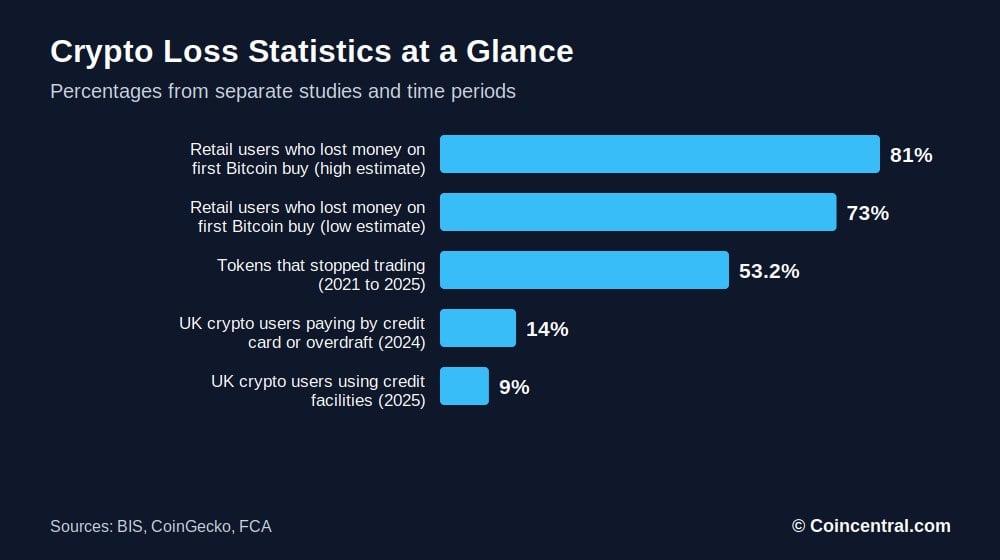
Several studies give a picture of how often things go wrong. The BIS estimated that 73% to 81% of retail crypto investors lost money on their first Bitcoin investment during the period it studied.
CoinGecko found that 53.2% of tokens tracked on GeckoTerminal between 2021 and 2025 stopped trading. Chainalysis estimated that scams and fraud took in at least $14 billion in 2025.
| Retail users who lost money on first Bitcoin investment | 73% to 81% | BIS |
| Tokens that stopped trading, 2021 to 2025 | 53.2% | CoinGecko |
| Token failures in 2025 | 11.56 million | CoinGecko |
| Scam and fraud inflows in 2025 | At least $14 billion, possibly above $17 billion | Chainalysis |
| Leveraged positions liquidated on October 10, 2025 | About $19 billion in 24 hours | CoinGecko |
| UK crypto users paying with a credit card or overdraft, 2024 | 14% | FCA |
Figure 1: Key percentages from BIS, CoinGecko and FCA research. The studies cover different groups and periods, so the numbers should not be compared directly.The figures come from different studies, countries and time periods. They are best read as separate warning signs, not as one combined total.
1. Buying After Prices Have Already Surged
One of the most common mistakes is buying because prices are rising fast. This is often called fear of missing out, or FOMO.
An investor sees Bitcoin rise 50%, or a memecoin climb 500%, and decides to buy before it goes higher. By then, much of the gain may already be gone.
What the BIS found
The BIS studied crypto exchange app usage across 95 countries. It found that rising Bitcoin prices were followed by more new users entering the market.
About 40% of these new users were men under 35, a group the researchers described as relatively risk-seeking. The BIS estimated that 73% to 81% of retail investors probably lost money on their first Bitcoin investment.
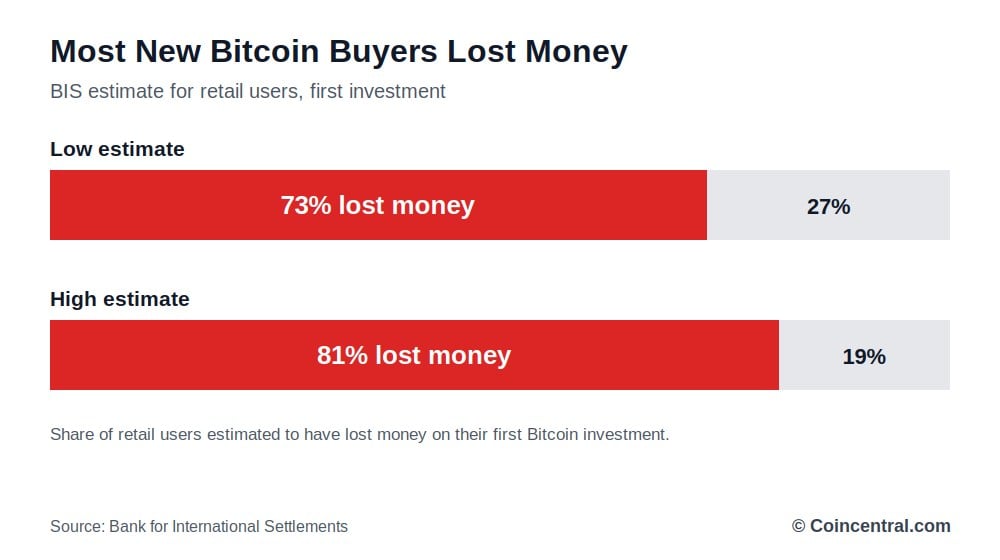 Figure 2: The BIS estimate of retail users who lost money on a first Bitcoin purchase.
The study also looked at major shocks, including the Terra/Luna collapse and the FTX failure. Larger and more experienced investors tended to sell, while smaller retail investors kept buying.
A common pattern
- Prices rise.
- Media coverage grows.
- New investors enter.
- Early holders take profits.
- Momentum reverses.
- Late buyers take the largest losses.
Buying something only because it went up is not an investment plan. It is momentum chasing.
How to avoid it
Decide what you think an asset is worth, why you want it and how much you will invest before a rally starts. Dollar-cost averaging, which means buying in smaller amounts over time, can reduce the risk of putting everything in at a peak.
Missing a rally is not the same as losing money. Another chance will come.
2. Taking Too Much Risk in Small Altcoins and Memecoins
Bitcoin and a newly launched memecoin are both cryptocurrencies, but their risks are very different. Bitcoin has traded since 2009, has deep global liquidity and a market value in the trillions of dollars.
A small token created last week may have no product, anonymous developers, almost no liquidity and no users. Even so, some investors put more money into these assets because the possible gains look larger.
How many tokens fail
CoinGecko studied tokens that traded on GeckoTerminal from July 2021 to the end of 2025. It found that 53.2% had stopped trading, which means more than 13.4 million tokens failed.
The numbers jumped in 2025, when about 11.56 million tokens failed. CoinGecko linked much of the rise to how easy it has become to launch tokens and memecoins.
| Tokens tracked in 2021 | About 428,000 |
| Tokens tracked by 2025 | Nearly 20.2 million |
| Tokens that stopped trading, 2021 to 2025 | More than 13.4 million (53.2%) |
| Token failures in 2025 alone | About 11.56 million |
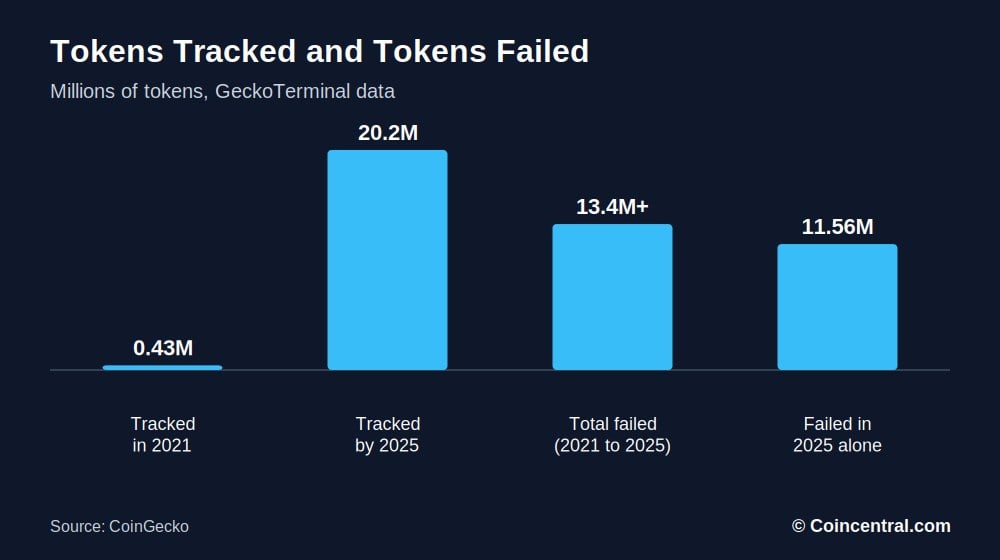 Figure 3: Tokens tracked and tokens that failed, based on CoinGecko data.
When millions of tokens exist, only a tiny share can build lasting liquidity, users and developers. People see the few big winners but rarely the many that disappear. This is called survivorship bias.
Market cap can mislead
Say a token has 100 million coins and the last trade was at $1. Its market capitalization looks like $100 million.
That does not mean holders could sell $100 million worth at $1. Real liquidity may be a few hundred thousand dollars, and a few large sellers can crash the price.
How to avoid it
Treat small altcoins as a separate risk category. Before buying, check these items:
- Token supply and unlock schedules
- Holder concentration
- Trading liquidity
- Developer activity
- Revenue or real usage
- Market cap and fully diluted valuation
If losing 100% of the money would hurt your finances, the position is probably too large.
3. Using Leverage
Leverage magnifies gains, and it magnifies losses by the same amount. An investor with $10,000 who opens a 10x Bitcoin position controls about $100,000 worth of BTC.
If Bitcoin rises 5%, the gain is about $5,000 before fees, a 50% return on the original money. If Bitcoin falls 10%, the entire $10,000 can be lost.
| -10% | -$10,000 | -100% |
| -5% | -$5,000 | -50% |
| -2% | -$2,000 | -20% |
| +2% | +$2,000 | +20% |
| +5% | +$5,000 | +50% |
| +10% | +$10,000 | +100% |
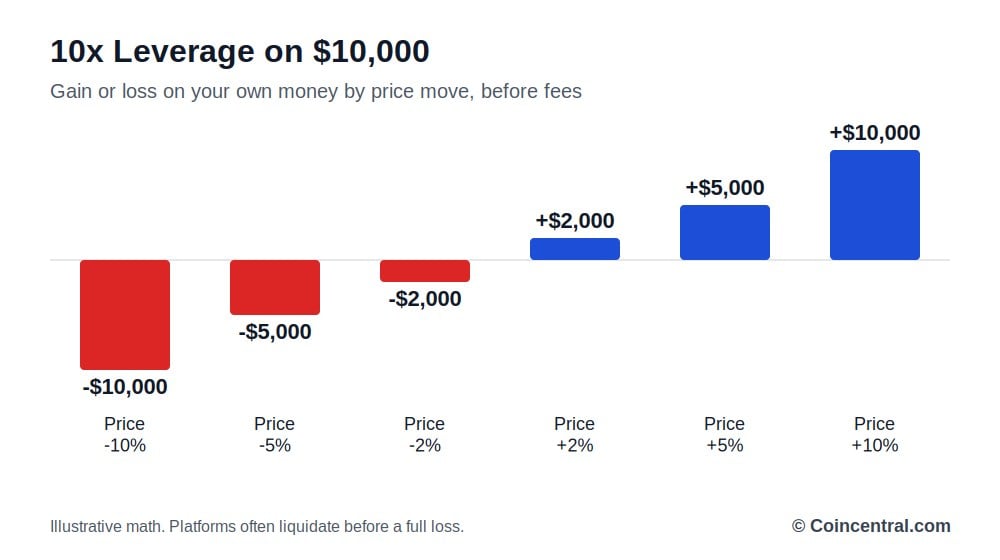 Figure 4: Gains and losses on $10,000 with 10x leverage, before fees and funding costs.
The October 2025 liquidations
CoinGecko’s 2026 analysis pointed to October 10, 2025. About $19 billion of leveraged crypto positions were liquidated in 24 hours, described as the largest single-day deleveraging event in crypto history.
This is why an investor can be right about the long-term direction and still lose everything. Imagine someone opens a heavily leveraged long position at $80,000, expecting $120,000.
Bitcoin drops to $70,000 and later reaches $120,000. An investor without leverage waits it out. The leveraged investor may be liquidated near $74,000 and miss the recovery.
Other costs of leverage
- Funding rates
- Borrowing costs
- Trading fees
- Liquidation penalties
The longer a leveraged trade stays open, the more these costs add up.
How to avoid it
For most long-term retail investors, skipping leverage removes the chance of forced liquidation. Owning an asset without borrowed money means a temporary drop cannot close the position.
4. Investing Money You Cannot Afford to Lose
Crypto losses hurt more when the money was needed for something else. Examples include emergency savings, rent, mortgage payments, credit cards, personal loans and tuition savings.
The FCA warns that cryptoassets are highly speculative and that people should be ready to lose all of their money. Even so, some investors borrow to take part.
UK borrowing data
FCA research found that the share of UK crypto users paying with a credit card or overdraft rose from 6% in 2022 to 14% in 2024. FCA research in 2025 found almost 9% of crypto users were using credit cards or existing credit to buy cryptoassets.
| 2022 | 6% | FCA consumer research |
| 2024 | 14% | FCA consumer research |
| 2025 | Almost 9% | Separate FCA research |
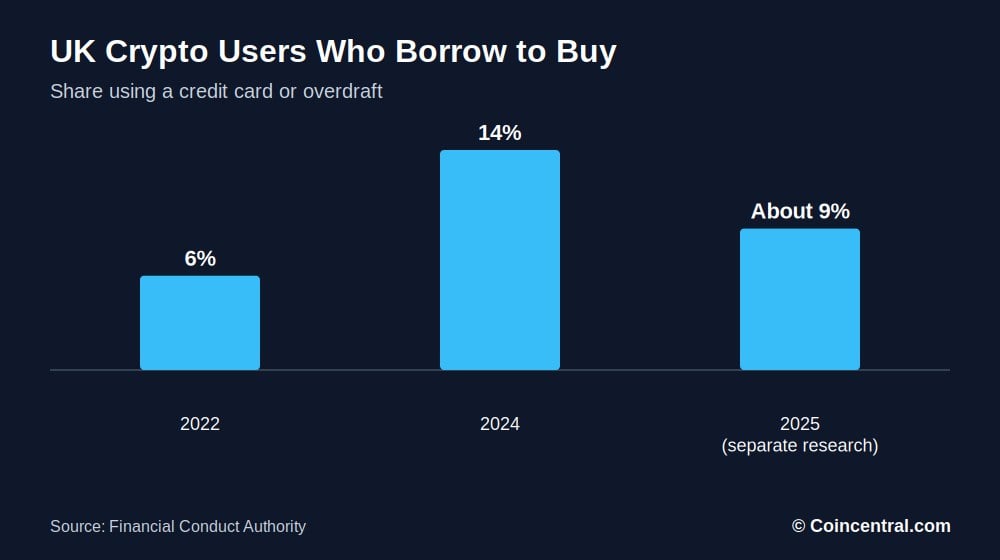 Figure 5: Share of UK crypto users who used credit to buy crypto, based on FCA research.
Borrowing creates two risks. The investment can fall, and the debt stays. If someone borrows $10,000 and the crypto drops 70%, they hold $3,000 of crypto and still owe $10,000 plus interest.
Position size changes behavior
A person with 5% of their portfolio in crypto may handle a 30% drop calmly. Someone with all of their savings invested is more likely to panic.
- Panic selling
- Constant trading
- Trying to win back losses
- Poor sleep
- Dropping a long-term plan
How to avoid it
Size crypto so that even a severe drop does not threaten essential goals. The right amount differs for each person, but one rule holds: do not invest money whose loss would force you to change your life.
5. Trading Too Much and Trying to Time Every Move
Crypto markets run 24 hours a day, seven days a week. There is always something moving, which makes overtrading tempting.
An investor may start with a sensible long-term position and slowly turn into a swing trader. They chase breakouts, rotate between altcoins and sell on rumors.
Each trade adds fees, bid-ask spreads, slippage and possible taxes. It also adds another chance to be wrong.
Behavioral biases
The OECD names FOMO, herding, anchoring and overconfidence as biases that raise risks for crypto investors. Overconfidence can be costly after a few winning trades.
In a bull market, almost everything rises. A trader who buys five altcoins and sees all five gain 50% may believe it was skill, when the whole market simply went up.
Timing means being right twice
Selling well means knowing when to get out. It also means knowing when to get back in.
Suppose an investor sells Bitcoin before a 15% drop, then waits too long to return while Bitcoin rallies 40%. In the example below, holding would have ended with more money.
| Hold through both moves | $10,000 | $8,500 | $11,900 | $11,900 |
| Sell first, buy back after the rally | $10,000 in cash | $10,000 in cash | $10,000 buys in at the higher price | $10,000 |
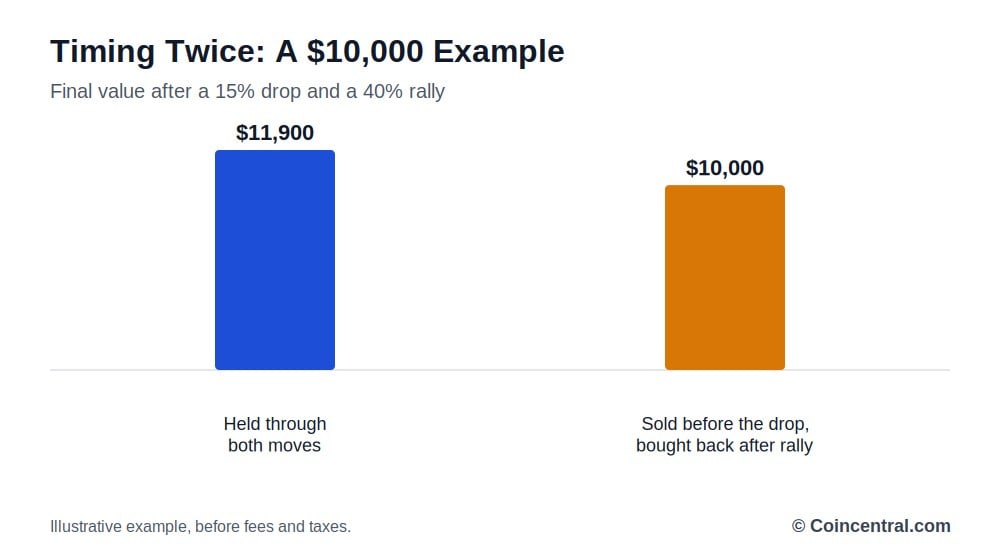 Figure 6: An illustrative example of holding versus selling and re-entering late. It ignores fees and taxes.
How to avoid it
Separate investing from trading. Keep a long-term core holding, and use only a small, separate amount for speculative trades.
- Set a maximum position size
- Set a maximum share of the portfolio
- Avoid leverage
- Rebalance on a schedule
- Do not buy only because the price is rising
Fewer decisions can lead to better results.
6. Ignoring Scams, Security and Counterparty Risk
A crypto investment can perform well and the investor can still lose everything. Wallet access can be lost, an exchange can fail, a transaction can be malicious or money can be sent to a scammer.
Scam statistics
Chainalysis estimates that crypto scams and fraud received at least $14 billion in 2025. It projects the final total could pass $17 billion as more illicit addresses are identified.
The average scam payment rose from about $782 in 2024 to $2,764 in 2025, an increase of 253%. Impersonation scams rose about 1,400% year over year.
| Scam and fraud inflows in 2025 | At least $14 billion |
| Projected 2025 total | Above $17 billion |
| Average scam payment, 2024 | $782 |
| Average scam payment, 2025 | $2,764 (up 253%) |
| Impersonation scam growth | About 1,400% year over year |
| AI-enabled scam profit vs. traditional scams | About 4.5 times higher |
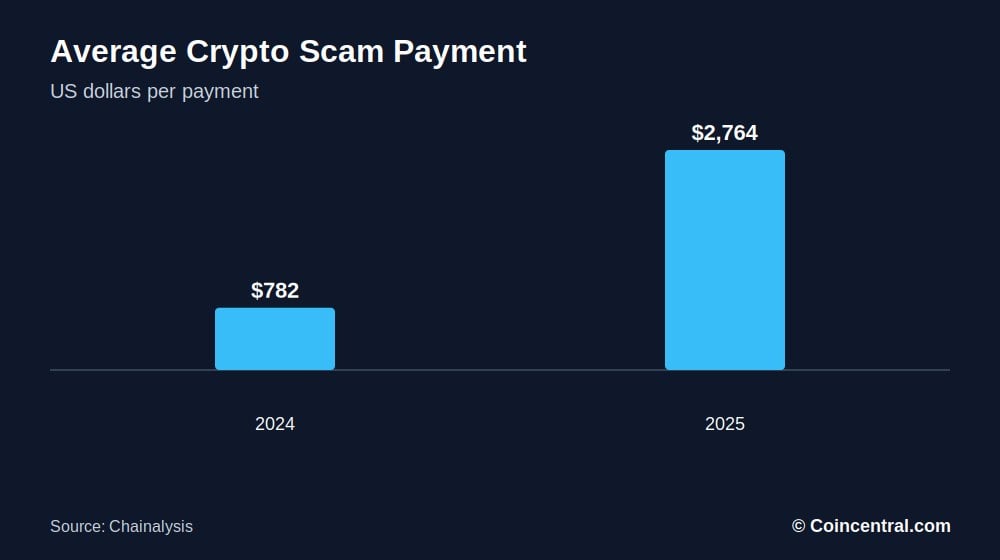 Figure 7: Average crypto scam payment in 2024 and 2025, based on Chainalysis data.
AI is making the problem worse. Chainalysis found AI-enabled scams were about 4.5 times more profitable than traditional scams in its 2025 data.
Common tactics include these:
- Deepfake videos
- Fake celebrity endorsements
- Fake customer-support agents
- Phishing websites
- Investment groups and romance scams
- Fake trading platforms
- Malicious wallet approvals
Security losses go beyond scams
OECD analysis of crypto cybersecurity incidents from 2016 through 2026 found that compromised private keys and wallet phishing caused more than $9 billion in losses.
Exchange risk
Investors learned about platform risk when FTX, Celsius, BlockFi, Voyager and Genesis failed. The FCA notes that Celsius owed users around $4.7 billion when it entered bankruptcy.
A person can pick the right coin and still lose access to it because the company holding it collapses.
How to avoid it
- Use strong, unique passwords
- Turn on two-factor authentication
- Never share a seed phrase
- Check website addresses carefully
- Be wary of unsolicited messages
- Avoid unknown wallet connections
- Consider self-custody for long-term holdings when it suits you
No real support agent needs your recovery phrase.
7. Having No Exit Strategy
Many investors know why they are buying. Fewer know when they will sell.
Imagine a token bought at $1 that rises to $3. The investor waits for $5, then $10, then reads predictions of $20.
The market turns and the token falls to $6, then $3, then $1. A large profit disappears because there was never a plan to collect it.
Bull markets also change expectations. A 100% gain can feel disappointing after seeing other tokens rise 500%.
Unrealized gains are not permanent
Until an asset is sold, its value can change. Bitcoin has had several declines of more than 70%, and smaller coins have often fallen 90% to 99%.
The math works against investors after deep losses. A 90% drop needs a 900% gain just to break even.
| 25% | 33% |
| 50% | 100% |
| 70% | 233% |
| 80% | 400% |
| 90% | 900% |
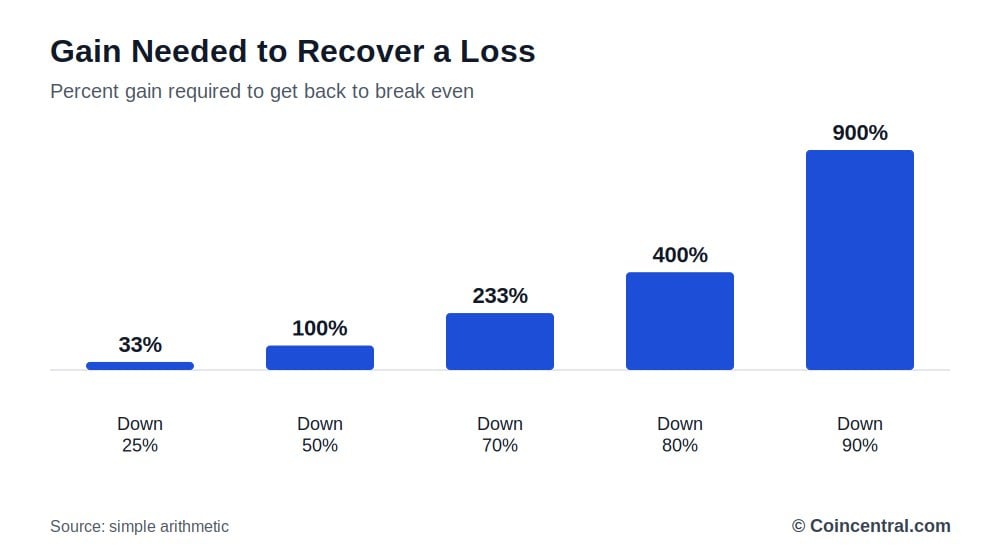 Figure 8: The gain needed to return to break even after a loss.
If a token falls from $100 to $10 and then doubles to $20, the investor is still down 80%.
Taking profit does not mean selling everything
An exit plan does not have to be all or nothing. The goal is not to call the exact top, which almost nobody does well over time.
- Recover the original investment after a large gain
- Sell portions at set targets
- Rebalance when crypto grows too large in the portfolio
- Hold a long-term core while taking profits on speculative assets
The aim is to stop a winning trade from becoming a loss because expectations kept rising.
Why Investors Lose Even When Long-Term Prices Rise
A key finding from the BIS is that retail investors can lose money even when an asset does very well over time. Bitcoin’s long-term record is strong, yet the BIS estimated that roughly three-quarters of retail users in its sample lost money.
The reason is that investor returns and asset returns are not the same. Bitcoin might rise 1,000% over several years, but a person who buys after a 700% rally and sells in the next crash can still lose heavily.
Behavior shapes realized returns. What you buy matters, but so do when you buy, how much you buy, whether you use leverage and when you sell.
The dollar amounts involved
| Leveraged positions liquidated, October 10, 2025 | About $19 billion in 24 hours | CoinGecko |
| Projected scam and fraud total, 2025 | Above $17 billion | Chainalysis |
| Scam and fraud inflows identified, 2025 | At least $14 billion | Chainalysis |
| Private key and wallet phishing losses, 2016 to 2026 | More than $9 billion | OECD |
| Owed to users when Celsius filed for bankruptcy | About $4.7 billion | FCA |
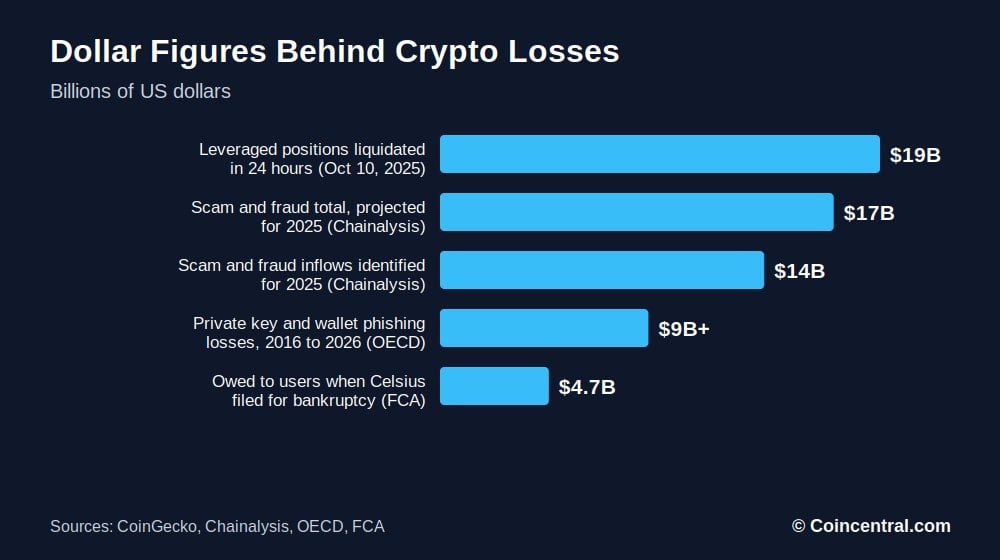 Figure 9: Dollar figures linked to crypto losses, based on CoinGecko, Chainalysis, OECD and FCA reports. The figures cover different events and periods.
A Simple Framework for Crypto Investing
Avoiding these seven mistakes does not guarantee profits, and crypto remains risky. A set of rules can still cut avoidable losses.
- Understand the asset before investing.
- Keep position sizes manageable.
- Avoid borrowing and excessive leverage.
- Spread money across assets instead of betting on one token.
- Use reputable platforms and strong security.
- Set rules for buying and selling.
- Assume any speculative token could become worthless.
The FCA says crypto investors should be able to lose their entire investment. That does not mean every coin will go to zero, but a portfolio should allow for the possibility.
The Bottom Line
People rarely lose money in crypto because of one factor. The same mistakes appear again and again: buying after surges, taking too much risk in speculative tokens, using leverage, investing money they need, trading too often, underestimating scams and having no exit plan.
The BIS estimated that 73% to 81% of retail users lost money on their first Bitcoin investment. CoinGecko found that 53.2% of tracked tokens stopped trading, and Chainalysis estimated scams could reach about $17 billion in 2025.
These numbers do not mean crypto cannot be profitable. They show that avoiding large losses matters, because an investor who survives a downturn stays invested for the next upswing.
Sources
- Bank for International Settlements: Crypto Trading and Bitcoin Prices: Evidence From a New Database of Retail Adoption. Research estimating that roughly 73% to 81% of retail users lost money on their first Bitcoin investment.
- Bank for International Settlements: Crypto Shocks and Retail Losses. Analysis of investor behavior around the Terra/Luna and FTX collapses.
- CoinGecko: Dead Coins: How Many Cryptocurrencies Have Failed?. 2026 study of token failures in GeckoTerminal data.
- Chainalysis: 2026 Crypto Crime Report: Scams. Estimates of 2025 scam and fraud inflows.
- Financial Conduct Authority: Investing in Crypto. Risk guidance for retail crypto investors.
- FCA: Cryptoassets Consumer Research 2024. Research on crypto ownership and funding methods.
- FCA: Cryptoassets Consumer Research 2025. Updated data on UK crypto investors.
- OECD: Improving the Digital Financial Literacy of Crypto-Asset Users. Research on FOMO, herding and overconfidence.
- OECD: Asia Capital Markets Report 2026: Developments in Crypto-Asset Markets. Analysis of crypto cybersecurity losses.
The post Why Do People Lose Money in Crypto? 7 Common Mistakes appeared first on Blockonomi.
What's Your Reaction?
 Like
0
 Dislike
0
 Love
0
 Funny
0
 Wow
0
 Sad
0
 Angry
0












Comments (0)