

‘Woman Unknown’ Review: May el-Toukhy’s Paranoid Period Thriller Depicts the Degradation of Women Accused of Sleeping with Nazis
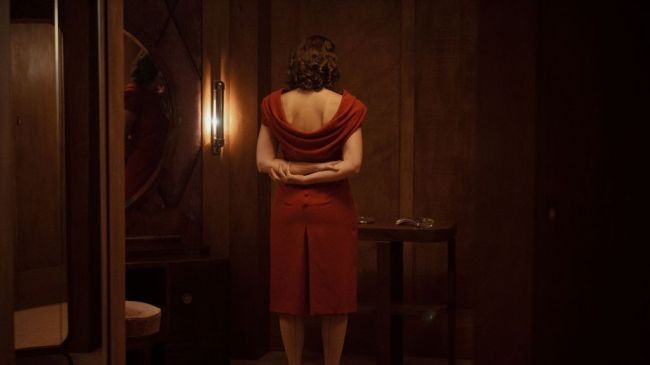
It’s a bold move to center a character study on a person determined to fly beneath the radar. Danish actress Mathilde Arcel is the focus of almost every frame in this slippery period thriller, yet she internalizes her concerns, only speaking when essential and, even then, weighs and measures her utterances so that they both give satisfaction and divert attention elsewhere. Deeper communication comes from restless eyes that scan her surroundings like a small animal who can sense predators nearby. This is a film about how fear can efface a woman’s identity until she disappears under a social mask, performing irredeemable deeds to survive.


The aptly titled “Woman Unknown” is Danish-Egyptian director May el-Toukhy’s third feature, arriving seven years after “Queen of Hearts” (remade by Catherine Breillat in 2023 as “Last Summer”). Following a foray into TV, directing episodes for “The Crown” and “Cry Wolf” el-Toukhy is back on the queasy terrain that seems to be her creative home. She brings the unflinching gaze that she used to explore a gender-flipped Lolita to tell the story of a barbaric, postwar witch-hunt.
Our setting is Denmark, 1945, in a period of anarchy shortly after the Nazi occupation. Arcel’s character Marie (or should that be Karen-Marie?) is a maid and nanny betrothed to her employer, the wealthy widower Christian (Carsten Bjørnlund). He is an older man with a retinue of female servants, elevated social status as a garment factory owner, and a slightly disturbed preadolescent daughter, although “disturbed” in this context means “not totally repressed.” Despite her father’s wishes that all signs of her dead mother be removed, Leonora (Flora Yde Sander) sleeps with a contraband photo under her pillow.
Marie is uneasy from the moment we meet her, wide awake in bed and staring at the ceiling beside a slumbering Christian. By contrast, there are pleasures to be found in Sabine Hviid’s handsome production design and DoP Jasper Spanning’s stately frames. The discrepancy between the inner disquiet emanating from Marie and the comfortable setting is compelling. If the threat is not coming from inside the house, where is it coming from? Mikkel Hess’s imposing drum-heavy score does not suggest that danger is coming, rather that it’s already here.
 ‘Woman Unknown’
Slowly a domestic drama built out of the minutiae of daily servant life is splashed with red, until it becomes a reckoning with the patriarchal thirst for female sexual degradation, and the violent desires masquerading as justice-seeking. This scope is testament to a script, penned by el-Toukhy and Maren Louise Käehne, that is loaded with implications. What is predominantly a chamber piece set in dimly-lit interiors draws tension from the specter of violence rampaging on the streets outside.
The fate that Marie is trying to avoid is made clear in two brutal sequences that complicate our understanding of history. The agents of terror here are none other than the Danish Resistance. Those brave opponents of Hitler are meting out street-level vigilante justice against anyone suspected of collaborating with the occupiers, as well as women who had romantic relationships with Nazis — feltmadrasser (field mattresses), as they were charmingly called.
We are embedded with Marie as she witnesses an awful scene as she passes through town, however el-Toukhy films an agonizingly-long sequence in closer detail than could plausibly be attributed to her point of view, rubbing our face in what is being done. In the center of a mob is a terrified woman wearing only a faded cream slip. Details jump out. Long lank blonde hair, scissors snapping, blood on her scalp. Face down on the ground. Scissors snipping open the back of her slip. Her naked back daubed aggressively in red paint as brush strokes create a thick swastika. “Nazi whore!” cries a man.
This sequence and its later partner are all the more shocking because the rest of the film is so hushed; the strokes of red all the more violent because of the hitherto muted color palette. In a sense, these sequences are the only ones that matter. el-Toukhy had been conducting research on witch-hunts from the 1500s when she found more recent photographic examples. Frequently these images of semi-naked women painted with swastikas were captioned: “Woman Unknown”.
el-Toukhy’s j’acccuse underlines the pornographic nature of these humiliation rituals. This is an angry, despairing film. The spectacle of a supposedly freedom-fighting group, not so much over-correcting in the wake of collective trauma, but weaponizing that very trauma to unleash hell on a vulnerable group evokes Haneke-level bleakness in its assessment of human nature.
Stakes established, Marie rushes on home. Arcel’s physically committed performance is the throughline that binds together a paranoid period thriller, an upstairs/downstairs domestic drama and a feminist primal scream. She is so poignant in her evocation of desperate unhappiness that, even after Marie does an objectively awful thing, a strain of warm empathy for her remains. Denied dialogue as a means of self-expression, her reveals are through body language. In public she scurries swiftly as if trying to escape a sniper’s laser. At home, she comports herself with rictus slowness wearing the expression of a woman playing 3D chess in her head.
She performs household and pre-conjugal duties very properly, calibrating her behaviour with Christian to offer exactly what he needs — no more, no less. For reasons that she cannot share with him, their sex life induces physical pain. She masks this (not that he is curious about her experience) before darting off to replenish her supply of morphine drops.
The mood of surveillance is conveyed through camera angles as Marie is often filmed at a slightly awkward remove, through windows or doors or grates. These shots are usually detached from another character’s point-of-view, inviting the question of how much scrutiny Marie is really enduring versus how much is a projection of her relentless fear of discovery.
The film falters when it comes to illustrating the one character in a position to out her. Enter Karl (Thorbjørn Hedegaard), a hometown acquaintance who yells her name on a public bus so many times that it verges into Alan Partridge “Dan!” territory. Karl is an icy-eyed, straw-haired gargoyle straight out of a Michael Haneke film who leverages the implied threat of exposure to play power games.
A flaw in the writing — only noticeable because of how precisely the hairtrigger atmosphere is drawn — is that Karl feels unreal. He acts out against Marie in reckless fashion and she responds with riskier and riskier choices. Their subplot develops into a heavy-handed auteurial point that does not blend in within this finely developed social portraiture.
On the flip side, Christian is a subtly drawn patriarch, not overtly villainous and as evasive as Marie in his own way. He is guided by appearances right down to his job manufacturing female outerwear. Marie’s value is contingent on how well she wears the social costume of “wife.” Their conversations are formal and factual. You could hear a pin drop during their private couple dinners.
During an early one of these, Christian says that a factory worker was taken by the resistance on suspicion of collaborating with the occupation and will have to be fired on his return. Marie waits the right amount of time before asking, “Even if he didn’t do it?” Yes, says Christian, the cloud of suspicion will damage the reputation of his factory either way.
The terms of their imminent marriage could not be clearer. Bjørnlund embodies a man unknown save for the performance of propriety. Even though this relationship is not based upon equality or intimacy, there is a matching commitment to disappear under a mask of manners.
Grade: B+
“Woman Unknown” premiered at the 2026 Venice Film Festival. It is currently seeking U.S. distribution.
What's Your Reaction?
 Like
0
Like
0
 Dislike
0
Dislike
0
 Love
0
Love
0
 Funny
0
Funny
0
 Wow
0
Wow
0
 Sad
0
Sad
0
 Angry
0
Angry
0











Comments (0)