

Yes, That’s a Wicker Penis: Inside Alexander Skarsgård’s Wild ‘Wicker’ Transformation
You’ll never look at a wicker basket the same way after “Wicker”. Based on Ursula Wills-Jones’s short story “The Wicker Husband”, the raunchy period comedy follows an outcast Fisherwoman (Olivia Colman) commissioning a master Basket Weaver (Peter Dinklage) to make her a wicker husband. The result is a man entirely woven of wicker whose dedication to his wife and romance is absolute; of course, it’s a role for Alexander Skarsgård.
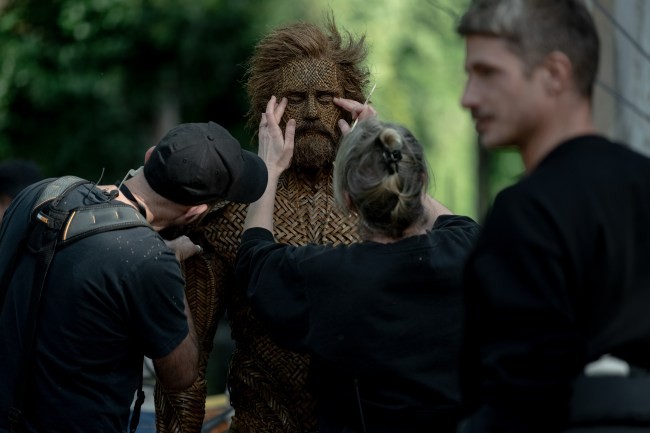
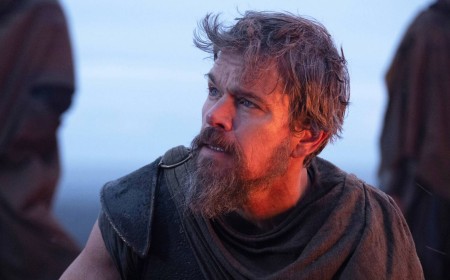
Transforming the 6’4″ Swede into the Wicker Husband required not actual magic, but something very close to it. Art director and prosthetic makeup designer Joe Dunckley, as well as makeup and hair designer Sarah Rubano from Wētā Workshop, and their teams collaborated with directors Eleanor Wilson and Alex Huston Fischer on creating a fully practical suit and full facial prosthetic makeup so that Skarsgård could move and emote as freely as the romance novel-inspired poster for “Wicker” promises.


“The success of the film hinged on the quality of the makeup itself; if you were going to be invested in this film, that character needed to be believable in that world,” Dunckley told IndieWire.
Over 18 months, the Wētā team researched, developed, and manufactured “Wicker”’s co-protagonist, developing an entirely new way to make prosthetic makeup in the process. “Traditional materials wouldn’t be viable because wicker’s geometry is just far too complex; it’s really unmoldable,” Dunckley said. “We had a very good understanding of the cutting edge of 3D printing technology, but we still didn’t know how exactly to do this; none of the hardware is intended to be used this way.”
 ‘Wicker’ Courtesy of Black Bear Pictures
Weaving the Wicker Husband
The timing was serendipitous; Wētā textiles and weaving team had just come off “Avatar”, where they had been weaving costumes for the Na’vi for years. Some jumped over to “Wicker” to help refine the creative process for the Wicker Husband. Explaining the creation process, Dunckley said: “Our concept team blocked out shapes, [head weaver Jasmin Van Lith] would do a physical weave sample; we’d incorporate that back into the 2D artwork. Then we’d do a 3D model of that weave, print out a test piece, and do a make-up test and see if it behaved in the way we wanted, then go back to the sampling.”
Dunckley shared that they aimed for this wicker weaving to replicate muscle fiber; it had to be tight enough to hold together but loose enough for the strands to move and flex. With the wicker weaving samples perfected, Rubano shared: “There were 50 individual 3D-printed body pieces from the neck down anchored onto very thin spandex or power mesh for the fabricated suit. Then the suit’s hood goes over his head and over [Skarsgård’s] chin so that as he moves his head, the neck moves along with him.”
For the face, they also applied individually crafted pieces: wicker ears, wicker lips, a jaw piece, a larger forehead, cheekbones, and a nose, which Rubano likens to “a Batman mask piece.” Then there’s the wig, eyelashes, and facial hair. Rubano explains these components are “made out of muka, a New Zealand flax plant, strands that are teased and shredded, and then knotted onto the weave, just like human hair onto lace.”
 Behind the scenes of ‘Wicker’Courtesy of Black Bear Pictures
Wētā is famous for its monsters and sci-fi creatures, so making a romantic lead gave the creatives a unique challenge. “We weren’t making a human being or a creature of flesh and blood,” Dunckley highlighted. Rubano added the other layer of difficulty: “Alexander’s going to be completely covered up, but we need his essence to shine through.” Maintaining Skarsgård’s likeness meant ensuring the utmost practicality of the costume: it would hide Skarsgård’s skin but not his expressions.
The costume was almost entirely practical; only a few details required CGI. One of which was sunlight peeking through the woven gaps of the Wicker Husband. “From the elbows down, [Skarsgård wore] fitted blue spandex under his forearms, so VFX was possible for very key moments,” Robano said. “The only other effects were the removal of a bit of pinkness in the tear ducts, waterline and around his eyeball.”
 ‘Wicker’ Courtesy of Black Bear Pictures
Dressing the Wicker Husband
Though Wētā created the face and torso of the Wicker Husband, a different pair of hands was required for below the waist. Hungarian costume designer duo Tóth András Dániel and Attila Godena-Juhász (who previously worked on “The Uprising” and “Martin Scorsese Presents: The Saints”) worked closely with Dunckley and Rubano to ensure continuity with costumes, silhouettes, and the wicker prosthetics.
“One week before the shoot started, the directors said we should see [the Wicker Husband] naked,” Dániel said. That triggered a fast-tracked costume project to create pants that seamlessly mimic the prosthetics. “We invented a technique: printing on an elastic base with a special paint that, if you treat it with heat, it’s three-dimensional… wicker penis included, Alex made a joke that because he came to the workshop for several fittings, and he really wanted to know the size of his [penis]. It was a lot of fun,” Dániel said.
Their small team then hand-painted and shaded every wicker detail for realism. “Unfortunately, it’s not so visible when he’s walking into the lake, but it was very cool,” Godena-Juhász said.
Beyond the wicker pants, Dániel and Godena-Juhász also dressed the Wicker Husband. They were granted freedom with costumes, not restricted by place or time. “If you need to create a village, a universe that [doesn’t really exist], you need to use references that aren’t known to the world; that’s why we ended up using Hungarian folk art and garments as an inspiration, because outside of Hungary, no one really knows what it looks like,” Dániel said.
 Behind the scenes of ‘Wicker’ Courtesy of Black Bear Pictures
Alongside this, the pair note that they also moodboarded inspiration from 17th-, 18th-, and 19th-century styles, textures, and colours before designing every costume component of this otherworldly erotic fantasy.
Then came time to get Skarsgård kitted up. “Alex is a big guy, and [when] Wētā added the prosthetics, they made him even bigger; it was such a nice silhouette,” Dániel said. “We made every piece of garment he’s wearing a little bit smaller, like it’s the suit you wore in high school and grew out of; the sleeves and hemline of the pants are short, and the waistline is not at the waist.”
Godena-Juhász added: “Also, everybody wanted to save time, and not apply the whole [wicker] body, so we made a padded under-layer. So even if he’s wearing the shirt, without the prosthetics, the silhouette remains the same.”
The Wicker Husband’s full-scale grand reveal comes after he knocks on doors around the village to borrow clothes, resulting in a snug-fitting wedding suit paired with brown laced shoes from a Hungarian shoemaker. “We ended up using this dark blue-greyish, very fancy tweed,” Dániel noted. “The cut of the three-piece suit is referring to the 17th-century menswear.” That refined seriousness, paired with the skin-tight fit, creates an image of both sophistication and sexiness.
 ‘Wicker’Courtesy of Black Bear Pictures
The latter is elevated in a later scene where the villager crowd parts, in shock and awe, to watch the Fisherwoman and Wicker Husband’s sensual dancing. “We decided to lose the jacket for that scene because it’s far more elevated and easier for him to dance without the jacket,” Dániel recalled. “The cut of the shirt was quite oversized, matching perfectly with Olivia’s blouse. It’s so romantic.”
The Wicker Husband’s presence — his brooding desire, and the spectacle driving the whole town wild with horny jealousy — is a majestic demonstration of cinematic craft from Dániel and Godena-Juhász and Dunckley and Rubano.
Thankfully, no one got splinters.
What's Your Reaction?
 Like
0
 Dislike
0
 Love
0
 Funny
0
 Wow
0
 Sad
0
 Angry
0






Comments (0)