

‘You Can See Everything’ Is Finally Here, but A24 Is Still Hoping to Ride the Hype of Secrecy
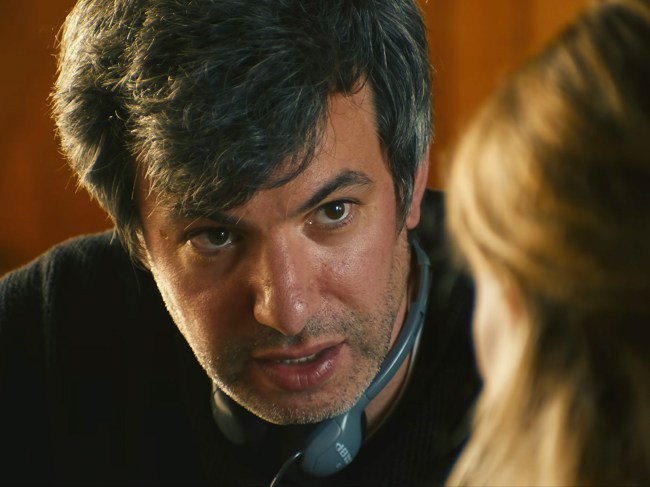
Oscar season boils down to crafting a winning narrative. Studios and publicists are tactical in selecting the right festival, the right venue, and the right occasion to unveil their wares and carefully provide audiences the appropriate context for a film to be appreciated and, if executed successfully, awarded. But A24 is broadcasting a somewhat divergent approach with its Elizabeth Holmes documentary “You Can See Everything”: see it, especially before you find out anything else about it.
After being produced in secret over three years, the film was first revealed to the world with a highly speculated-about mystery screening at Telluride Film Festival. There, the film’s directors, Nathan Fielder and Lance Oppenheim, implored the sold-out audience to not spoil its most discombobulating twists. “You Can See Everything” electrified what had been a somewhat quiet festival season, with awards prognosticators instantly canonizing the showstopper as a serious threat to become the first documentary to land a best picture Oscar nomination.


Six weeks later, the film is now opening in about 800 theaters across North America and projecting a debut of up to $8 million – practically a blockbuster figure for a documentary. Two more sold-out screenings have also come, at New York Film Festival and the Academy Museum in Los Angeles. The screening at NYFF (where A24 also kicked off the virality-mindset marketing of “Marty Supreme” last year) was such a hot ticket that a Film at Lincoln Center programmer shared a post lamenting that she couldn’t manage to get a seat. And though NYFF typically shares videos of its Q&As online, the organization made an agreement with A24 to withhold posting the post-screening conversation between Fielder, Oppenheim and festival director Dennis Lim until after opening weekend.
That atypical gesture of confidentiality matches the co-directors’ hope that audiences won’t spoil how the documentary unfolds, inviting its few viewers so far into an air of secrecy that began with its confidential production circumstances, already mythologized among the press and Fielder acolytes. As Fielder has been shared in Q&As, “You Can See Everything” first began with a seven-person crew visiting the home of Holmes and her partner, Billy Evans, in 2023. The small group documented Holmes in the month leading up to her 11-year prison sentence for wire fraud and defrauding investors in her tech start-up Thernaos.
The cat very nearly stayed in the bag over three years, apart from a 2025 report by independent journalist Jeff Sneider detailing a rumor about Fielder working on a project that involved meeting Holmes while she was in prison. When IndieWire sent a text to a source close to the project about the piece, they did not initially respond. Later, speaking in-person, they claimed that they didn’t write back because they were legally barred from doing so. A24 declined to comment for this story.
Nondisclosure agreements aren’t an unusual part of above-the-line workers and crew members agreeing to come aboard a film production, though the scope of their contents can vastly vary. Per The Wall Street Journal and Variety, NDAs were employed on Fielder’s HBO docuseries “The Rehearsal,” which sees the comedian giving everyday people the opportunity to rehearse difficult conversations with hired actors and elaborate sets. While some subjects have gone on to break those contracts, the series was largely able to preserve its biggest week-to-week reveals. But, perhaps more essentially, they also limit viewers’ avenues to gain clarity on Fielder’s signature ability to push the limits of ordinary behavior in highly constructed circumstances, leaving viewers to figure where one begins and the other ends on their own.
With “You Can See Everything,” Fielder also finds a kindred spirit with Oppenheim, whose documentary work like HBO’s series “Ren Faire” and the FX feature “Spermworld” hinged on the formal premise of directly inviting subjects into the filmmaking process. Across his work, Oppenheim collaborates with the people being documented, helping them craft reenactments of particularly consequential moments in their lives and, sometimes, even venturing into expressionistic compositions that break from vérité and stylishly reflect the subjects’ psyches. Both Fielder and Oppenheim’s open reconstruction of documentary reality drives “You Can See Everything” through its epic, near-three-hour running time, particularly through the film’s latter half, after Holmes goes to prison and the crew is forced to rethink how to continue the project with limited access to her.
It is in that turn where “You Can See Everything” becomes a truly bizarre awards player, with the production inviting a well-known actor aboard. In pre-screening introductions, Fielder and Oppenheim have implored audiences to not discuss this actor’s identity or the nature of their involvement, but this hasn’t stopped some awards prognosticators from predicting the film in supporting performance categories. IndieWire understands that the publicists behind the awards campaign for “You Can See Everything” are not providing specific guidance to awards predictors on whether to conceal this performer’s identity.
Some movies have pulled off keeping an actor’s involvement largely unknown until a film’s release; think Kevin Spacey’s serial killer in “Se7en,” or Matt Damon’s castaway coward in “Interstellar.” But the modern age of Oscar jockeying hasn’t seen such a film then parlay that secrecy into a nomination. And this isn’t even to mention the especially odd idea of an acting nomination coming from a documentary, no matter how many recreations there are in it.
The especially strange awards prospects for “You Can See Everything,” with unique qualifiers across several awards bodies, seem a bizarre aftershock to the film itself, which teases viewers to put a finger on what’s real and what’s not. Even Fielder, who often hovers above his work with a removed, Machiavellian pose, has claimed that question even stumps him. As he put it during his Telluride Q&A, “I still am not sure to this day what I experienced.” Taken in a media landscape defined by aggressive promotional gauntlets and hand-fed readings of each film, the film’s ability to totally bemuse viewers is an irreplaceable commodity — even if it’s a first impression that has been as aggressively engineered as any other awards player’s.
A24’s “You Can See Everything” is now playing in theaters.
What's Your Reaction?
 Like
0
Like
0
 Dislike
0
Dislike
0
 Love
0
Love
0
 Funny
0
Funny
0
 Wow
0
Wow
0
 Sad
0
Sad
0
 Angry
0
Angry
0









Comments (0)