

You Won’t Stop Quoting Steven Seagal and Keenen Ivory Wayans Once You See ‘The Glimmer Man’

On Friday nights, IndieWire After Dark honors fringe cinema in the streaming age with midnight movies from any moment in film history.
First, the BAIT: a weird genre pick, and why we’re exploring its specific niche right now. Then, the BITE: a spoiler-filled answer to the all-important question, “Is this old cult film actually worth recommending?”
The Bait: You Always Remember Your First… Steven Seagal Movie
Having a taste for Steven Seagal movies is a little like having an STD; you’re not sure where you got it, and you’d prefer to keep it to yourself. Personally, I blame my infection on ace action director Andrew Davis, who helmed Seagal’s first feature, “Above the Law,” and conned me by actually putting Seagal at the center of a really good movie. Seagal himself wasn’t any more dynamic an actor than he is now — he’s always had a limited range that makes Chuck Norris look like De Niro — but the movie Davis built around him was so textured and compelling that I got hooked.


And hooked is the right word, because as much as Seagal is a venereal disease, he’s also a drug, and the only cure for Seagal is more Seagal. There’s something about his breathy delivery (he comes across as a kind of thuggish Marilyn Monroe), his oddly limited fighting style (he’s one of the few martial arts stars whose feet seem perpetually planted in place on the ground), and the stripped-down simplicity of his revenge narratives (reflected in their three-word titles: “Hard to Kill,” “Out for Justice,” “On Deadly Ground,” etc.) that makes his movies oddly comforting, and highly addictive.
It might be hard to believe for people who weren’t around in the late 1980s and early 1990s when Seagal was in his prime, but before he was exiled to the world of straight-to-video oddities like “China Salesman” (opposite Mike Tyson — highly recommended!) and became a conspiracy theorist obsessing over the deep state, Seagal was a major box office draw in well-resourced studio movies. Again, he owes much of his success to Davis, who not only established Seagal (after CAA super-agent Mike Ovitz became determined to make his personal aikido teacher a star) but directed his best and most enduring movie, “Under Siege.”
Essentially “Die Hard” on a boat, “Under Siege” was a massive hit and put Seagal in a position to write his own ticket at Warner Bros. for several years, until he flamed out under a deluge of sexual harassment accusations and increasingly weird movies. (His sole directorial effort, the earnest eco-thriller “On Deadly Ground,” which casts Seagal opposite Michael Caine, of all people, needs to be seen to be believed.) Before he left the studio system, however, Seagal gifted us all with “The Glimmer Man,” a movie that somehow manages to hit every cliché in the book yet be aggressively, fascinatingly outré.
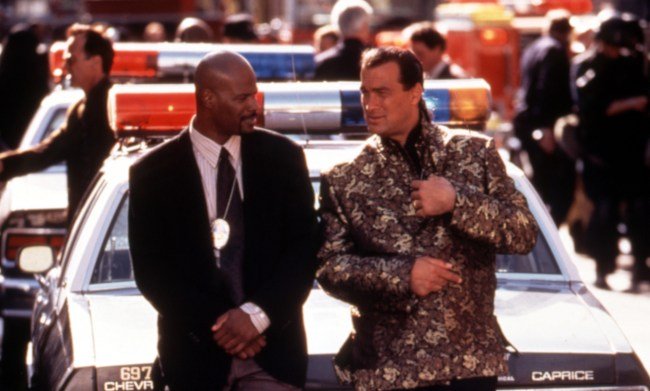
Released in 1996, a year after “Se7en,” “The Glimmer Man” essentially follows that film’s formula of combining a buddy cop movie and a serial killer thriller, though whether the influence was intentional or “Glimmer Man” was already in the works when “Se7en” came out is an open question. Instead of Brad Pitt and Morgan Freeman hunting down a murderer, we’ve got Seagal and Keenen Ivory Wayans, and in an intriguing example of casting against type, Seagal is the good-natured chatterbox and Wayans the stuffy crank — it’s like if Eddie Murphy and Nick Nolte switched roles in “48HRS.”
It must be said that Seagal is actually genuinely — and intentionally — funny in a lot of the movie; he’s more adept at the comedy the script requires than one might expect, and he and Wayans have a handful of pretty amusing scenes together. Where the movie’s true eccentricity comes in is in its combination of breezy comedy with shocking brutality and gore, perhaps most exemplified in an oddly casual moment in a morgue where Seagal and Wayans find a clue in the form of a serial number on a dead woman’s breast implant. The post-“Lethal Weapon” era saw many buddy-cop comedies that mixed laughs and violence (Wayans’ brother Damon co-starred in one of the best, “The Last Boy Scout”), but this takes it to a whole new level.
 ‘The Glimmer Man’ (1996)©Warner Bros/Courtesy Everett Collection
Where things get even weirder is in Seagal’s conception of his character as an ass-kicking Buddhist. He walks around in ornate floral jackets and discusses his belief in peace and reluctance to engage in violence, often right before mowing down a dozen guys at once. Evidently, Seagal’s own contradictory feelings on the subject led to some interesting moments on set, as when he refused to follow the script and gun down bad guy Stephen Tobolowsky; according to Tobolowsky, he had to talk Seagal into killing him by saying his character was in pain and that killing him would be a merciful act.
As in the Andrew Davis pictures and John Flynn’s “Out for Justice,” Seagal is well-served in “The Glimmer Man” by a director skilled at placing Seagal’s skill set in context. John Gray would go on to create the TV show “The Ghost Whisperer” and was deservedly acclaimed as a sturdy craftsman of Hallmark Hall of Fame movies (a surprising fate for the auteur behind an action film peppered with deer penis jokes), and in “The Glimmer Man,” he orchestrates a number of professionally choreographed Steadicam shots and action set pieces that make the movie feel more respectable than it should.
The real auteur behind “The Glimmer Man,” however, has to be Seagal himself — he not only starred in and produced the movie with his partner Julius R. Nasso (whose most recent credit is the intriguingly titled “The Pendragon Cycle: Rise of the Merlin”), but he also wrote two of the songs! Unfortunately for Seagal, “The Glimmer Man” was the beginning of his commercial sputtering; it grossed 40 million bucks but cost 45, and subsequent Seagal movies would see similar diminishing returns, though he did have one last hit starring with DMX in “Exit Wounds.” As of this writing, Seagal is still at it — he’s in post-production on “Order of the Dragon” playing a character with the very Seagal-esque name of “Mason Ryker” — but if you want to see him at his most entertaining, you need to go back 30 years and over three dozen movies to the glory that is “The Glimmer Man.” —Jim Hemphill
 ‘The Glimmer Man’ (1996)©Warner Bros/Courtesy Everett Collection
The Bite: Happy Pride Month! Make These Crazy Cops Kiss
When IndieWire’s midnight movie club got started just a few years ago, I never could have predicted needing to address, in print, the subtextual implication that my 54-year-old colleague had given me a communal disease via a Steven Seagal movie. But before anyone calls HR, let me state plainly: I cannot imagine discovering “The Glimmer Man” any other way.
Jim is a freak, and broadly speaking, getting to know cinephiles like him is how you find out about periods of cinematic history that Hollywood itself seems grateful to have forgotten. Watching the first few minutes of John Gray’s surprisingly quotable LA crime caper from 1996, I knew I should recognize the dark-haired fox advising me “not to knock Chinese potions” — but I simply didn’t.
Having cued up “The Glimmer Man” before reading why we were actually watching it, I wrongly assumed it was the theatrical return of Keenen Ivory Wayans in the new “Scary Movie” that had brought such a wonderfully goofy procedural my way. And in one of my dimmer moments, I googled Seagal’s name, wondering if he was the French guy who did all those paintings. (Note: That was Marc Chagall, who isn’t Jason Segel… either. Anyway!)
 ‘The Glimmer Man’ (1996)©Warner Bros/Courtesy Everett Collection
I still know the frame-bending appearance of an industry star when I see one, and “The Glimmer Man” had me hooked on its starring duo from the jump. The buddy cops’ zesty chemistry goes out on a high as Detective Campbell and Lieutenant Cole bicker next to ambulance at the film’s end. And as a bisexual gal celebrating Pride Month? I’m man enough to admit that I thought their flirty little dynamic throughout the entire movie was, frankly, pretty hot.
“The Glimmer Man” is the kind of film that’s not explicitly gay but winds up feeling very gay because of its genre vocabulary. There’s a subtle distinction between the sass a cop can dish out to a criminal in a booking cell and the coquettish kind of line he might use that night when he appears outside his hunky partner’s apartment door. And the homoerotic ballad of Campbell and Cole doesn’t toe that line so much as jump rope with it.
 ‘The Glimmer Man’ (1996)©Warner Bros/Courtesy Everett Collection
From the leading men’s surprisingly tender car talks about self-care and religion, to that one mobster who randomly started quoting Shakespeare, the movie Seagal and Wayans made sounds like an LGBTQ-inclusive spinoff of Demi Moore’s “Striptease.” In 1996, when both of those films came out, I would’ve been just one year old at most. Even then, I’m confident that had I been shown either of these movies as a baby, then my first word would’ve been “gay.” (Or, possibly, “homoerotic”? I was very advanced.)
Regardless, whether you’re a queer woman in her thirties today or a weird straight kid watching Steven Seagal movies in the Mesozoic Era (tell those Christians the dinosaurs were real, Jim!), “The Glimmer Man” doesn’t care who it infects. Thank you for this truly world-changing recommendation. But now, this little grasshopper must get back to writing fan fiction. (“It was a dark and stormy night, when Campbell and Cole’s squad car began to stink of… deer penis.”) —Alison Foreman
“The Glimmer Man” (1996) is available to rent or buy on VOD.
Read more installments of After Dark, IndieWire’s midnight movie club:
- CBS Can Take ‘The Late Show’ Off Streaming, but I’ll Never Forget Working for Stephen Colbert
- Crash Out with ‘Maximum Overdrive’: Director Stephen King’s One and Only Feature Film
- Deeply Unnerving 1994 Indie ‘What Happened Was’ Reminds You Dating Has Always Been Hell
- Michelle Yeoh, Maggie Cheung, and Anita Mui Save a Bunch of Babies in ‘The Heroic Trio’
- When 4/20 Lands on a Monday, You Have to Watch Gregg Araki’s ‘Smiley Face’ — OR ELSE!
- Video Game Movies Were More Fun When They Were as Weird as 1993’s ‘Super Mario Bros.’
What's Your Reaction?
 Like
0
Like
0
 Dislike
0
Dislike
0
 Love
0
Love
0
 Funny
0
Funny
0
 Wow
0
Wow
0
 Sad
0
Sad
0
 Angry
0
Angry
0











Comments (0)