

10 Calvin and Hobbes Moments That Prove Bill Watterson Was a Genius

When it debuted in 1985, readers immediately recognized something extraordinary, yet few predicted how deeply a strip about a hyperactive six-year-old and his stuffed tiger would shape pop culture. On the surface, Bill Watterson delivered pristine slapstick comedy, but a closer look reveals a genius who treated the comic strip as a legitimate canvas for high art.
Watterson’s genius lies in his absolute refusal to compromise. He famously fought his syndicate over merchandising and creative control to protect his creation’s integrity, bringing that artistic rigor to the panel grid. He also challenged restrictive Sunday comic strip formats, reshaping how Calvin and Hobbes was presented and leaving a lasting mark on the comic strip industry.
By experimenting with cinematic compositions and watercolor landscapes, he elevated comic illustration to breathtaking new heights. Watterson’s genius is the reason Calvin and Hobbes has endured the test of time, and this article highlights 10 definitive moments when Watterson’s genius was on full display.
10 Calvin and Hobbes Go, Dinosaur Hunting

Calvin’s fascination with dinosaurs highlights Bill Watterson’s raw artistic talent and his affinity for childhood obsessions. Whether Calvin is stomping around the backyard, pretending to be a Tyrannosaurus rex, or using his trusty cardboard time machine to travel straight to the Jurassic period, his dinosaur adventures represent the absolute peak of the strip’s visual and narrative freedom.
For a hyperactive six-year-old, dinosaurs embodied coolness, power, and freedom, offering escape from bedtime and schoolwork. These prehistoric sequences also let Watterson flex his skills as an illustrator with sprawling, hyper-detailed landscapes straight out of a natural history museum. He rendered dinosaurs and their environments with precision, then subverted the grandeur with great comedic moments.
Ultimately, Calvin’s dinosaur hunting represents Watterson’s deep respect for a child’s capacity for unadulterated wonder. The dinosaur strips capture the vibrant but fleeting time of youth, when a visit to the grocery store can instantly become more exciting by turning you into a rampaging Tyrannosaurus rex, or a boring class can be livened up by dinosaurs battling in a child’s fantasies.
9 Calvin’s Outrageous Snowman Creations

Calvin’s outrageous snowman creations are a motif that showcases Bill Watterson’s subversive wit and dark humor. To Calvin, snow is a tool for creating unearthly monstrosities. Calvin constructs nightmarish avant-garde scenes like snowmen being trampled by the family car, or a set of five injured snowmen on the sidewalk, a horrific display Calvin’s mother did not appreciate.
The Snowman strips satirize the fine art world and the pomposity of modern artistic critique brilliantly. Calvin often defends his outlandish creations with comic jargon, presenting them as masterpieces. Watterson proves himself a master of satire, using a six-year-old to parody artistic pretense while offering sharp observations about life, death, and human nature.
8 The Transmogrifier Turns a Cardboard Box Into Anything

The “TRANSMOGRIFIER” is an upside-down cardboard box that can turn the user into whatever they wish to be. This device represents one of Bill Watterson’s most brilliant creative devices in Calvin and Hobbes. Calvin uses the box to transform himself into a tiger to understand Hobbes better, and accidentally turns himself into several other creatures before returning to human form.
The brilliance of the Transmogrifier is how perfectly it captures childhood play. Watterson understood that children did not need expensive toys or a TV to be entertained. A simple cardboard box can be anything with a child’s imagination. To Calvin and Hobbes, it is a high-tech invention; to Calvin’s parents, it simply looks like a six-year-old playing with a box.
The Transmogrifier gave Watterson narrative flexibility, enabling wildly absurd, high-concept stories in which Calvin became a toad, an elephant, or a pterodactyl without breaking the strip’s logic. Its versatility also let Watterson repurpose the cardboard box as a Duplicator, a Time Machine, or a Transmogrifier/Duplicator hybrid. With a simple cardboard box, Watterson created numerous hilarious situations and adventures.
7 The Duplicator Creates More Calvins

The Duplicator is one of Calvin’s cardboard-box creations, invented by tipping the Transmogrifier over. It’s a machine that can duplicate anything using the power of the photocopier and the Transmogrifier. Calvin first decides to duplicate himself after deciding that cleaning his room was too daunting a task.
He expects the clone to clean his room, but the clone is just as selfish, lazy, and rebellious, so it goes outside instead. Chaos follows as the clones make more clones and get Calvin in trouble, until he tricks them into the Transmogrifier, which turns them into worms. Watching Calvin get frustrated by his own behaviors is comedic gold.
6 Calvin Creates G.R.O.S.S. to Defeat Susie

Wattersons captures the hilarious absurdity of childhood gender rivalries in Calvin and Hobbes, especially when Calvin creates Get Rid Of Slimy Girls Club (G.R.O.S.S.). Born from his need to assert superiority over Susie Derkins, the secret society defends male supremacy through anti-girl propaganda, elaborate handshakes, and poorly executed military strikes.
Operating from a treehouse with cardboard offices, Calvin appoints himself Dictator-for-Life, giving Hobbes the titles of First Tiger and club president. The club’s sense of understanding is a masterclass in irony, since Calvin is targeting a girl who is usually minding her own business, doing her homework, or playing in her own yard.
Hobbes and Calvin spend a lot of time bickering over titles, constantly changing, losing, and regaining ranks to suit the club’s needs or as temporary punishment. In one comic, the two decide to hit Susie with water balloons, but when they don’t find her, they take her Binky Betsy doll instead for a $100 ransom.
However, Susie outsmarts them by distracting Calvin with a dummy envelope and kidnapping Hobbes while he wasn’t looking. She eventually got her doll back, along with 25 cents from Calvin in exchange for Hobbes. Calvin views it as a successful mission because Hobbes caught a glimpse of her diary. G.R.O.S.S. is a great backdrop for hilarious hijinks.
5 Calvin’s Spaceman Spiff and Stupendous Man Fantasies

Whenever the pressures of the classroom, chores, or his parents become too overwhelming, Calvin escapes into the alter egos of his imagination, most notably the space explorer Spaceman Spiff and the caped champion of justice, Stupendous Man. As Spaceman Spiff, Calvin explores alien worlds in his red flying Saucer, fighting off slimy “Zargon” monsters with his death-ray blaster.
Naturally, as Stupendous Man, he is like a superhero, complete with a red cape and a mask made from a secret-agent towel. He uses “stupendous muscle” and “mind-boggling intelligence” to thwart the evil plans of the “Babysitter Girl” (Rosalyn) or his mother. These identities are a coping mechanism for Calvin, helping him escape when life gets too rough.
The humor in both alter egos lies in the inevitable return to reality. Through them, Watterson explores the extent of a child’s imagination. He presents Calvin not as inherently naughty, but as a child actively reinterpreting a world that feels overwhelmingly controlled by adults.
4 Hobbes’ Ambiguous Reality

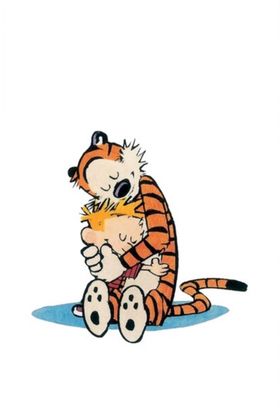
The question of whether Hobbes is real or imaginary is the philosophical backbone of Calvin and Hobbes. Watterson handled this with a dual perspective. When Calvin is alone with him, Hobbes is a talking anthropomorphic tiger; however, when anyone else enters the frame, he instantly reverts to a lifeless plush toy. This was a deliberate narrative choice.
Watterson’s masterful execution ensures that Hobbes’s nature remains ambiguous, and no single perspective is the “true” one over the other. Watterson stated in an interview that the strip does not assert that Hobbes is a product of Calvin’s imagination. Instead, that is the assumption adults make because no one sees Hobbes as Calvin does.
Conclusively, Hobbes is real to Calvin, and their relationship anchors the narrative. By refusing to reduce Hobbes to a toy or fantasy, Watterson preserved the wonder of childhood imagination, showing that reality depends on perspective. Whatever the rest of the world thinks, Hobbes remains as real to Calvin as anything.
3 The Philosophical Conversations During Sled Rides

Among the most iconic and thematic motifs in Calvin and Hobbes are the wild, reckless sled rides. These rides are usually full of philosophical conversations with a six-year-old. As Calvin and Hobbes careen past trees, rocks, and sudden drops at breakneck speeds, Calvin delivers long, articulate monologues on morality, human nature, technology, fate, and the meaning of existence.
The contrast between danger and intellectual discourse creates a comic rhythm that became one of Watterson’s signature storytelling devices. He used the sled rides to turn a six-year-old and his tiger into modern-day philosophers. As they spout deep philosophy in constant physical peril, the moments are as introspective as they are hilarious and always end with an inevitable crash,
2 The Final Calvin and Hobbes Strip

On December 31, 1995, Bill Watterson published the final Calvin and Hobbes Sunday strip, bringing a decade of artistic brilliance to a close on his own uncompromising terms. His own terms. Watterson opted for a more uplifting, poetic ending rather than a tearful goodbye, leaving the comic strip on a high note.
The strip opens after a fresh heavy snowfall. Calvin and Hobbes walk outside with a sled in hand; they gaze at the beautiful winter landscape, and Calvin says: “It’s a magical world, Hobbes, ol’ buddy... Let’s go exploring!” This wasn’t a somber farewell; this ending leaves the characters doing what they love best, with the promise of more untold adventures.
Watterson gave this iconic comic strip a satisfying conclusion with a simple but heartfelt ending that offered readers a sense of finality and a hopeful message. The snowy hill represents a blank slate and an endless sense of wonder.
1 Bill Watterson’s Fight to Give Sunday Strips More Space

Beyond his brilliant writing and skill with the brush, Watterson’s genius extended to revolutionizing the medium itself. During the late 1980s and early 1990s, Sunday funnies were turned into rigid, uniform panel grids so editors could slice, crop, and rearrange strips to squeeze as much advertising as possible into every page. Watterson saw this rigid format as an impediment to the medium.
In his view, it suffocated visual storytelling and made the funny pages repetitive. In a shocking turn of events, Watterson leveraged the popularity of Calvin and Hobbes to demand more space for his Sunday strips. He demanded an unbreakable, fixed half-page, or the newspaper syndicates couldn’t run it at all.
Conclusively, Watterson’s rebellion was a selfless stand to protect the integrity of cartooning as an artwork. His demand for a larger real estate allowance to support more creative expression led to some of the most iconic, dynamic artworks in illustration history. He completely changed what readers expect from a Sunday strip.
Writer Bill Watterson
Colorist Bill Watterson
Publisher Andrews McMeel Publishing
What's Your Reaction?
 Like
0
Like
0
 Dislike
0
Dislike
0
 Love
0
Love
0
 Funny
0
Funny
0
 Wow
0
Wow
0
 Sad
0
Sad
0
 Angry
0
Angry
0












Comments (0)