

James Gray on His ‘Only Real Beef with Streaming’ and the ‘Recurring Nightmare’ That Started at Cannes in 2009
James Gray time-travels back to his Queens roots once again for his latest film, “Paper Tiger.” It’s a location, an atmosphere, a state of mind he’s explored across decades and genres, dating back to his 1994 debut feature, “Little Odessa.” Like “Paper Tiger,” “Little Odessa” also featured the shadows of the Russian mafia looming over a family unit — to devastating ends. But even 30-plus years later, with his new movie — starring Miles Teller, Adam Driver, and Scarlett Johansson — Gray wanted to go just as dangerous.
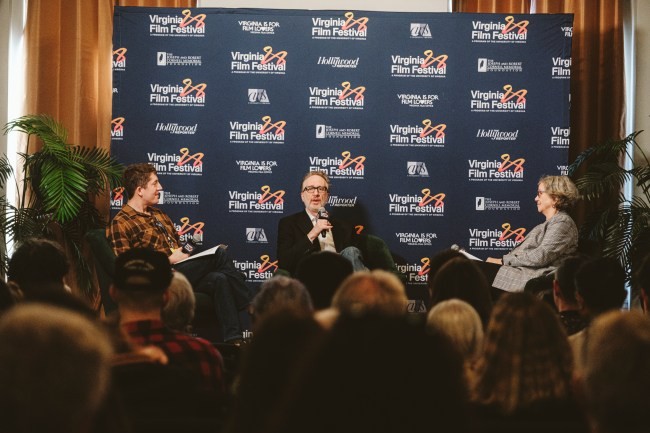
Adam Driver, for one, has danger in him, according to Gray, who cast the Oscar nominee as a former police officer who links up with the red mafia in the 1980s. Gray recently joined IndieWire’s “Screen Talk” podcast hosts Anne Thompson and Ryan Lattanzio for a wide-ranging, amusingly discursive live conversation at the Virginia Film Festival. One that showcased his knack for impressions — from Luca Guadagnino beckoning Gray out of this year’s Cannes to sit down for the Italian filmmaker’s Bernardo Bertolucci documentary, to the waves of disappointment cresting through Maximilian Schell during an early Venice screening of “Little Odessa.”


“Almost all great performances have to have some measure of danger in them,” Gray said. “I can actually only think of one that doesn’t have any, which would probably be Jeff Bridges as The Dude in ‘The Big Lebowski,’ which has no danger at all.” (Though John Goodman’s PTSD-addled Vietnam vet in the Coens’ 1998 hardboiled slacker comedy qualifies as dangerous.)
“Adam is a fantastic, intense presence in [‘Paper Tiger’],” said Gray, who wrote “Paper Tiger” with Driver in mind.
Gray also spoke about the “recurring nightmares” for any filmmaker: “You screen your movie, and everybody walks out midway through. I’ve never had that happen to me, thank God.”
But one personal experience of watching this happen to someone else became seared in his unconscious: “When I was on the jury in Cannes [in 2009] … there was a movie made by a fantastic director. I won’t say his name, but he’s a great director of real reputation. And you have to sit in this jury box, which is sort of in the back of a theater, and the seats … when a person gets up, it’s spring-activated, and so it makes this very loud tack. I’m on the jury, and I’m watching this movie, and I start hearing tack, tack, tack, tack, tack, tack, tack. And people start walking out in droves. And the movie ended, and it was about half full, and people were booing. And that did become a nightmare for me. And by the way, I’m not the only director for whom that’s a nightmare. I’ve talked to many director friends of mine, and they’re like, ‘Oh, yeah. No, I’ve had that dream.'”
James Gray served on the Cannes jury in 2009 under president Isabelle Huppert — whom he reiterated, as Huppert previously did with IndieWire, he has no feud with despite rumors of a fractious deliberation — with such films as Gaspar Noé’s “Enter the Void” and Lars von Trier’s “Antichrist” in the competition. (But again, he’s not naming names here.)
“I know there’s directors who go, ‘I like it. I like when they boo,’ but that’s such a crock,” said Gray. We also asked for his thoughts on audiences dozing off in movies — which some directors, like Lucrecia Martel, have likened to falling asleep in the sun, a reflex of comfort — which certainly happens with some frequency at Cannes as any attendee knows.
“Who likes when you fall asleep during a movie? No, I’m sorry. The movie is required to keep you awake, and as Hitchcock once said, it has to be just long enough to accommodate your bladder’s capacity,” Gray said. “Which, by the way, you know when people say, ‘Oh, well, what do you think of the streaming thing and all that?’ I have only one real beef with streaming, and that’s the pause button, because it is my job to keep you there for an hour and a half, two hours, maybe even three. Where you’re not falling asleep, where you are riveted, where you’re not moving.”
He added, “I can’t stand the people who go, ‘I watched the first half on Tuesday, but I’m gonna catch the second half on a Saturday.’ … There’s nothing you can do about it, and it’s not, it’s not streamer-centered, because most people watch your films now at home. And whether it’s Netflix or Peacock or whatever, it doesn’t matter. The pause button is a problem.”
He pointed to his early relationship to “Vertigo,” a Hitchcock film he didn’t like in the first half, as an example of the virtues of experiencing a movie entirely in one sitting. “The result is so much more rewarding when you are forced to experience the whole thing because it’s like a dream, and you can’t pause your dream. And sometimes you don’t like your dream … sometimes the only way you can get yourself out of that dream is to convince yourself it is a dream in your dream. REM sleep is an hour and a half to two hours a night. What’s a movie’s runtime? It’s about the same thing. It didn’t happen by accident,” Gray said.
Listen to the podcast below or on your preferred podcast platform.
What's Your Reaction?
 Like
0
 Dislike
0
 Love
0
 Funny
0
 Wow
0
 Sad
0
 Angry
0







Comments (0)