

10 Great Vintage Lenses for Portrait Photography
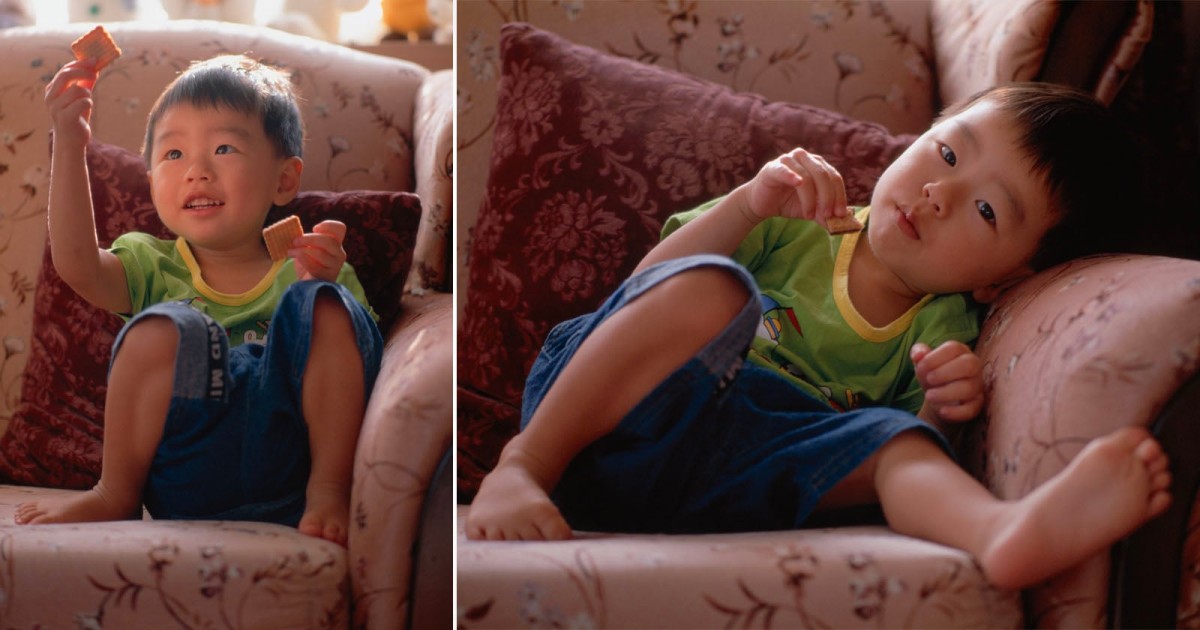
 Photo Credit: Yoshiyuki Shimizu, Nikon
Vintage lenses are often talked about as if their only value is “character.” That usually means lots of flare, low contrast, possibly swirly bokeh, spherical aberration, or some other charming defect that gives digital images a little analog grit. There is nothing wrong with that, of course. A flawed lens can be a wonderful creative tool. But the more interesting vintage bargains are not always the strange ones. Sometimes the best buys are lenses that are simply much better than their used prices suggest.
That is the category this list lives in. These are not exotic collector pieces, ultra-fast halo lenses, or cult objects that have already been picked clean by YouTubers. They are practical, genuinely high-performing manual-focus lenses that can still hold their own on modern digital cameras. Some are compact primes. Some are macro lenses. I forced myself to include some zooms from an era when most zooms were not especially good — especially more difficult when I’m working under a budget. Anyway, the common thread is value: sharpness, contrast, color, useful rendering, and enough optical refinement to make them feel like tools rather than toys.
There are a few caveats. Used prices fluctuate constantly. Condition matters more than almost anything else. Fungus, haze, balsam separation, oily aperture blades, stiff helicoids, and decentered elements can turn even a legendary lens into a disappointment. And while nearly all of these adapt beautifully to mirrorless cameras, some mounts are easier to live with than others. Nikon F, Olympus OM, Canon FD, Minolta SR/MD, Pentax K, and Contax/Yashica are straightforward. Contax G is more complicated because the original lenses lack a standard manual focus ring and require a specialized adapter. I have set my budget level for this at $200-250. However, many of these are far less than that in excellent condition, and you’ll find the ones who aren’t with a little patience.
If you want high image quality without modern-lens prices, these ten lenses are a very good place to start.
At a Glance:
Vivitar Auto Wide-Angle 28mm f/2.5 (also under Kiron and Panagor)
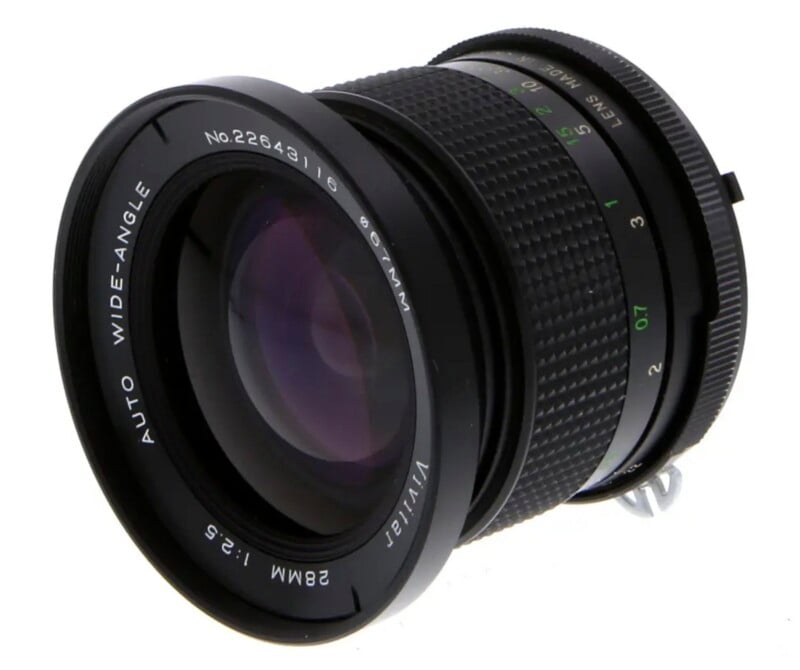 Image Credit: KEH
The Vivitar name is not really a manufacturer. It is a badge, and the company behind it commissioned lenses from a rotating cast of Japanese optical firms. That makes buying a “Vivitar” a matter of knowing which one you are actually getting. The 28mm f/2.5 Auto Wide-Angle worth owning is the version built by Kino Precision, identified by a serial number beginning with 22. The same optic turns up wearing Kino’s own Kiron badge and, less often, a Panagor label. All three are the same lens.
The optical formula is unusual: eight elements in eight groups, every one air-spaced, with multicoating and a six-blade diaphragm. That is a lot of glass-to-air surfaces for a lens of this vintage, and it shows in both directions. What you get in return is a wide-angle that focuses to about 0.3 meters, which is unusually close for a 28mm, and a lens with genuine mechanical substance — an all-metal barrel around 320 grams, a long and beautifully damped focus throw, and a built-in hood. It was sold in essentially every mount that mattered: M42, Nikon F, Canon FD, Minolta SR, Olympus OM, Pentax K, Konica AR, and Contax/Yashica.
The close focus is the feature that keeps it interesting. A 28mm that gets that near lets you shoot environmental portraits and detail work with real subject separation, which is not something most wide-angles of this era can do. Contrast holds up better than you would expect from an eight-group design, color is good, distortion is low, and the out-of-focus rendering has a pleasant soap-bubble quality when the background cooperates.
It is not a corner-to-corner performer, and pretending otherwise does nobody any favors. Wide open on full frame, the outer field is soft and vignetting is obvious; the corners do not fully resolve until f/8 or beyond. All those air-glass surfaces also make it prone to spectacular flare, which is either a problem or a feature depending on the day. Use it at f/5.6 and up, keep the sun out of the frame unless you want the show, and it is a very satisfying lens for the money — usually well under $100 in good condition.
Tokina AT-X 28-70mm f/2.6-2.8 or 28-70mm f/2.8
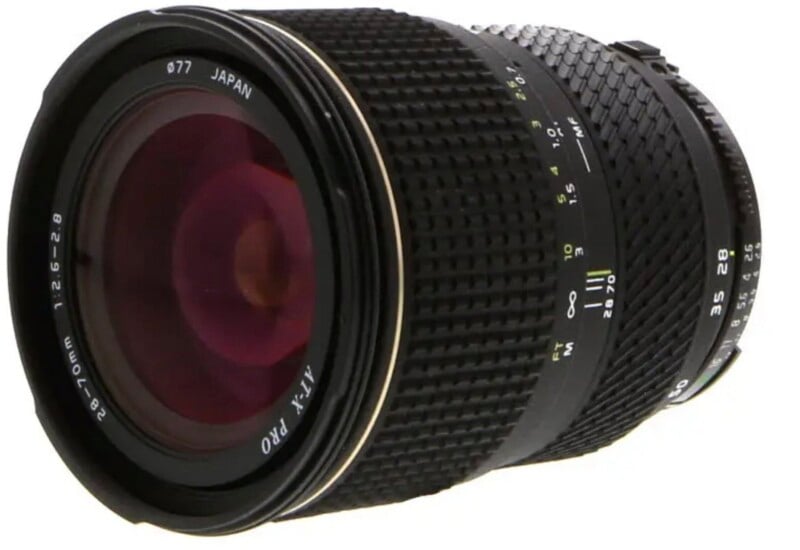 Image Credit: KEH
Two different lenses hide behind this heading, and the distinction matters. The first is the Tokina AT-X 28-70mm f/2.8, made from roughly 1988 to 1994: sixteen elements in twelve groups, 72mm filters, about 610 grams, and 0.7m minimum focus. The second is the AT-X PRO 28-70mm f/2.6-2.8 that replaced it, produced from 1994 through the late 1990s in PRO and PRO II variants, with 77mm filters and about 760 grams. The PRO II added a high-refraction, low-dispersion element and better coatings, and is easy to spot by its bayonet hood mount instead of the earlier screw-on.
The f/2.6-2.8 versions share a design lineage with the Angenieux 28-70mm f/2.6 AF, a lens the French firm sold briefly in the early 1990s. The most credible account is that Tokina was involved in the original engineering rather than simply buying the drawings afterward — Angenieux had no autofocus experience and Tokina had plenty. Whatever the exact arrangement, it explains why a third-party zoom from this period punches so far above its reputation.
These are autofocus-era lenses, which makes them the odd entries on a list otherwise built from manual-focus glass. In practice, that is not much of an obstacle: the AT-X focus clutch lets you pull the ring back into manual mode, the barrels are aluminum rather than plastic, and adapted to mirrorless you are focusing by hand anyway. What you gain is a constant fast aperture across a genuinely useful range, which almost no true manual-focus zoom of the period offers.
Optically, expect some spherical aberration wide open — “Tokina glow” is the usual term, most visible at 70mm and gone by f/4. From f/4 to f/8 both versions are sharp in the center and respectable at the edges, with saturated, slightly film-like color. There is barrel distortion at 28mm and pincushion at 70mm, both correctable. The plain AT-X 28-70mm f/2.8 is the budget pick and can still be found around $200-250; the PRO and PRO II have crept up past that as word has spread, so patience matters more here than with most lenses on this list.
Pentax SMC 40mm f/2.8
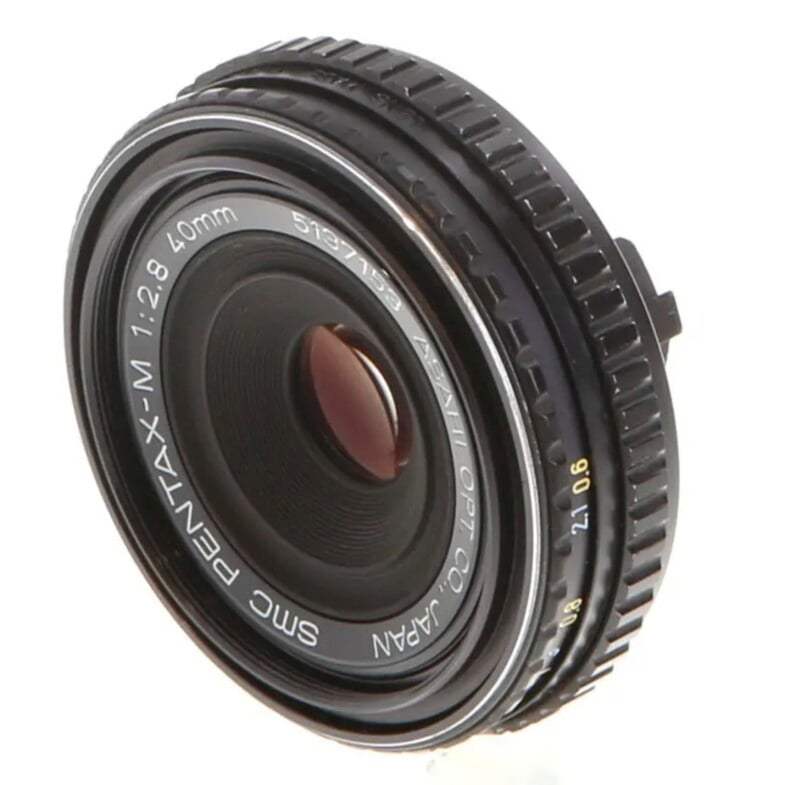 Image Credit: KEH
The Pentax SMC 40mm f/2.8 asks a simple question: what if the best lens is the one you actually bring with you?
This tiny pancake prime is one of the most charming lenses in the Pentax manual-focus ecosystem. At 40mm, it sits in a sweet spot between the classic 35mm documentary view and the 50mm normal lens. It is wide enough for everyday scenes, but not so wide that it exaggerates space. It is normal enough for general photography, but not as tight or familiar as a 50mm. The result is a focal length that feels natural, casual, and flexible.
The main attraction, of course, is size. Mounted on a small Pentax film body, the 40mm f/2.8 makes the camera feel almost pocketable. Adapted to mirrorless, the adapter adds bulk, but the lens itself remains wonderfully compact. It is the sort of lens that makes a camera feel less like equipment and more like something you just happen to have with you.
Optically, the 40mm f/2.8 is good rather than flawless. Wide open, it can be a little lower in contrast and not as biting as the best standard primes. Stopped down to f/4 or f/5.6, it becomes sharp, crisp, and very satisfying. What makes it special is not laboratory perfection. It is the combination of adequate speed, tiny size, good sharpness, a focal length that suits everyday photography, and, especially, its consistency across the frame, even at f/2.8. There is very little fall-off in detail from the centers to the corners, which is quite impressive.
It is a lens for walking, not pixel-peeping. Put it on a camera, set the aperture to f/5.6, zone focus, and go make pictures. Compared with the faster Pentax 50mm lenses, the 40mm f/2.8 is not the obvious value pick if you only care about speed. But if you care about compactness, handling, and the particular perspective of 40mm, it earns its place easily.
Note: The Konica Hexanon AR 40mm f/1.8 is an excellent alternative if you desire more speed. It is a Double Gauss (Planar) derivative, whereas the Pentax is a Tessar derivative. Unfortunately for the Konica, the combo of a focal length wider than the typical 50mm Planar-type lenses and the pancake design means its performance wide open features significant spherical and chromatic aberrations. The best performing alternative in this space is the Nikkor AI 45/2 P, though that’s not quite a “vintage” lens in truth (but it is in spirit).
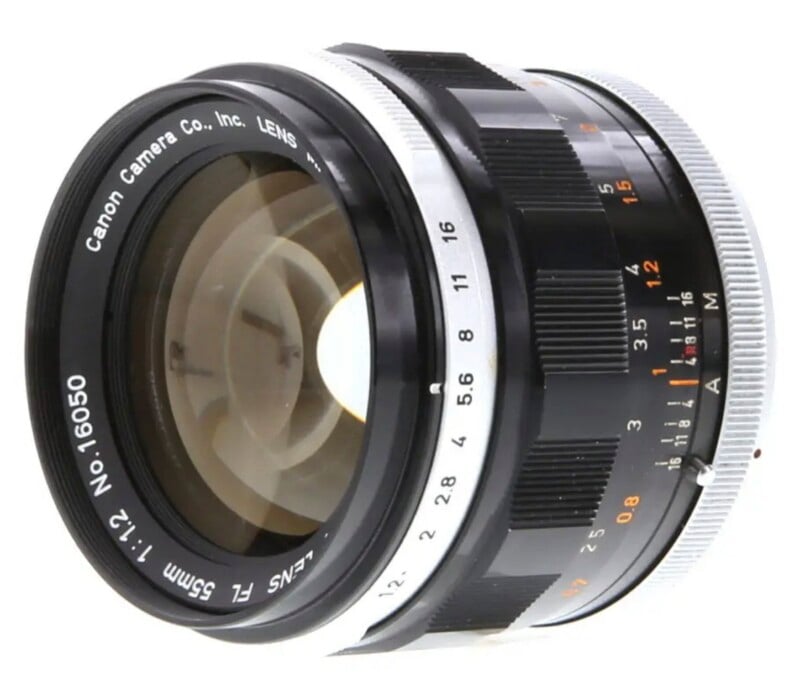
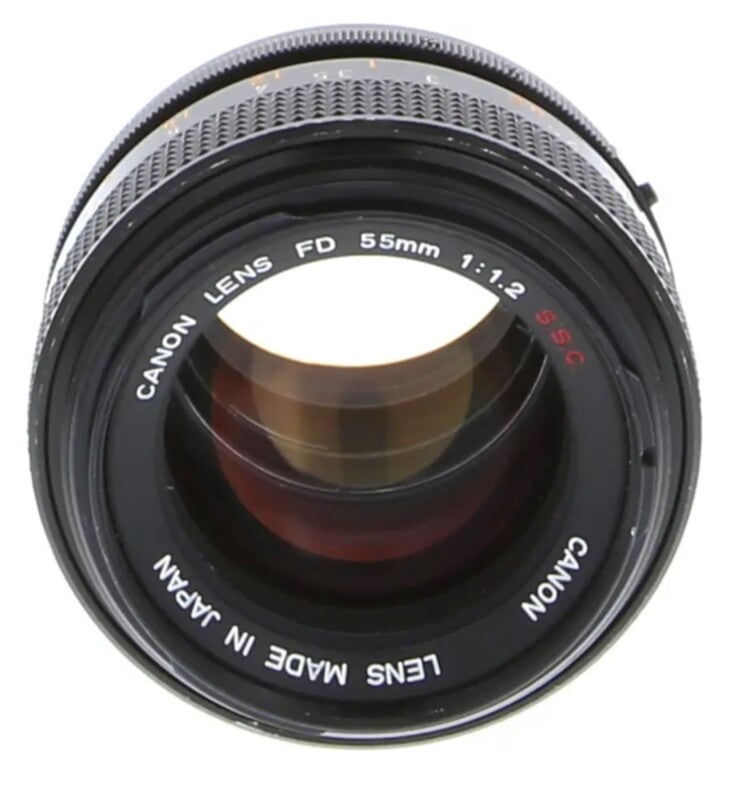
Canon FL 55mm f/1.2 or FD 55mm f/1.2
 FL version | Image Credit: KEH
An f/1.2 lens for the price of a decent dinner is the whole pitch here. The Canon FL 55mm f/1.2 arrived in 1968 with seven elements in five groups, an eight-blade diaphragm, 58mm filters, 0.6m minimum focus, and 480 grams of metal and glass. It is the cheapest honest route into f/1.2 that exists, and it has stayed cheap largely because the FL breech-lock mount is a dead end on film bodies — on an FD camera you are stuck with stop-down metering. Adapted to mirrorless, none of that matters.
Wide open, it behaves exactly as a 1968 f/1.2 should. Contrast drops, spherical aberration puts a soft glow around highlights, and the bokeh runs to the bubble variety with pronounced optical vignetting (cat’s-eye bokeh) toward the edges. There is field curvature to contend with, so focus-and-recompose is unreliable at f/1.2. This is the character everyone buys the lens for, and it is genuinely lovely on faces at close and medium distances.
 FD version | Image Credit: KEH
What surprises people is how quickly it cleans up. By f/2.8 the spherical aberration is essentially gone and the lens picks up contrast and sharpness dramatically; by f/4 it is a thoroughly competent standard prime. That dual personality is the real argument for it: a portrait lens with an obvious signature wide open, and a normal lens with no excuses two stops down.
A word on the family. The FD 55mm f/1.2 S.S.C. is multicoated and a bit better corrected, and the aspherical versions — the FD 55mm f/1.2 AL of 1971 and the later S.S.C. Aspherical — were the first SLR lenses to use an aspherical element. They are also several times the price, and both aspherical versions use thoriated glass that yellows with age. For this list, the plain FL is the value proposition, and it typically sells for $125-200.
Helios 44-2 58mm f/2
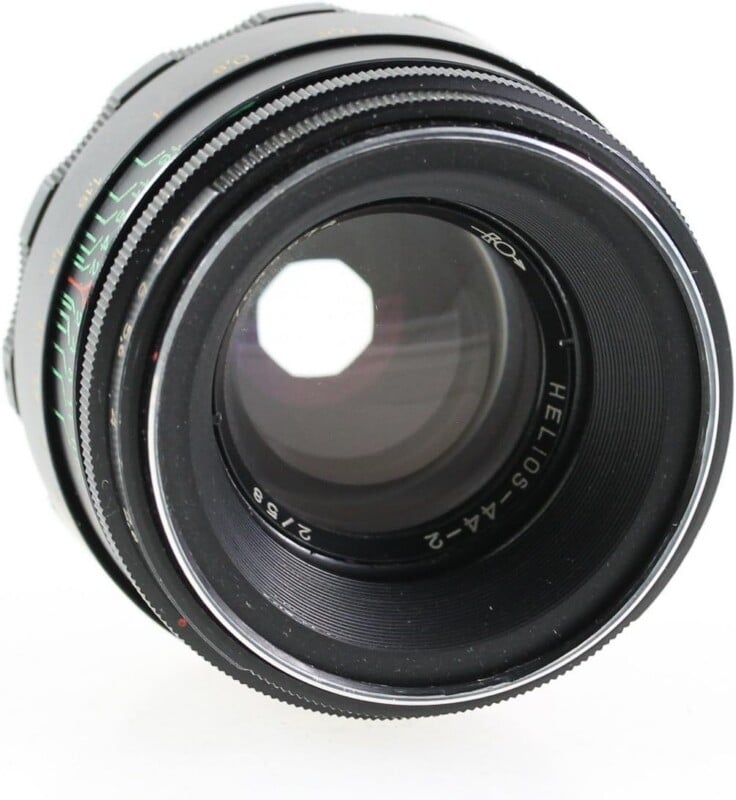 Image Credit: KEH
Every list like this eventually has to deal with the Helios 44-2, and it is worth being clear about why. This is not a lens that is quietly better than its price suggests in the way that, say, the Nikkor 105mm is. It is a lens whose defects happen to be beautiful, and it costs almost nothing — $30-$75 for a usable M42 copy. On a list otherwise built around competence, it is the deliberate exception.
The design is a Soviet copy of the Carl Zeiss Jena Biotar 58mm f/2: six elements in four groups, produced in enormous numbers at KMZ, Valdai, and BelOMO from the late 1950s onward. The 44-2 specifically is the M42 version with an eight-blade preset diaphragm and 52mm filters, single-coated. The preset mechanism is genuinely useful for video, since the lower ring adjusts aperture smoothly with no clicks and no exposure jumps.
The famous swirl is a product of the design’s uncorrected off-axis aberrations combined with mechanical vignetting, and it does not appear on demand. You need a busy background with specular highlights, a subject reasonably close, and the aperture wide open. Get those three things right and the corners smear into a rotational pattern that no modern lens will give you. Get them wrong and you have a soft, low-contrast standard lens. Stopped down to f/5.6 or f/8 the center sharpens up considerably and the swirl disappears entirely.
Sample variation is real — these were made by the million across multiple factories over decades, and quality control was not the priority. Check for haze, oily blades, and decentering before committing, though at these prices buying two is not an unreasonable strategy. The later 44M, 44M-4, and 44M-7 versions add automatic aperture coupling and progressively better coatings, which raises contrast but tends to tame the effect people want. If the swirl is the point, the 44-2 is the one to get.
Contax Zeiss C/Y 80-200mm f/4 Vario-Sonnar
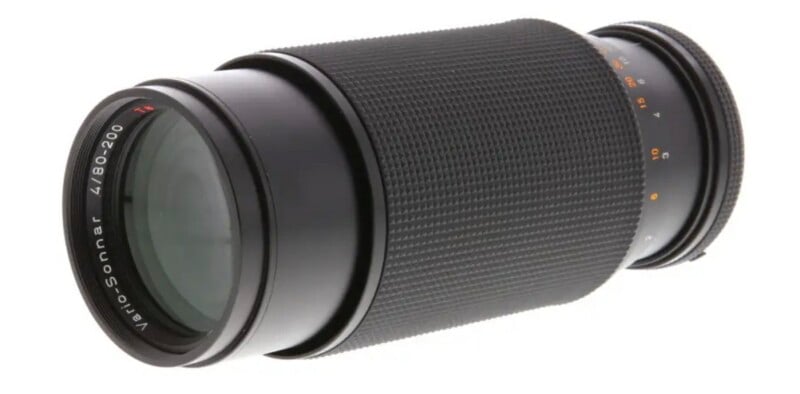 Image Credit: KEH
The Contax Zeiss 80-200mm f/4 is not as good as its larger brother, the 100-300 Vario-Sonnar, but because it’s overlooked, it’s quite affordable. A manual-focus telephoto zoom from the film era should, by stereotype, be soft, low in contrast, and full of chromatic aberration. This lens is not that. It is big, yes. It is not fast by modern standards, though it’s not exactly slow either. Optically, it has a seriousness that still comes through.
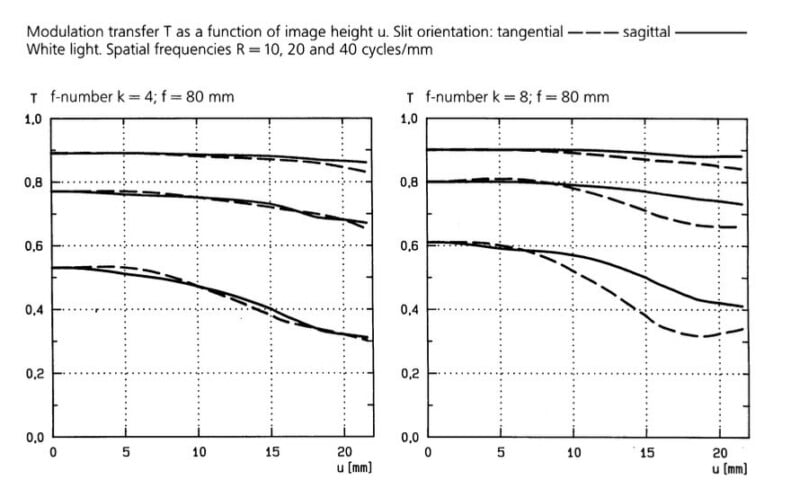 MTF at 80mm | Source: Zeiss
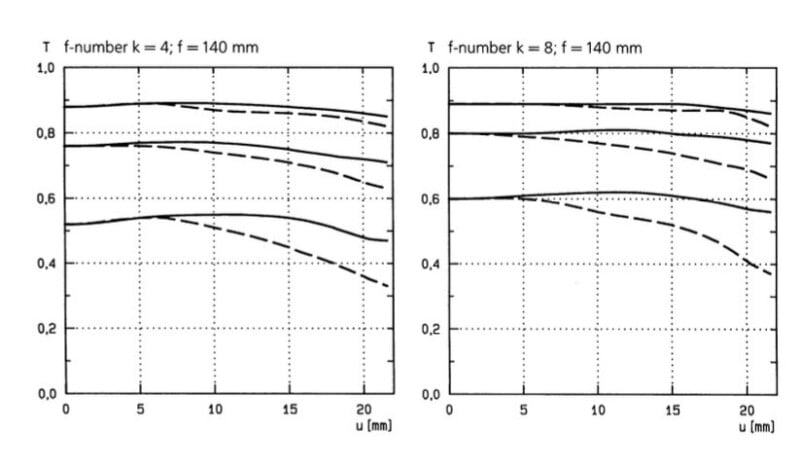 MTF at 140mm | Source: Zeiss
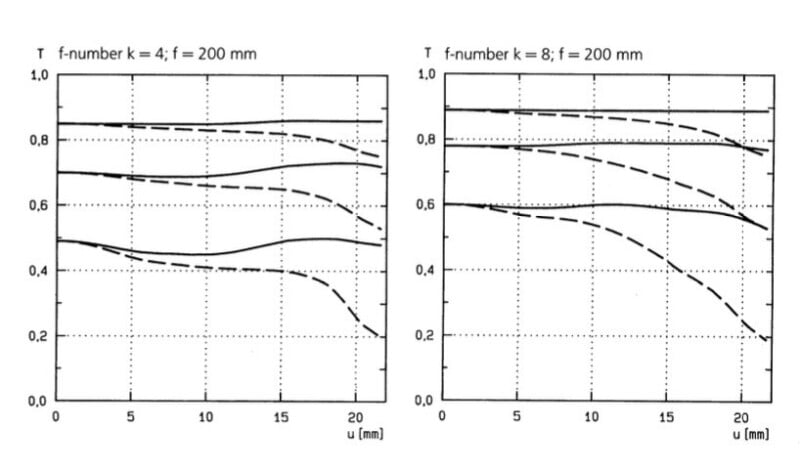 MTF at 200mm | Source: Zeiss
The outside appeal is obvious: Zeiss color and contrast in a useful telephoto zoom range, without the price of faster or more famous Zeiss primes. The 80-200mm range covers portraits, compressed landscapes, events, details, and travel telephoto work. The constant f/4 aperture keeps exposure predictable. The C/Y mount adapts easily to mirrorless (and Canon EF), and the lens has the mechanical feel people expect from Contax-era Zeiss glass.
This is not a casual pocket lens. It is a substantial piece of equipment. You will feel it in the bag, and you will feel it on a small mirrorless body. But the reward is a telephoto zoom with unusually convincing contrast and color for its age. It has the kind of crispness people often describe as “Zeiss pop,” though that phrase is overused enough to deserve retirement. What it really means is that the lens combines sharpness, contrast, and tonal separation in a way that gives images a sense of clarity–the transitions from in to out of focus are very clearly defined, because there are no optical maladies to cloudy the waters.
Check out these MTF charts from Zeiss — which use measured rather than theoretical MTFs — that show not only high overall performance but also good consistency across the frame and, in particular, very little change throughout the zoom range.
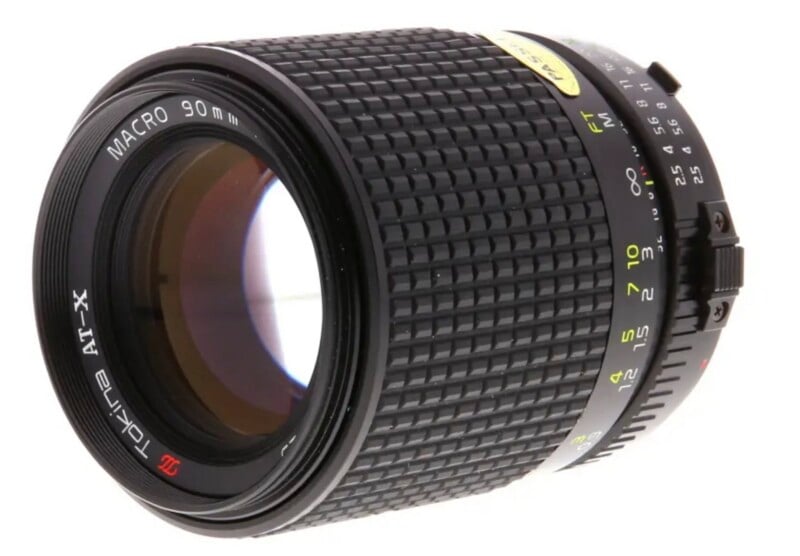
Tokina AT-X 90mm f/2.5 Macro
 Screenshot
The Tokina AT-X 90mm f/2.5 Macro has one of the best nicknames in vintage optics: the “Bokina.” That name tells you almost everything about why people love it. Macro lenses are often associated with flat, technical sharpness and nervous backgrounds. The Tokina is TACK sharp, but it is also known for unusually smooth out-of-focus rendering, making it useful not only as a macro lens but also as a portrait lens.
The basic specification is excellent: 90mm, f/2.5, manual focus, 1:2 macro on its own, and 1:1 with the dedicated matched extender. That makes it more flexible than many vintage short telephotos. It is long enough for comfortable close-up work, fast enough for portraits, and optically strong enough to satisfy people who care about sharpness.
Wide open, the Tokina has enough resolution to be taken seriously, but its real charm is the way it draws. Backgrounds tend to melt rather than chatter. Subject isolation is strong without looking brittle. Color and contrast are good, and the lens has a slightly rich rendering that works beautifully for flowers, portraits, nature details, and close-focus still life.
It is not a tiny lens. It has real mass, and the dedicated 1:1 extender makes the setup longer and more cumbersome. But the handling is part of its appeal. It feels like a serious optical tool. The focus throw is long enough for precision, and the lens rewards slow, deliberate shooting.
Tokina is the romantic macro-portrait hybrid. If you photograph insects, flowers, textures, hands, faces, or anything where close-up detail and background rendering both matter, it is easy to understand why the Bokina became a cult favorite.
Contax G 90mm f/2.8 Sonnar
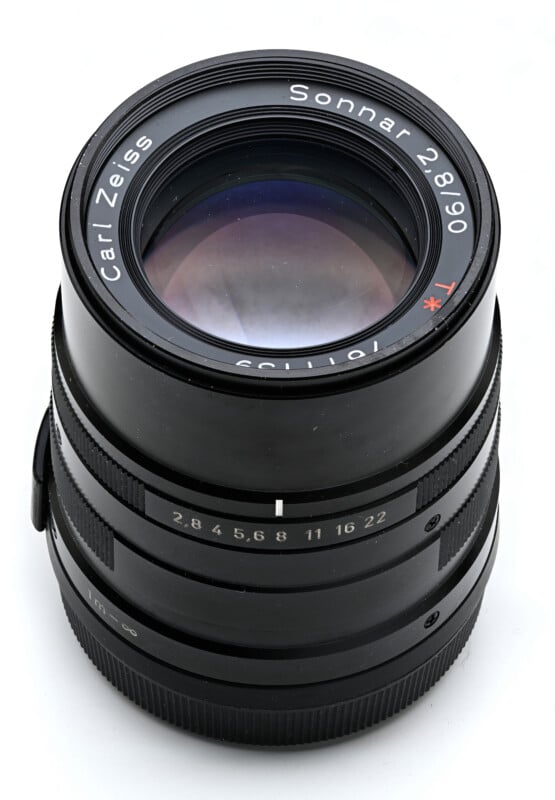 Photo by Phiarc, licensed under CC-BY-SA 4.0
The Contax G 90mm f/2.8 Sonnar is one of the great optical bargains with one major practical catch: it was designed for an autofocus rangefinder system, not for conventional manual focusing, so the focus helicoid is adjusted via a screw on the lens mount, rather than a focusing ring.
Get past that speed bump, and the lens is wonderful. It has the classic Sonnar virtues: strong central sharpness, high contrast, saturated color, and very smooth background rendering. It is a portrait lens, a landscape detail lens, a travel telephoto, and a compact companion to the famous Contax G 45/2 Planar or 28/2.8 Biogon.
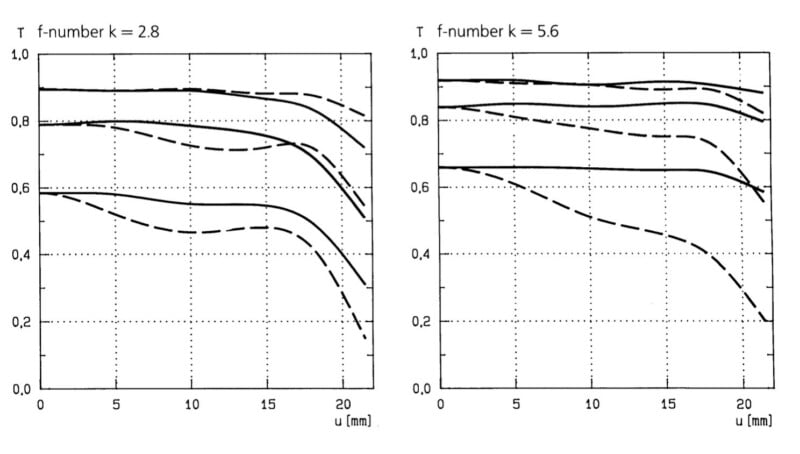 Source: Zeiss
The downside is ergonomics. Since the adapter requires its own focusing ring, the quality — both tolerance precision and subjective focusing experience — of such adapters varies wildly. The focusing action may feel vague, stiff, or too short; the integration with the focus screw may be imprecise or weak. Better adapters improve the experience, and Techart makes an autofocus adapter, but the Contax G lenses are never quite as straightforward as native manual-focus SLR lenses. My recommendations are Metabones, Shogun, or Kipon (the latter is especially compact compared to others on the market).
Nikon Nikkor 105mm f/2.5 (non-AI, AI, or AI-S)
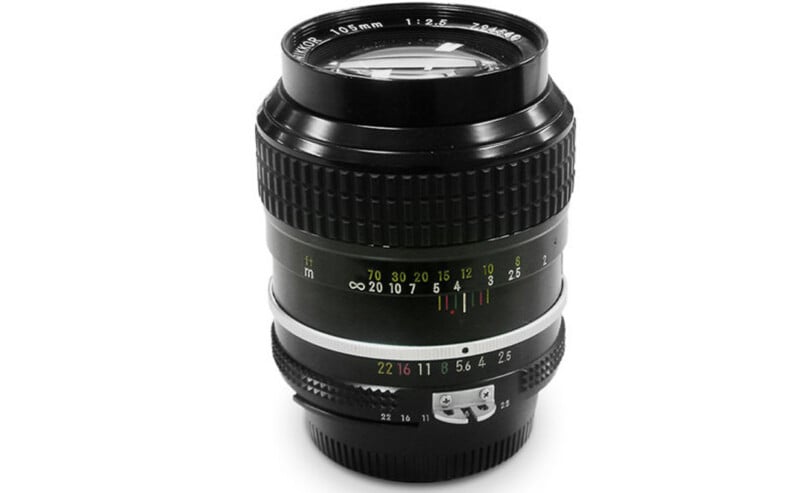 Image Credit: Nikon
If there is a single lens that justifies the entire premise of buying vintage glass for portraiture, this may be it. Nikon made the 105mm f/2.5 for forty-seven years and sold more than six hundred thousand of them, which means supply is abundant and prices stay reasonable — typically $100 to $180 depending on version and condition. It is also, by broad consensus, one of the finest short telephotos ever built for 35mm — a consensus that was built in the wake of Steve McCurry’s “Afghan Girl” portrait on an FM2 with the AI-S version.
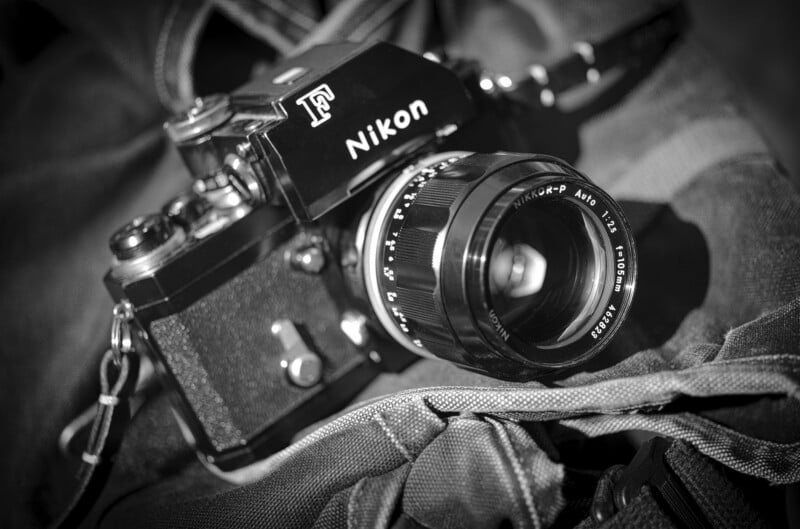 Image Credit: B&H Photo
What most buyers do not realize is that there are two entirely different lenses sharing the name, and the difference is a genuine optical redesign rather than a cosmetic revision.
The original, sold from 1959 to 1971 and marked NIKKOR-P, is a Sonnar derivative: five elements in three groups, descended from Wakimoto Zenji’s 1953 design for the Nikon rangefinders, with the rear element trimmed slightly to clear an SLR mirror. Sonnar-type designs use thick cemented groups to control aberrations with very few air-glass surfaces, which in the single-coated era meant excellent flare resistance and beautiful tonal gradation. These lenses are single-coated, a touch warmer, slightly lower in contrast, and noticeably gentle in the way they hand off from sharp to unsharp. Wide open there is a faint softness that flatters skin. The Sonnar versions run to roughly serial number 286451.
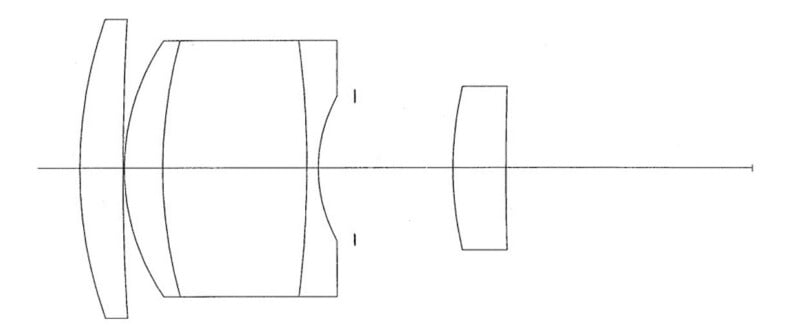 NIKKOR-P 10.5cm f/2.5 Lens Cross-Section | Source: Nikon
In 1971 Nikon replaced it with a five-element, four-group design that is properly a Xenotar type but is universally called the Gauss version. The giveaway is the rear element, which is visibly larger. This is the optic that carried through the multicoated NIKKOR-P.C of 1973, the K of 1974, the AI of 1977, and the AI-S of 1981, and it is what the overwhelming majority of copies on the used market actually contain.
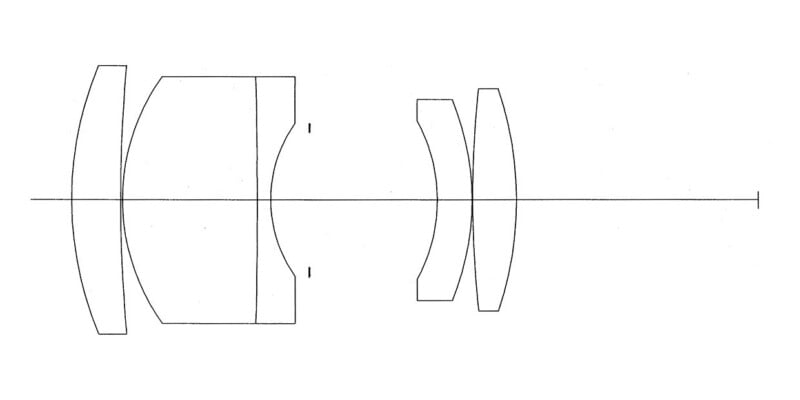 AI Nikkor 105mm f/2.5 Lens Cross-Section | Source: Nikon
The Gauss version is the better-corrected lens. It holds contrast more firmly wide open, it is cleaner at closer focusing distances — where Sonnar derivatives characteristically weaken — and the multicoated variants from 1973 onward handle backlight far better. If you want a modern-feeling short telephoto that happens to cost $150, this is the one. The Sonnar version is not soft in any absolute sense; it is simply lower in contrast and more forgiving, which some photographers prefer for portraits and which others read as a lack of bite. Beyond f/2.8 the two converge, and by f/4 you would struggle to identify which is which in a blind test.
There is one more variable worth knowing. The earlier pre-AI barrels use rounded aperture blades, while the AI-S switched to straight seven-blade construction, so stopped-down highlights render as soft circles on the older versions and as heptagons on the newest. The AI-S is also the lightest and slimmest of the family and the only one with a built-in sliding hood. For mirrorless use, any of them adapts trivially and non-AI copies carry no penalty at all; the AI coupling only matters on Nikon film and DSLR bodies. Buy on condition and price rather than version, but know which optic you are getting.
Contax Zeiss C/Y 135mm f/2.8 Sonnar
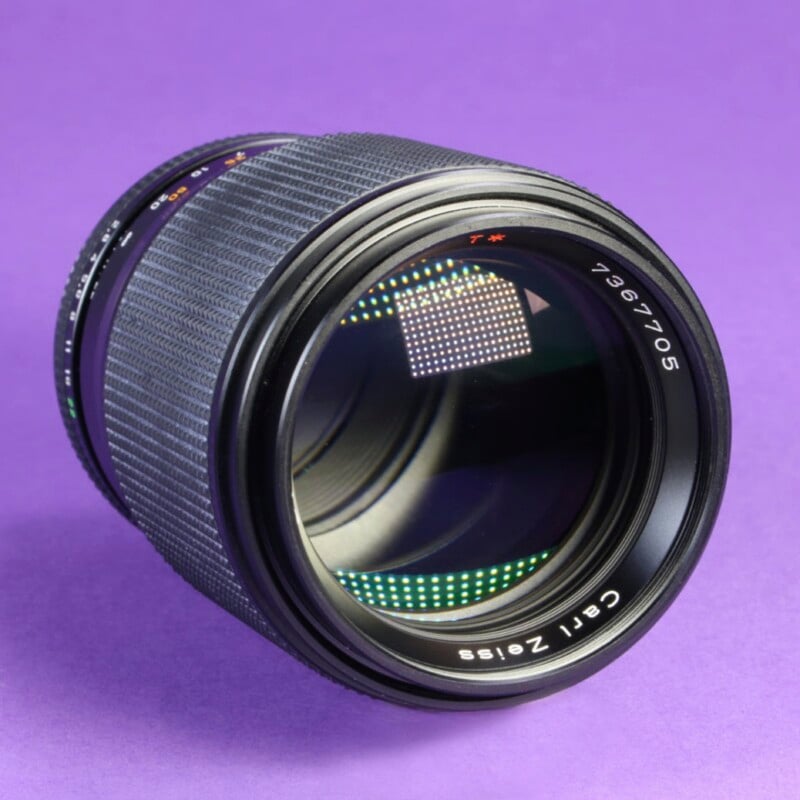 Image by Blue Moon Camera
The 135mm f/2.8 category is one of the great value zones in vintage lenses. Nearly every major manufacturer made one, many are inexpensive, and a surprising number are very good. The Contax Zeiss is one of the better examples, combining classic telephoto usefulness with Zeiss transparency.
A 135mm lens is not as universally useful as a 50mm or even 85mm, but when it fits, it really fits. It is excellent for portraits, compressed landscapes, close-up still life, distant textures, and isolating subjects without needing an extremely fast aperture
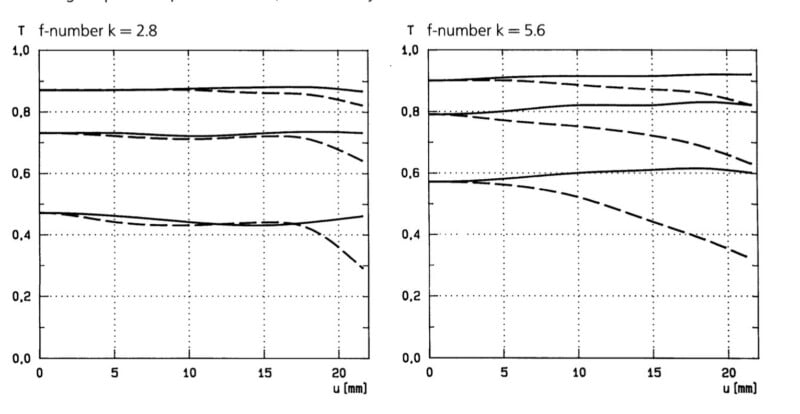 Source: Zeiss
Compared with cheaper 135mm lenses from other brands, the Zeiss is not always the absolute bargain by price alone. You can find many competent 135mm f/2.8 lenses for less. But the Contax earns its place because it combines optical quality, mechanical feel, and rendering consistency. It renders images without imposing its own signature; that level of transparency and neutrality is what I seek for most of my photography. With that said, the lens is not very expensive at all, especially for one wearing the Zeiss name, and I’ve regularly seen it priced between $100 to $125 in decent condition.
A Few Personal Runners-Up
A list like this could easily become twenty or thirty or two hundred lenses long. The following are not afterthoughts so much as near-misses: lenses that remain excellent budget choices, but which either overlap with the main list or have become just a little too dependent on price and condition.
Nikon 24mm f/2.8 (in any of the AI, AI-S, or AF-D variants)
Pentax SMC Takumar 28mm f/3.5
Minolta MD 45mm f/2 Rokkor-X
Contax Zeiss C/Y 45mm f/2.8 Tessar
Minolta M-Rokkor 90mm f/4
Affiliate Disclosure PetaPixel articles may include affiliate links; we may earn a commission if you buy through one.
What's Your Reaction?
 Like
0
Like
0
 Dislike
0
Dislike
0
 Love
0
Love
0
 Funny
0
Funny
0
 Wow
0
Wow
0
 Sad
0
Sad
0
 Angry
0
Angry
0









Comments (0)