

10 Technologies Photographers Inherited From the Military
The zoom ring on a modern 70-200mm traces back to a viewfinder accessory the US Army Signal Corps clipped onto its 35mm combat movie cameras. Frank Back, the Austrian-born engineer who designed it, spent the war improving cameras and lenses for the Signal Corps and then turned the same optical trick into the first zoom lens that caught on. That kind of lineage runs through more of a modern kit than most people expect, and it runs shorter and less often than the retellings suggest.
Three separate things get blurred together whenever this subject comes up. Some technology was genuinely invented because the military needed it, whether for a war being fought or for the survey and sighting work that fills the years between them. Some was invented in a civilian lab and then classified, bankrolled, or scaled by defense money it would never have seen otherwise. And some was simply used by the military first and handed down intact. Sorting the ten below into those three buckets is most of the work, because the third category gets promoted into the first constantly.
Invented Because the Military Needed It
1. The Practical Zoom Lens
Zoom optics existed long before Back. Clile C. Allen patented a design that held focus through a change in focal length in 1902, US Patent 696,788, and the Bell & Howell Cooke Varo 40-120mm went into industrial production for 35mm movie cameras in 1932. Neither stuck. What changed was Back's wartime job. He was born in Vienna, reached the United States in the summer of 1939, and during the war worked on cameras and lenses in New York, including a variable-focus viewfinder, the PH-532/UF, issued with the Signal Corps version of the Bell & Howell Eyemo. That viewfinder is where he worked out the single-barrel linear movement, the scheme that puts the moving elements in one sliding barrel and throws out the cams and gears earlier zooms ran on. The barrel in the finder carried a variator and nothing else, and the image only had to satisfy an eye at an eyepiece. Film is less forgiving, so for the camera lens he added a compensator element to the same barrel, fixed to the variator so the two travel together, and that is what holds the image in focus through the zoom.
He applied for a patent on the civilian version on July 30, 1946, and US Patent 2,454,686 was issued on November 23, 1948. A prototype covered a Brooklyn Dodgers game against the Cincinnati Reds for WCBS-TV on July 21, 1947, and Paramount newsreel cameramen shot the World Series with one that fall. The still-photography version, a 36-82mm f/2.8 Zoomar sold through Voigtländer in 1959, was the first zoom in regular production for 35mm cameras. The optics inside a Canon RF 70-200mm f/2.8 L IS USM are not Back's, because modern zooms run on the cam-driven mechanical compensation Pierre Angénieux introduced in 1956. What starts with a combat newsreel viewfinder is the zoom lens as standard equipment. Bell and Howell would build you a Varo on special order in 1932, and by 1935 it had shrunk to something you sometimes rented. Back's is the design that stuck, in television and newsreels first, on still cameras a decade later.
2. Color Infrared Film
Infrared-sensitive emulsions were not a military invention. Kodak's Walter Clark had been publishing on infrared photography through the 1930s, and his book on the subject appeared in 1939. What the war produced was the false-color version. Living vegetation reflects near-infrared light strongly and green paint and dyed netting do not, so a film that renders infrared as red separates a hedgerow from a tarpaulin at a glance. Kodak built exactly that under contract, a color camouflage detection film supplied to Allied forces from 1942 and sold under names like Kodacolor Aero Film, Camouflage Detection. The line ran for decades after: Ektachrome Infrared Aero Film in 1959, then Aerochrome, which forestry and geology used far longer and more usefully than anyone ever used it to find gun pits. Kodak stopped making the 35mm consumer version, Ektachrome Professional Infrared EIR, in 2007, and announced the end of Aerochrome III 1443 in October 2009, which is why surviving rolls now trade like relics. If you want infrared today you convert a body and shoot a Hoya R72, which gets you white foliage and channel swaps rather than the film's palette. Aerochrome's specific color needs a full spectrum conversion and one of the filters built to pass a measured mix of visible and infrared light, because an infrared-pass filter throws away the visible color the film was recording alongside the infrared.
3. Night Vision and the Image Intensifier
Work on the first practical American night-sighting device began in 1943 at the Army's Engineer Board at Fort Belvoir, Virginia, with Frankford Arsenal designing the telescope, designated the T120, and RCA's George A. Morton consulting on the image tube. The result was the Sniperscope, an active infrared device that flooded the scene with an invisible beam and read the return. The M1 and M2 versions reached Okinawa in 1945 mounted on the T3 carbine, a purpose-built variant of the M1 carbine with an integral receiver mount, giving a working range of roughly 70 yards. About 1,700 scopes were built during the war. Germany was working the same problem independently and issued its own active infrared sights to combat units in the last months of the war, the FG 1250 on Panther tanks and the ZG 1229 Vampir on the StG 44, so the priority here is American rather than absolute.
The paperwork for that issue survives. Forty-four Panthers went to five units in March and April 1945, and Leitz built somewhere between 200 and 310 of the rifle sights. What the sights did once they got there is another matter. British investigators who captured a German infrared unit in May 1945 were told the gear had been used on the Eastern Front with great success, including a claim of 67 Soviet tanks knocked out in a single night, but their own report noted that full reports were lacking, and the unit in front of them was a training outfit that had never taken its equipment into action. No German infrared engagement has been confirmed from surviving records since. Passive intensification, which amplifies ambient starlight instead of supplying your own light, arrived with the first-generation AN/PVS-2, developed from 1964 and in the field in Vietnam by 1967. Microchannel plates in the 1970s produced the second generation and the head-worn goggles that followed. What photographers inherited here is narrower than the usual telling. Modern low-light photography came from silicon, not from photocathodes, and a stacked back-illuminated sensor owes nothing to a Starlight scope. The tube itself survives as a product you can still buy, and a small group of astronomers mount intensifiers on telescope eyepieces to watch faint nebulae live rather than photograph them.
4. Aerial Mapping Cameras and Photogrammetry
Aimé Laussedat was an officer in the French army's engineering corps when he began, around 1849, trying to build topographic maps out of photographs. He called it metrophotography, told the Académie des Sciences in 1859 that he had produced maps from images shot with a combined theodolite and camera, and lofted cameras on kites and balloons to work from above. No war asked for any of this. He wanted to replace slow, imprecise ground survey with something an army engineer could do faster, and the French army funded his experiments for years without ever putting the method into routine use. Carl Pulfrich at Zeiss turned the idea into an instrument with his stereocomparator in 1901, and Eduard von Orel's stereoautograph, invented in 1907, went into production at Zeiss from 1909, with the widely sold Model 1911 following.
By the Second World War, the hardware was industrial. A Fairchild K-17 shot 9 by 9 inch negatives on 9.5-inch roll film through interchangeable cones at 6, 12, and 24 inches. Only the 6 inch cone carried the Bausch & Lomb Metrogon, the f/6.3 wide angle derived from the Zeiss Topogon that covered a 90 degree field; the 12 inch f/5 and 24 inch f/6 cones used Tessar-type lenses, which is what a narrower field of view calls for. Mapping units flew three of them together in the trimetrogon cluster, one vertical and two obliques tilted 60 degrees, for horizon-to-horizon coverage. The stereo did not come from the cluster; it came from the forward overlap between successive frames along the flight line. Every drone mapping mission you have seen is that same method with the arithmetic moved into software. Fly a grid, overlap the frames, and let the geometry of the overlap rebuild the terrain.
Invented in a Civilian Lab, Then Classified or Bankrolled
5. Anti-Reflection Lens Coatings
Alexander Smakula was working at Carl Zeiss in Jena when he filed his 1935 patent on November 1 of that year. The idea is a quarter-wave film evaporated onto glass in a vacuum, thin enough that the reflection from its front surface cancels the reflection from the glass behind it. Multiply that across a dozen air-to-glass surfaces and you get the complex modern lens. Zeiss holds the patent, granted in December 1939, and the process became the T coating, single-layer until the T* multi-coating replaced it on photographic lenses in 1972. The familiar version of the story stops there, at a German military secret.
Two things complicate it. John Strong at Caltech published a single-layer evaporated coating in the Journal of the Optical Society of America in 1936, in the open literature and independently, and Katharine Blodgett's nonreflecting glass at General Electric was announced in December 1938 and is credited with wartime service in submarine periscopes and aerial cameras, although her stacked molecular films were soft enough to wipe off and the coatings that lasted were the evaporated kind. The coating was arrived at more than once, on both sides of the Atlantic. What the war decided was the queue. Periscopes, gunsights, and reconnaissance lenses got coated glass first, and civilian buyers did not get it in quantity until afterward, when Kodak began labeling fully coated optics Lumenized around 1947.
6. The Digital Sensor
This is the entry that gets overstated most. Willard Boyle and George Smith sketched the charge-coupled device at Bell Labs in October 1969, in a session that by their own account ran about an hour, and shared the 2009 Nobel Prize in Physics for it. Fairchild built the first commercial CCDs in 1973, including the 100 by 100 pixel array that Steven Sasson used in his 1975 Kodak prototype. A telephone company invented the CCD, not a defense contractor. It was not the first solid-state image sensor, though. IBM demonstrated the scanistor in 1964, and Westinghouse, an actual defense contractor, had a working camera built around a 50 by 50 array of phototransistors in 1965. Peter Noble at Plessey published self-scanned silicon detector arrays with an amplifier inside every pixel in 1968, the ancestor of the CMOS sensor in your phone. Bell Labs did not get there first. It got there with a design clean enough to beat everything else, and the CCD pushed the rest aside for the next 20 years.
The chip actually in your camera is a CMOS active pixel sensor, a different architecture that Eric Fossum's team developed at NASA's Jet Propulsion Laboratory in the early 1990s, which moves the credit sideways to a civilian space lab rather than a military one. The military role is real but different, and it is also later than the legend has it. The National Reconnaissance Office launched the first KH-11 on December 19, 1976, an electro-optical satellite that sent images down as signal rather than dropping film canisters, but that first spacecraft read its focal plane with an array of silicon photodiodes, not a CCD. Robert Kohler, the CIA program manager at the time, said in a 2004 oral history that the switch to charge-coupled devices came in 1978 and 1979, and that the CCD contractor was Westinghouse in Baltimore. A figure of 800 by 800 pixels circulates for the Block II satellites of the 1980s, but it traces back to unsourced reference pages rather than to any declassified document. Civilian space money mattered at least as much: the Jet Propulsion Laboratory worked with Texas Instruments from 1973 to 1979 on space-grade CCDs, and JPL produced what NASA calls the first astronomical image made with CCD technology, a view of the south pole of Uranus, around 1975. Government programs really were making electronic pictures from orbit two decades before you could buy a digital camera. They did not invent the chip that made it possible.
Lifted From the Gun Deck
7. The Coincidence Rangefinder
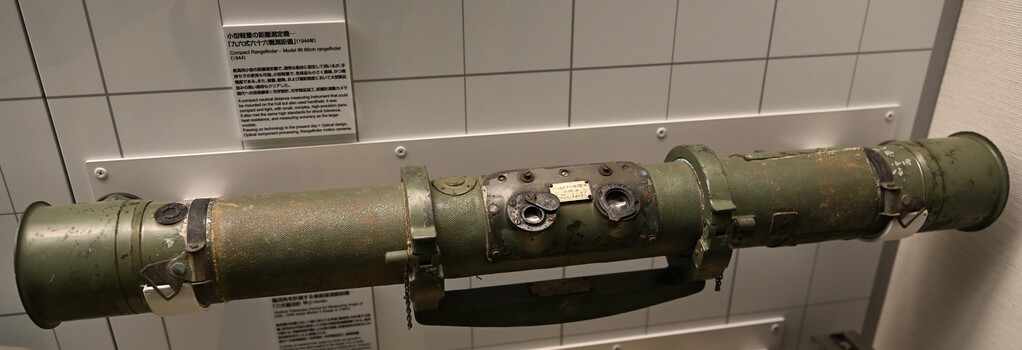
Archibald Barr and William Stroud were professors of engineering and physics at Yorkshire College in 1888 when they answered an advertisement in Engineering calling for a short-base rangefinder for infantry. The Admiralty came back to them in 1891, adopted their design, and gave them a contract for six instruments in 1892. They set up Barr & Stroud's Patents Ltd in the mid-1890s to exploit it, moved the work to Glasgow, and incorporated as Barr & Stroud Ltd in 1913, by which point the Anniesland works employed several hundred people building rangefinders and fire-control instruments for navies. Zeiss took the stereoscopic route instead, building a stereo telemeter in the early 1890s on Hector de Grousilliers' patent, with the first practical version demonstrated by Pulfrich in 1899.
The optical principle is exactly what sits in a camera: two windows a known distance apart, a moving prism or wedge, and a target image that snaps together when the geometry is right. Kodak shrank it first. The No. 3A Autographic Kodak Special of about 1916 is generally credited as the first production camera with a coupled rangefinder, built on J. E. Woodbury's British patent 13421 of 1914, and the Leica II brought the idea to 35mm in 1932. There is no transfer contract to point at here, no program. Camera engineers took a solved naval gunnery problem and made it small, which is a weaker claim than the usual one and happens to be the true one. The format survives commercially in the Leica M11.
8. Gyroscopic Stabilization
Theodore Kenyon graduated from MIT in 1924, flew for Colonial Airlines from 1926, and joined Sperry Gyroscope in 1936, building aviation instruments and finishing his career with close to 40 patents. He spent the war demonstrating autopilots at military bases while his wife Teddy test-flew Navy aircraft for Grumman, and that is the period when gyro stabilization did its most consequential work: Charles Stark Draper's Mark 14 gunsight, which Sperry manufactured to the tune of more than 85,000 units, let a shipboard gunner track an aircraft while the deck rolled under him.
In April 1950, Kenyon filed a patent for a gyro-stabilized sighting instrument intended for hand-held binoculars, sextants, and cameras, and he founded Kenyon Laboratories in Lyme, Connecticut in 1953. The company still sells Kenyon gyro stabilizers, and that is still how a good deal of handheld shooting out of a helicopter door gets steadied. The lineage stops there, though. In-body and in-lens stabilization use vibrating-structure angular rate sensors, piezoelectric ceramic in the early systems and silicon MEMS now, paired with a moving element or a moving sensor rather than a spinning flywheel, and they descend from consumer electronics rather than from gunsights.
Inherited Wholesale
9. Nikon Itself
Nippon Kogaku K.K. was formed on July 25, 1917, out of the optical instruments division of Tokyo Keiki, the mirror division of Iwaki Glass, and Fujii Lens Manufacturing, with backing from Koyata Iwasaki of Mitsubishi. The purpose was national. Japan bought its binoculars, scopes, and rangefinders from Germany, and the Imperial Japanese Navy wanted a domestic supplier it could rely on in a war. For nearly three decades the company's principal customer was the military, and it made binoculars, periscopes, bombsights, aerial cameras, and rangefinders. Accounts of its wartime peak vary, with the commonly cited figures around 19 factories and roughly 23,000 employees. The occupation cut it back to a single plant and around 1,400 people, redirected it to civilian goods, and the first camera to carry the Nikon name shipped in 1948.
Canon is where this gets told wrong. Precision Optical Instruments Laboratory was set up in November 1933, in a rented room in Roppongi, to build a 35mm rangefinder camera. Goro Yoshida had taken a Leica apart and concluded that nothing inside it justified the price, and the lab produced the Kwanon prototype in 1934 and incorporated as Precision Optical Industry on August 10, 1937. That is a commercial origin, not a military one, and no amount of wartime contracting turns it into one. The genuinely odd detail runs the other way. The Hansa Canon of February 1936 carried a Nikkor 50mm f/3.5, and by Canon's own museum, Nippon Kogaku made the rangefinder optics and the focusing mount while the Canon side built the body and the shutter. Canon's first production camera looked through navy-funded glass.
10. GPS and Geotagging
Nothing about GPS was designed with a photograph in mind, which makes it the cleanest case on this list. The Department of Defense launched the first Block I NAVSTAR satellite on February 22, 1978, the constellation was declared fully operational in 1995, and the system is still owned by the US government, operated by the Space Force, and paid for by the US taxpayer. The moment that mattered to photography came on May 1, 2000, when Selective Availability, the deliberate degradation of the civilian signal, was switched off. Predicted civilian accuracy improved from about 100 meters to about 20 meters overnight, which is the difference between a fix that could sit a block or two off and one that puts you on the right side of the road. Consumer geotagging followed within a few years. Every time a camera or a phone writes a latitude and longitude into a file, it is reading a timing signal built to put a weapon on a coordinate and to replace the separate navigation systems each service was building, then handed over, at no charge, to anybody holding a receiver.
Lead image: a Type 96 66 cm coincidence rangefinder built by Nippon Kogaku for the Imperial Japanese Navy in 1944, on display at the Nikon Museum. Photo by Doricono, CC BY 4.0. Source.
What's Your Reaction?
 Like
0
Like
0
 Dislike
0
Dislike
0
 Love
0
Love
0
 Funny
0
Funny
0
 Wow
0
Wow
0
 Sad
0
Sad
0
 Angry
0
Angry
0








.jpg)
.jpg)

Comments (0)