

7 Huge Differences Between Christopher Nolan's 'Interstellar' and Steven Spielberg's Original Script

Published Sep 6, 2026, 10:01 AM EDT
Surprise! Spielberg’s version had aliens (and sex)
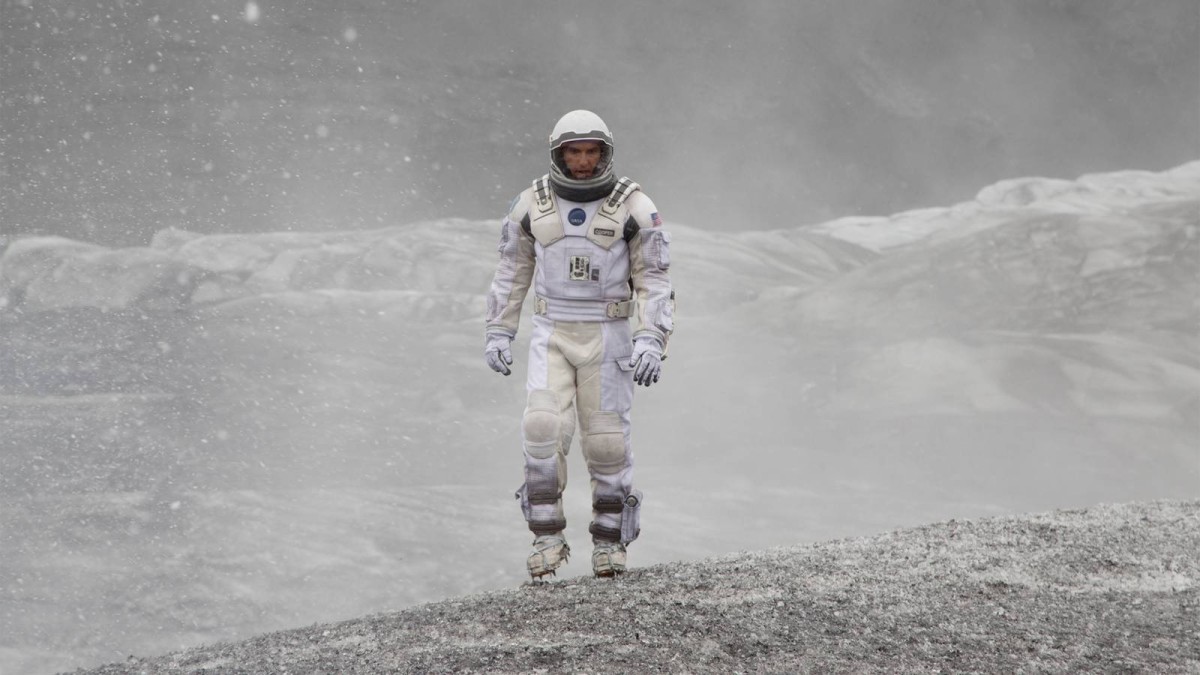
 Image: Melinda Sue Gordon/Paramount/Everett Collection
Sign in to your Polygon.com account
More than six weeks after its premiere, Christopher Nolan’s The Odyssey is still going strong at the box office. Recently, it surpassed Deadpool & Wolverine to become the highest-grossing R-rated film of all time. As such, the celebration of Nolan’s entire filmography continues, including his 2014 sci-fi epic, Interstellar, which is about a team of astronauts traveling into deep space to find a new home for humans before the Earth becomes uninhabitable.
But before Christopher Nolan signed on as the director of Interstellar, the director was none other than Steven Spielberg, who developed the story with Nolan’s screenwriter brother, Jonathan Nolan. Spielberg had been on the project for about a year when he moved his production company, DreamWorks, from Paramount to Disney, meaning he had to drop out as Interstellar’s director. Shortly afterward, Christopher Nolan came on as director, which came with a major rewrite by the director himself.
The script of Spielberg’s version of the film is accessible online, though. If you read it, it's clear that we would have gotten a much different movie. Here are the seven biggest differences between the Interstellar we got from Christopher Nolan and the version we almost got from Steven Spielberg.
1 Cooper wasn’t a NASA pilot

In Christopher Nolan’s version of Interstellar, Matthew McConaughey’s character Cooper was a trained NASA pilot before the events of the film, but NASA had shut down before he could go on any missions. In Spielberg’s version, Cooper is merely a crafty engineer who stumbles upon a space probe returning from deep space. The probe leads him to the secret NASA base where he is then selected for the space mission that’s about to leave Earth.
2 Murph was Cooper's son, not his daughter
 Image: Warner Bros. Entertainment, Inc./ Paramount Pictures Corporation.
Jessica Chastain’s character, Murph Cooper, was a boy in the original version. Murph’s personality is much the same, though, as both versions of the character are a lot like Cooper. “Murph’s Ghost” isn’t a thing in the original version either, but I’ll get to that later.
3 There was only one planet to check out, not three
 Photo: Warner Bros.
In the finished film, we learn that, 48 years before the story began, a mysterious wormhole to another galaxy appeared in our solar system, placed there by some unknown intelligence. NASA then sent probes into the wormhole and the probes reported back that there were 12 potentially habitable planets on the other end of the wormhole.
Then, 10 years before the events of the film, NASA sent 12 astronauts on single-person, one-way missions to those planets to see if they could potentially be a new home for humans. Three of those astronauts reported back promising results. There was Miller's Planet, which was the one with all the water and the giant wave that nearly wrecked the ship. Mann’s Planet was the icy planet where Hugh Mann (Matt Damon) went crazy. Edmunds' Planet is the one we just barely see at the very end of the film; that’s the one where Anne Hathaway’s character, Dr. Brand, went to, following after her boyfriend Dr. Edmunds (who we never meet).
In the Spielberg version, there essentially was no project Lazarus where a bunch of astronauts checked out a bunch of planets. Instead, the wormhole led straight to one planet, which looks similar, at first, to Mann’s planet. Also, in the Spielberg version, only probes had been sent before the current NASA mission with Cooper and Brand.
4 There was a Chinese expedition
 Image: Warner Bros.
After going through the wormhole and arriving in the other galaxy, the NASA crew lands on the planet and find the remains of a Chinese expedition, including four grave sites for the Chinese crew, buried by their robot companions. The Chinese crew had died due to radiation exposure from a nearby neutron star.
5 It had aliens
 Photo: Paramount Pictures / Everett Collection
At first, the planet in the Spielberg version seems to resemble what will become Mann’s Planet in the film, as it is similarly icy and appears to be lifeless. However, under the ice, the NASA crew find a lush environment with water, breathable air, and shapeshifting lifeforms that appear to be plants at first until they break apart and reassemble themselves as dangerous animal life. The presence of alien life in this screenplay is undoubtedly the biggest difference between the two versions, but not the most surprising given Spielberg’s penchant for movies featuring extraterrestrial life.
6 And time travel — like, real time travel
 Image: Paramount Pictures
Towards the end of Christopher Nolan’s movie, Cooper gets sucked into a black hole, which places him in a device called the Tesseract. This allows him to communicate with Murph in the past. “Murph’s Ghost” in the beginning of the movie was just her dad sending messages from the future. After Cooper sends the message, he awakes in a giant space station called “Cooper Station” in time to meet Murph as an old woman, just before she dies.
The original screenplay was quite different. After escaping the ice planet, the NASA crew heads into a wormhole which leads them to a Chinese space station 4,000 years in the future. This was built by the descendants of the Chinese embryos from the Chinese expedition, raised by robots.
Aboard the space station, Cooper learns of an experimental time-travel device and decides to travel back to Earth to meet Murph in the past. The time-travel device works, but Cooper arrives at the wrong time, years after Earth has become a barren wasteland. He finds his old house and loses consciousness, only to awake in Cooper Station to meet an old Murph, just like in the movie.
7 And… there’s a zero-gravity sex scene
 Image: Paramount Pictures
The most surprising difference between the two versions of Interstellar is that Spielberg’s version had a sex scene — in zero-gravity! Unlike the movie, Brand and Cooper have a romantic arc in the original screenplay. This culminates in a gravity-free sex scene.
Yeah, it’s safe to say this would have been a very different movie.
What's Your Reaction?
 Like
0
Like
0
 Dislike
0
Dislike
0
 Love
0
Love
0
 Funny
0
Funny
0
 Wow
0
Wow
0
 Sad
0
Sad
0
 Angry
0
Angry
0





Comments (0)