

A Heron, a Crab, and a Safari Truck: 7 Wildlife Shot Problems Solved
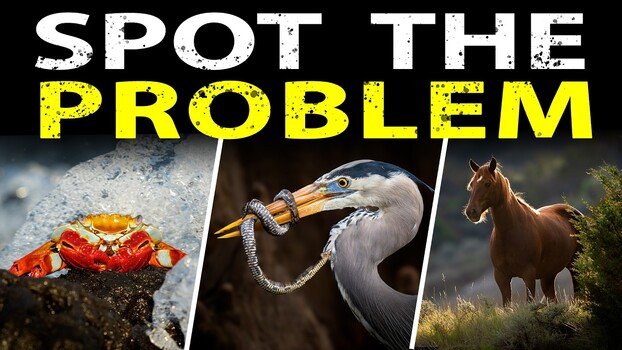
Knowing your gear is one thing. Knowing what to do when the shot isn't working is another. This breakdown of seven real wildlife situations covers the kind of fieldcraft that doesn't show up in spec sheets or camera manuals.
Coming to you from Steve Perry, this practical video walks through seven actual wildlife photos, each paired with the specific problem Perry faced while making it and the decision that saved the shot. One early example involves a great blue heron wrestling a snake in thick vegetation. Perry couldn't move closer without flushing the bird, so he got low, identified a small opening in the vegetation, and committed to 1/1,250 s at ISO 10,000, knowing noise reduction software could handle the grain on a frame-filling head shot. He makes an important point here: the more you fill the frame, the better noise reduction performs. A heavy crop at that ISO would have destroyed the feather detail entirely. Another standout situation involves shooting what looks like an eye-level image from a raised safari truck, accomplished entirely by staying back and using a longer lens to flatten the angle between camera and subject.
Perry also covers back button autofocus in a way that actually justifies it, rather than just recommending it by default. He was hand-holding a 400mm f/2.8 while squatting on slippery rocks in the surf, trying to keep focus on the eye stalks of small crabs as waves crashed over them. The problem with standard AF lock in that situation is that any small movement on your part, which is inevitable when you're unstable, throws critical focus before the wave even hits. Back-button AF let him stay locked until the exact moment the wave was about to break, then disengage and fire. He reports sharp eye stalks 95% of the time, even with the crab submerged. That's a specific result, not a general claim, and it's the kind of thing worth paying attention to. His section on rim lighting is equally grounded: watch your highlights, make small positional adjustments to control how light wraps the subject, keep ISO low so you have room to lift shadows in post, and look for a darker background to keep the rim light from washing out.
The final two scenarios cover rain photography and metering for large expanses of white. For rain, Perry works between 1/60 s and 1/200 s to render drops as streaks rather than frozen points, shoots wide open for a misty separation from the background, and shoots high volumes of frames because a sharp raindrop directly in front of the eye can ruin an otherwise strong image. For white-dominated scenes like breaking surf, he explains why your meter will consistently underexpose and how he dialed in roughly 1 1/3 stops of positive exposure compensation in full manual to counteract it. He also used the rear LCD rather than the viewfinder while standing in the surf, which let him watch incoming waves and keep the camera out of danger.
Each of these situations comes with enough context that you can recognize them in the field before they become problems. The rain tips alone are worth the watch, and Perry goes deeper on the tortoise composition and the metering scenario than what's covered here. Check out the video above for the full rundown from Perry.
What's Your Reaction?
 Like
0
Like
0
 Dislike
0
Dislike
0
 Love
0
Love
0
 Funny
0
Funny
0
 Wow
0
Wow
0
 Sad
0
Sad
0
 Angry
0
Angry
0





Comments (0)