

A Jupiter-size planet that escaped its star's death
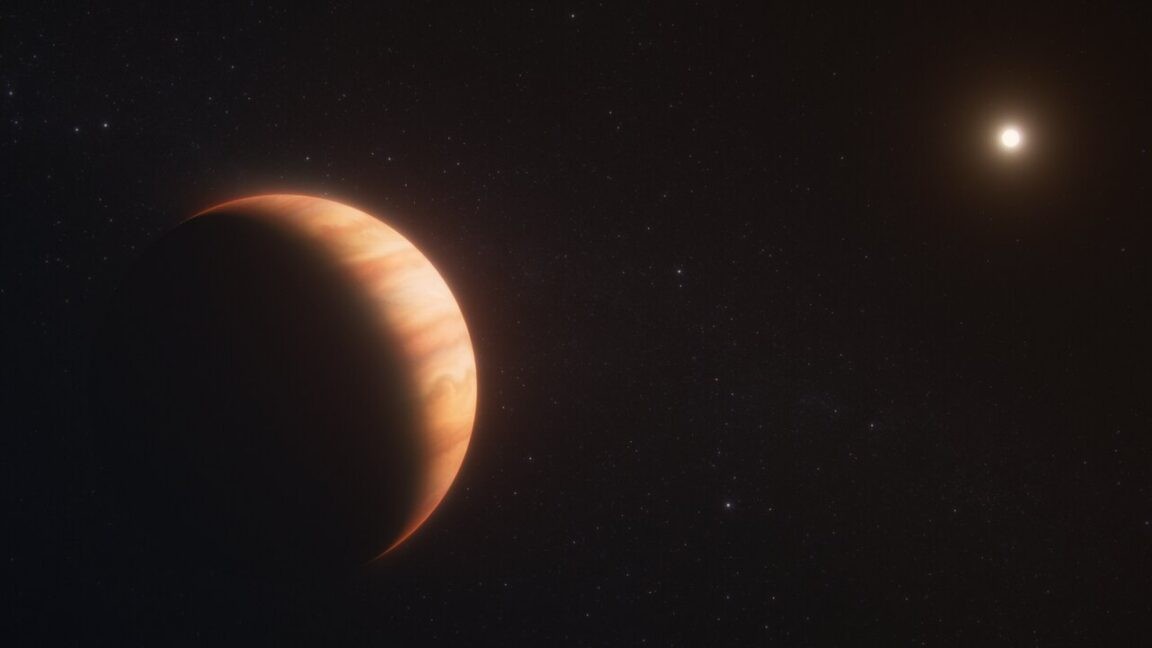
It’s unclear how the planet avoided its star’s bloated red giant stage.
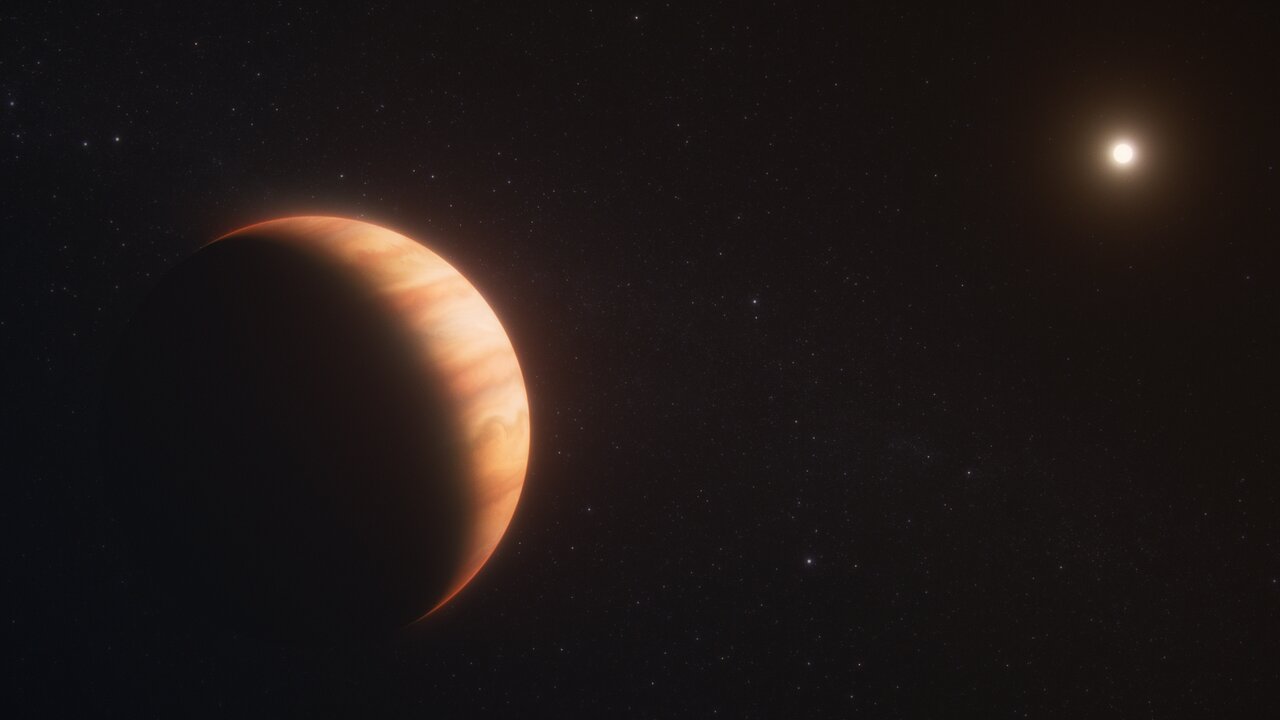
WD 1856 b is the only confirmed case of a planet that survived the death of a Sun-like star. It’s a Jupiter-size world orbiting a white dwarf—the burned-out remnant of a Sun-like star. Now, a team of astronomers has used the James Webb Space Telescope to take a closer look at this planet for the first time, and what they found makes an already strange system even stranger.
A feeding frenzy
WD 1856 b was an accidental discovery. Astronomers pointed the TESS observatory at a sample of roughly 2,000 white dwarfs in 2020. These stars are the remains of a Sun-like star that have already gone through a red-giant phase, leaving behind an Earth-size body that’s primarily composed of elements like carbon and oxygen. The TESS team was searching for small objects like comets or asteroids that might transit across the face of these dead stars.
What they found in the WD 1856 system was a gas giant. “As soon as they looked at it, they said, okay, that’s weird,” said Christopher O’Connor, a theoretical astrophysicist at Cornell University and co-author of the recent Nature study on WD 1856 b.
The white dwarf is about seven times smaller than the gas giant circling around it. Its brightness should be dropping to nearly nothing each time the planet crosses in front of it, but instead it’s dipping by about half. O’Connor thinks the reason is a grazing transit, where only the edge of the planetary disk clips the face of the star. “That’s a very unlikely viewing angle,” he said, “but it’s the only way to explain what we actually see.”
What’s more, the planet orbits at about 0.02 AU from the white dwarf, which goes against our ideas of how the death of a star should reshape its system. “When the star expands to become a red giant, it consumes the inner planets,” O’Connor explains. Then, in the process of shrinking down to a white dwarf, it loses about half of its original mass, which means its gravitational pull becomes weaker. “The outer planets, like gas giants, should migrate outward by about a factor of two,” O’Connor said.
WD 1856 b, though, apparently did not migrate outward. It got closer.
The discovery immediately has the science community buzzing. “It sent theoretical astrophysicists into a feeding frenzy,” O’Connor said. “When you find something that’s totally bizarre, totally in the wrong place, totally unexpected from any previous way of thinking about things—that’s the Universe inviting us to get creative.” First, though, scientists needed more data to get creative with, so O’Connor’s team booked time on the James Webb Space Telescope to take a closer look at what was going on in the WD 1856 system.
Eight minutes of light
The JWST observations were done on April 27, 2023, and captured a single transit that lasted just eight minutes. The viewing angle and the unusual size mismatch between the star and its planet posed an immediate technical problem. Standard exoplanet transmission spectroscopy assumes a smaller planet is entirely silhouetted against the face of a much larger star, which was not the case here.
To get around it, the team developed new equations to express the transmission spectrum as the time-varying area of the planet overlapping the star’s disk. Then, they modified POSEIDON, software for reconstructing exoplanets’ atmospheres based on JWST data to account for the grazing transit geometry (the software had been developed by Ryan MacDonald, the lead author of the study). When the scientists were done crunching numbers, WD 1856 b’s atmosphere proved somewhat surprising.
It turned out the planet is shrouded in aerosol hazes, and its atmosphere contains methane. It is also far hotter than the team expected. WD 1856 b apparently emits roughly 25 times more energy into space than it receives from its cooling host star. Even though its star, according to O’Connor, has been dead for about 6 billion years, the planet is glowing.
This extraordinary temperature, O’Connor argues, tells us a lot about WD 1856 b’s history.
Running hot
“We expected this planet to be roughly as hot as Jupiter, but it wasn’t,” O’Connor said. At about 0.02 AU from a white dwarf that has been cooling for 6 billion years, WD 1856 b should be somewhere between 150 and 200 Kelvin, close to the temperature of Jupiter’s cloud tops. Instead, it is around 400 Kelvin. “Whatever is causing this planet to glow, it must be an internally derived heat rather than just re-radiating energy from the star,” O’Connor said.
The planet, according to the team, cannot be radiating warmth left over from its formation. Something must have heated it at some point. Working backward through planetary cooling models, the team managed to estimate when it happened. Doing so, the scientists figured out the most probable reason why WD 1856 b got so close to its star.
The team initially came up with two competing scenarios to explain how WD 1856 b ended up in its current orbit. The first is a common-envelope model, in which the planet was originally in a close orbit and survived being engulfed when its star expanded into a red giant, emerging from the stellar envelope hot and tight against the remnant core. In the second, a high-eccentricity migration model, the planet started farther out, had its orbit destabilized by gravitational interactions with companion objects (WD 1856 has two distant stellar companions) and then spiraled inward over billions of years through a sequence of highly eccentric plunges.
One of the points at which these two scenarios differ is timing. Common-envelope evolution concludes when the star finishes its red giant phase, in this case roughly 5.4 billion years ago. High-eccentricity migration could deliver a planet to its current orbit billions of years later.
Running the planet’s current temperature backward through their cooling models, the team found that the reheating event most likely occurred 3 billion to 5.5 billion years after the end of the red giant phase—far too late for the common-envelope scenario. “We interpret the planet’s temperature as residual heat from its migration process,” O’Connor said. “And we think the timing is such that it can only have been through gravitational interactions with the companion stars.”
But this explanation comes with a caveat.
Search for survivors
The cooling models used in the calculation were built for objects with Jupiter-like atmospheric compositions, where methane accounts for roughly 0.3 percent of the atmosphere. On WD 1856 b, the methane content stands at roughly 7 percent. Because methane is a very potent greenhouse gas, this discrepancy might have skewed the models’ predictions. O’Connor says building new models of objects with atmospheric compositions closer to those of WD 1856 b might be necessary to ensure we have the evolution of the survivor planet right. “That’s going to take a pretty dedicated effort,” he said. Efforts like this, though, might soon pay off.
WD 1856 is only about 75 light-years from Earth—it’s practically our galactic neighbor. O’Connor takes the proximity as a hint that there might be more planets that outlived their stars out there. “Having one so close to us is a suggestion that there might be a lot more of these waiting to be found,” he said. Before embarking on the wide search for planetary survivors, though, the team wants to examine the WD 1856 system in more detail.
“We’ve already taken additional James Webb Telescope observations of this system. Those happened long after we submitted this paper. Our team has only really just started,” O’Connor said.
Nature, 2026. DOI: 10.1038/s41586-026-10514-7

Jacek Krywko is a freelance science and technology writer who covers space exploration, artificial intelligence research, computer science, and all sorts of engineering wizardry.
What's Your Reaction?
 Like
0
Like
0
 Dislike
0
Dislike
0
 Love
0
Love
0
 Funny
0
Funny
0
 Wow
0
Wow
0
 Sad
0
Sad
0
 Angry
0
Angry
0











Comments (0)