

The Photography Path for 2026
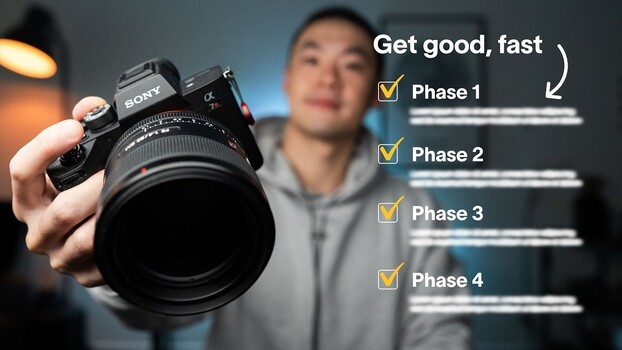
A blueprint for learning photography that 340,000 people watched has aged in a way its own creator didn't expect, and three stages of it now point beginners in the wrong direction. The reason is AI, which arrived between the original video and this update and quietly changed what's worth practicing.
The revised 10-stage path comes from Pat Kay, who lays out both what to learn and the order to learn it in after a decade of shooting. Stage one is foundation, meaning the actual history and concept of photography as the transfer of light onto a physical medium, from an 1826 pewter plate to today's sensor. From there, Kay tells you to pick a single genre and dig into its history, concepts, and masters before touching anything else. The gear stage is the first of three rewrites, and the new advice is blunt: cap your research at two weeks, then buy a used body, because a camera from four or five years ago outperforms what pros shot on a decade ago at a fraction of the price. Put the savings into one great lens, since the look of your images comes from glass more than from the body. A phone works too if a dedicated camera isn't realistic right now.
Exposure and focus stay untouched because, as Kay puts it, physics didn't get a firmware update. He wants you off auto and fluent in shutter speed, aperture, and ISO, then deep into continuous versus single focus, hyperfocal distance, depth of field, and eye tracking. The middle of the path is about volume and honesty. Stage five is your first 5,000 deliberate frames, reviewed after every shoot against a checklist of framing, light, sharpness, and whether you caught the moment or rushed it. Kay shows his own year-one failures on screen and treats them as feedback rather than embarrassment. He also folds in digital hygiene here, telling you to name files, back them up, and keep a copy outside your house before you're 5,000 deep. Editing waits. Lightroom is where most people land, though he's fine with Capture One, Luminar, Photoshop, or Snapseed.
The second rewrite is the one worth sitting with. AI noise reduction, masking, subject detection, and culling now do in one click what took Kay years to get fast at. He goes further than most and says a visual aesthetic, the look you layer on top, is becoming easy to replicate, and that editing itself may eventually get absorbed by AI almost entirely. So why grind through thousands of edits across 50,000 images in a single year? Because the edits were never the moat. They're how you discover what you actually like, warmer or cooler, too much or not enough, and that accumulation is taste. A bad image with a perfect AI edit is still a bad image, which is his way of pointing you back at the only thing fully under your control, which is what's in front of the lens.
That distinction lands harder if you notice where the entire industry is moving. Camera makers now sell autofocus that locks onto an eye before you've thought about it, and editing suites lead their marketing with generative tools rather than sliders. The practical takeaway from Kay's framing is that the parts of photography getting automated are the parts that were always downstream of a decision you made earlier. When and where you press the shutter, what you point at, which light you chase, none of that gets easier with a better model. If you're starting now, that reframes how you spend your reps. The people who treated culling and masking as their edge are watching that edge evaporate, while the ones who built judgment about light and moment keep everything they earned. Replication, the free exercise Kay moved years earlier in the path, is the cheapest way to build that judgment. Find a great photo made near you and rebuild it exactly, same framing, angle, and focal length, and you'll feel how deliberate good work actually is.
The back half covers the third rewrite, feedback, plus a stage where you stop shooting entirely and ask who your images are even for. Kay also stakes out a position on schooling that he expects a fight over in the comments, and closes on the number the whole video builds toward. Watch the full breakdown above to see the stages Kay reordered and the reasoning behind that final number.
What's Your Reaction?
 Like
0
Like
0
 Dislike
0
Dislike
0
 Love
0
Love
0
 Funny
0
Funny
0
 Wow
0
Wow
0
 Sad
0
Sad
0
 Angry
0
Angry
0








Comments (0)