

A Portable Projector for Portraits, Outdoor Exhibitions and More
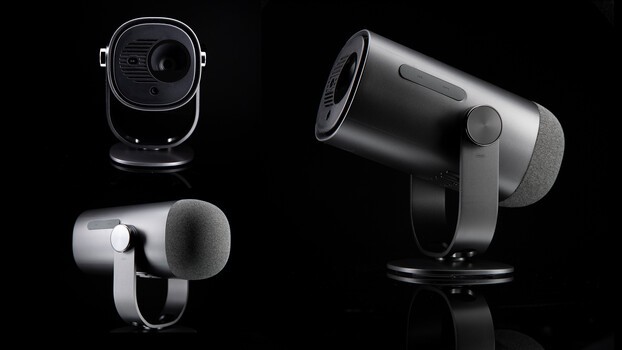
I've been looking for new ways to exhibit my photo and video work, ways that aren't tied to white walls or interior spaces. That search led me toward projectors, and I found one that fits. The appeal of something untethered is obvious in the fact that you can take your work almost anywhere. I initially expected I'd need a separate power station, but instead I found a quality projector with a built-in battery, making the whole setup far simpler than I'd imagined.
One of the ongoing challenges as a photographer is simply getting your work in front of an audience. Rather than trying to convince people to come and see my photography in a traditional setting, or even just interacting meaningfully online, I've become more interested in the idea of taking the work to the audience, and placing images in a space where it makes sense contextually.
I'm particularly drawn to the idea of an "accidental audience": people who had no intention of viewing my work, who may not have much of an interest in photography or even know that I exist, but who then encounter the work unexpectedly while they're somewhere for an entirely different reason. This is why I have previously exhibited in traditional and nontraditional exhibition spaces including libraries, health centers, and cafes. The desire for physical exhibition mixed with the reach of an online presence merged together in my mind, and I began thinking of ways to exhibit digitally, on location, without white walls to fix images to. That way of thinking became a real driver for me, and ultimately led me to look for a projector that could take my work anywhere, without being tied to a fixed location.
I wanted something quick and simple to use which is portable, and most importantly has to be high quality. I found that the Dangbei Freedo is a perfect mix of these desires. It's a high-quality compact projector that houses a built-in battery, speaker, and stand. That combination alone made this projector stand out for me.
Key Tech Specs
- Resolution: 1080p Full HD
- Brightness: 450 ISO Lumens
- Battery Life: Up to 2.5 hours video / 6 hours audio only
- Audio: 6 W 360° Dolby Audio speaker
- Operating System: Google TV (Netflix, YouTube, Prime Video built-in)
- Auto Setup: InstanPro AI autofocus and keystone, obstacle avoidance, screen fit
- Projection Angle: Built-in gimbal stand (-30º to +135º tilt)
- Projection Size: Scalable to large image sizes in low-light environments
- Connectivity / Inputs: Wi-Fi, Bluetooth, HDMI, USB-C, wireless casting / screen mirroring
- Power: 65 W USB-C charging
- Portability: Compact, lightweight, fully battery-powered
After initial setup, I decided to take the projector into a photography studio for a controlled environment to test in, and was pleased with the quick and intuitive autofocus and keystone correction. I used the projector itself as a light source, and projected simple shape designs and images to create abstract portraits, with good effect. I am looking forward to trying this with video in the future.
Before continuing with professional experimentation, I've also enjoyed using the Dangbei Freedo off-grid for more relaxed moments, like projecting films onto the interior and exterior walls of my campervan. There's something beautiful about creating a cinema experience in such a confined, self-contained space while the rain falls on the roof, and also outdoors on warmer nights.
The projector is controlled with a simple remote control which is easy to confuse with the remote for my Firestick. In terms of battery life when playing video and sound, you can expect 2.5 hours of playback. Should you want to watch something longer, away from mains power, Dangbei offers a 65 W portable power bank with high-speed USB-C input and output, which functions as a torch too. This will allow up to 6 hours of playback.
Beyond personal use, what excites me most is the Dangbei Freedo's potential as a tool for creating or showcasing work. Being able to take projection into different environments, rather than being confined to a home, studio, or gallery, opens up new ways for how images are experienced and engaged with, not just viewed. You could build a temporary installation in a space that wasn't designed for art at all. Allowing flexibility to exhibit work in a more organic, site-specific way that can all be done without fixed power makes it even more appealing.
A battery-powered projector offers freedom. You could use one in places where access to mains power isn't feasible: projecting onto the side of a building in a remote location, setting up an outdoor screening in a field or forest, on a rooftop terrace, or even creating visuals inside an abandoned building where power is long gone. Equally, cordless isn't exclusively for remote use; it could be as simple as working around constraints, like shooting in a minimal studio setup without trailing cables everywhere, or even just due to a blackout or power cut at home.
The built-in gimbal stand is a transformative tool which lets you tilt the projector anywhere from -30º to +135º, so you can project onto walls, ceilings, or more unconventional surfaces without difficulty. You can go from pulling it out of your bag to having a usable image in under a minute, which is a big deal when working creatively or responding to a location. Is it the brightest projector you'll come across? In terms of measuring battery-powered projectors, it is one of the best in its class and size in relevance to its price point. Of course, there are more powerful options at a higher cost with more weight and bulk should you need that.
In terms of color rendering, this projector covers 90% of the DCI-P3 color space, which is exceptional considering the price point. Much like any projector, that accuracy is influenced by the surrounding environment. Ambient light and the surface you're projecting onto will affect contrast and color accuracy, especially when projecting onto unconventional materials, so working in darker environments is advised for best results. That said, this isn't always a drawback. In a creative context, those shifts can become part of the aesthetic, adding texture and unpredictability to the final result rather than detracting from it. For more controlled viewing, projecting onto a gray screen will give you the best contrast.
What I Liked
- Truly wireless, self-contained design
- Quick, intuitive setup which is great for spontaneous use
- Built-in gimbal stand with a mounting screw to add to a tripod or light stand to gain height
- Low, unobtrusive fan noise
- Strong image quality for its size and category
What Could Be Better
- Brightness (450 ISO lumens) won't compete with premium mains-powered projectors
- Best performance still depends on lower-light environments
- Audio is good, but external speakers will still outperform in larger spaces
Final Thoughts
The Dangbei Freedo is portable, it's wireless, it's small, lightweight, and easy to carry with you as part of a working kit. I'm particularly looking forward to pushing this further with my next series of work, experimenting more with projection photography and seeing how this can shape both the shooting process and the final presentation. There's something engaging about working with light in this way, where the image becomes part of a physical space, interacting with surfaces, textures, and people.
Acquiring new tools can unlock new creative ways of working, but more importantly, they can spark ideas and re-energize your enthusiasm in a meaningful way. This feels like one of those moments. If you're looking for an alternative way to exhibit photography or video, especially outside of traditional gallery spaces, a projector opens up many possibilities.
What's Your Reaction?
 Like
0
Like
0
 Dislike
0
Dislike
0
 Love
0
Love
0
 Funny
0
Funny
0
 Wow
0
Wow
0
 Sad
0
Sad
0
 Angry
0
Angry
0






Comments (0)