

A Rescue Boat Filmed a Humpback Mother Standing Vigil Over Her Stillborn Calf
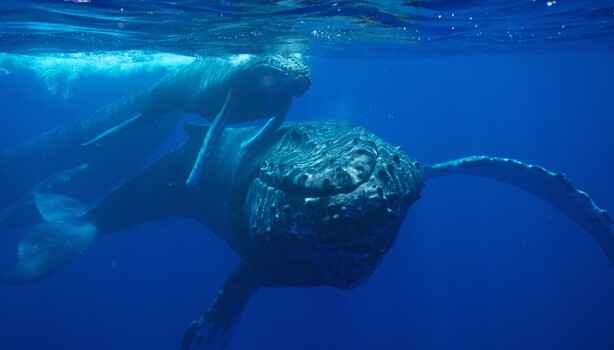
A female humpback whale gave birth to a stillborn calf about a kilometer off Australia's Gold Coast on July 17, 2025, then kept diving to the seafloor to lie beside it, nudge it with her head and a pectoral fin, and hold eye contact for a minute or more at a time, until the boat watching her left at 10 a.m. A rescue boat captain floating nearby with the engines off recorded it on a handheld GoPro, and the 12 minutes of usable footage are now the first detailed record of a humpback mother attending a stillborn calf.
The account was published on September 16 in the journal Discover Animals by Jan-Olaf Meynecke of Griffith University's Whales and Climate Research Program and Andrew Mulville of Sea World Foundation, the captain who shot it. "At first sight, I thought it was just two whales resting on the surface, but their behaviour was unusual," Mulville said in a Griffith University release. "It was definitely not what I was expecting to see out at sea that day."
At about 8:00 a.m., two adult humpbacks were milling at the surface over Palm Beach reef. Around 8:30, the camera caught the amniotic membrane drifting free. By 8:45, the footage showed a calf under 4 meters long lying motionless on the bottom, with no sign of breathing. The mother made short dives of one to two minutes, surfaced in almost the same spot each time, and went back down to the calf. A second adult, an escort, stayed with her throughout. Neither whale tried to raise the calf toward the surface, which the authors say might mean she knew early on that it was dead, though they note other explanations. Two adult humpbacks were seen in the same area over the next two days, possibly the same pair, though the paper could not confirm it.
Whales attending their dead is not new to science, but a humpback mother with a stillborn calf is. Dolphins account for more than 90 percent of recorded cases, and the orca known as Tahlequah carried her dead calf for 17 days across more than 1,500 kilometers in 2018. Baleen whales had almost nothing comparable in the literature, partly because newborn humpbacks carry little blubber and tend to sink soon after death. "It's pretty heartbreaking to watch this female making continuous contact with the deceased calf," Meynecke told AFP. "On land we witness this more often, whereas at sea it's really rare to document something like this," he added. The authors are careful with the word grief. The behavior "may represent a form of grief-related behaviour in humpback whales," they write, while allowing that distress, attachment, or instinct could explain the same actions.
Mulville shot from a drifting 5-meter boat in calm water with poor visibility, and the stills in the paper are green and grainy. They are also the only detailed record of this behavior in the species. The team uploaded the mother's fluke to Happy Whale, the public database that holds identification photos for more than 15,800 individual humpbacks on Australia's east coast. It matched nothing, so she is a new entry who can be recognized if she returns. Six other dead newborns were reported along the same coast that month, and the water was 20.5 degrees Celsius, below the 22 to 28 degree range of previously studied humpback births.
This is the second humpback first this year that came from a camera in the hands of someone who happened to be there. About two months before the paper appeared, a photographer in Australia flew a drone over a humpback giving birth, apparently the first time that had been recorded from the air. If you spend time on the water near whales with a camera, the lesson is to be ready rather than to chase, engines off, at the distance your local rules require, and to send what you get to the people who can use it. A fluke photo uploaded to Happy Whale becomes a data point, and 12 minutes from a handheld GoPro just became a paper.
Lead image: humpback whale and calf, Hawaiian Islands Humpback Whale National Marine Sanctuary. Photo by J. Moore/NOAA, taken under NOAA Permit #15240, public domain. Not the whales in this study.
What's Your Reaction?
 Like
0
Like
0
 Dislike
0
Dislike
0
 Love
0
Love
0
 Funny
0
Funny
0
 Wow
0
Wow
0
 Sad
0
Sad
0
 Angry
0
Angry
0











.jpg)
Comments (0)